


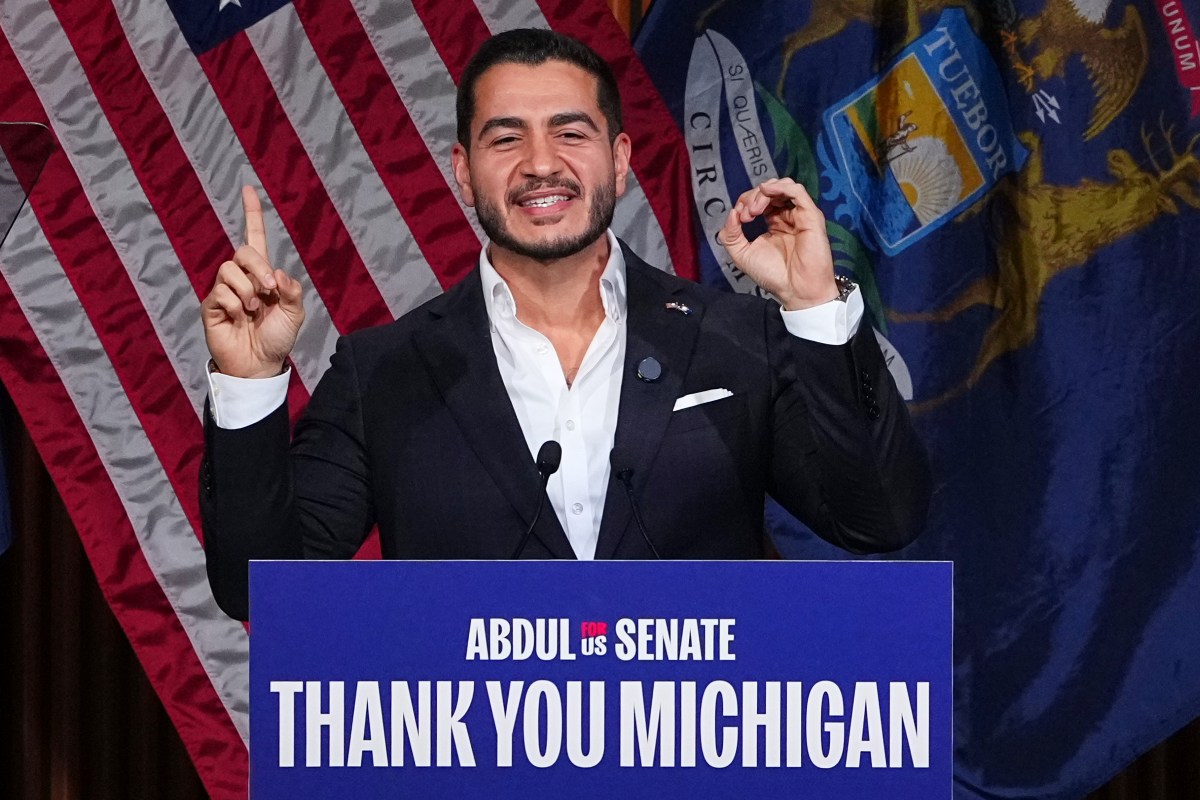
CBS News projected Wednesday that progressive Democrat Abdul El-Sayed defeated former Republican Rep. Mike Rogers in Michigan’s open US Senate race, retaining the seat for Democrats and making El-Sayed the first Muslim elected to the Senate.
The 42-year-old physician and former Detroit health director, of Egyptian descent, overcame a contentious campaign in a state that voted for President Donald Trump in both 2016 and 2024. He will succeed retiring Democratic Sen. Gary Peters. Unofficial tallies showed him leading by roughly five to six points with most precincts reporting when major outlets called the race early Wednesday.
El-Sayed ran on a left-wing platform centered on Medicare for All, higher taxes on the wealthy, and sharp criticism of U.S military support for Israel. His primary victory over more moderate Democratic Rep. Haley Stevens was itself closely fought and expensive, with outside groups spending tens of millions of dollars.
The general-election contest was repeatedly defined by questions about El-Sayed’s background and past statements. Rogers and Republican allies highlighted social-media posts from 2012 by El-Sayed’s half-sister, Eman Abdelhadi, in which she described their mother’s activism in the Muslim Brotherhood while a college student in Egypt in the early 1970s and stated that the family had “long been” connected to the group.
El-Sayed has repeatedly denied any personal or family ties to the Muslim Brotherhood. He has said he was not raised by his biological mother after his parents divorced when he was three years old, that he has never discussed the matter with her, and that the posts amount to “hearsay.” At a town hall and in media interviews he explicitly disavowed the organization.
Critics also pointed to a November 2012 open letter that El-Sayed, then a medical student at Columbia University, signed with other Egyptian Americans. The letter supported then-President Mohamed Morsi—who rose through the Muslim Brotherhood’s political wing—and called on him to “purge the media and the police as quickly as possible” of holdovers from the previous regime. Fact-checkers note that the letter itself does not mention the Muslim Brotherhood by name and does not contain an explicit pledge of support to the group.
Additional scrutiny has focused on campaign donations from individuals later described by conservative outlets as having links to Brotherhood-associated networks, as well as El-Sayed’s earlier writings that downplayed concerns about the Brotherhood’s rise during the Arab Spring. Michigan fact-checking organizations have concluded there is no public evidence that El-Sayed himself was a member of the organization or formally pledged support to it.
In January 2026 the U.S. government designated the Egyptian, Jordanian, and Lebanese chapters of the Muslim Brotherhood as specially designated global terrorists or foreign terrorist organizations, citing material support for Hamas. Those designations did not exist in 2011–2012 when El-Sayed commented on Egyptian politics.
Rogers, a former House Intelligence Committee chairman and Army veteran who narrowly lost Michigan’s other Senate seat in 2024, argued that the pattern of associations and statements raised legitimate questions about judgment on national-security issues. El-Sayed’s campaign characterized the attacks as Islamophobic attempts to question the dual loyalty of a Muslim American candidate, comparing them to historical challenges faced by John F. Kennedy and Barack Obama.
With El-Sayed’s projected win, Democrats hold the seat in a key Midwestern battleground. The result is expected to intensify debate within both parties over progressive foreign-policy stances and the proper boundaries of scrutiny of candidates’ family histories and past political statements.