


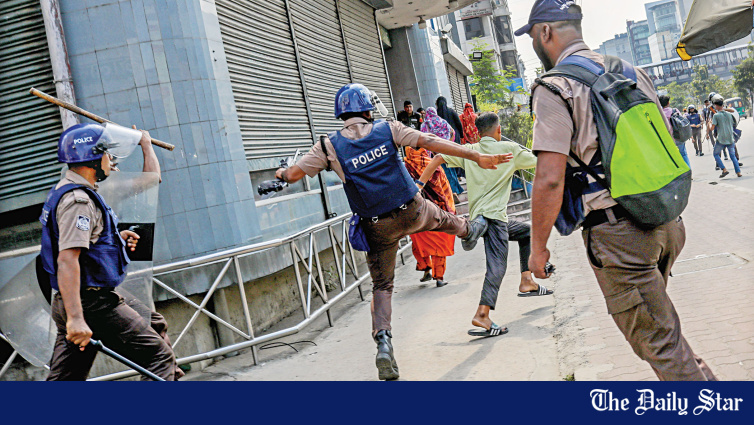
JusticeMakers Bangladesh in France (JMBF), a human rights organization registered in France, has strongly condemned what it describes as a “brutal crackdown” by Bangladesh’s BNP-led government on RMG workers protesting for higher wages and basic labour rights.
According to JMBF’s statement issued on November 6, based on reports up to November 5, at least one worker has been killed, more than 210 people injured, at least 216 arrested, and 18 criminal cases filed against approximately 19,521 people, many of them unidentified.
The RMG protests, which began around October 31 in industrial hubs including Ashulia, Mirpur, Gazipur, Savar, and Narayanganj, centre on demands to raise the minimum monthly wage from 12,500 Bangladeshi taka (about $100–105) to 30,000 taka (roughly $240).
Workers also seek payment of outstanding wages and benefits, salaries by the 7th of each month, an end to blacklisting, and reinstatement of dismissed workers, citing rising living costs and inflation that have eroded purchasing power.
Death of Toufiq Hossain and Use of Force
JMBF highlighted the death of Toufiq Hossain, a worker at Laila Styles Limited. He was critically injured on November 2 in Gazipur in an attack allegedly carried out by BNP leaders and activists in front of Noman Terry Towel Mills. He died the following morning while receiving treatment at Shin Shin Japan Hospital in Uttara, Dhaka. JMBF has called for an independent investigation into the killing and prosecution of those responsible, regardless of political affiliation.
Human Rights Watch (HRW) also reported the death, citing a co-worker’s account that Hossain was caught between protesting workers and men allegedly hired by a factory to confront protesters and was severely beaten.
Local media reports have varied on the precise circumstances of the incident.
Between October 31 and November 4, police used batons, tear gas, rubber bullets, and sound grenades against protesters in multiple locations. JMBF noted particularly disturbing reports that sound grenades were fired during an absentee funeral prayer for Hossain in Gazipur and that a three-month-old infant lost consciousness after exposure to tear gas in Mirpur.
Police accounts, reported by Reuters and local outlets, have described clashes in which protesters threw bricks, vandalised vehicles, and blocked roads, prompting the use of tear gas and sound grenades to disperse crowds.
Arrests, Cases, and Industry Impact
JMBF expressed concern over the scale of arrests—including labour leaders—and the filing of cases against thousands of mostly unidentified individuals, warning of risks of arbitrary detention and the criminalisation of legitimate labour activity. It also raised alarms over financial investigations by the National Board of Revenue targeting 225 individuals and institutions, including the freezing of more than 100 bank accounts.
According to the Bangladesh Garment Manufacturers and Exporters Association (BGMEA), at least 529 factories suspended production on November 1 alone, affecting roughly 987,000 workers. The sector is Bangladesh’s second-largest export earner after China’s, employing about four million people and generating more than 80% of the country’s export earnings.
The government formed a six-member wage board on November 1. On November 4, the board agreed that a revised pay structure would take effect from December, with workers receiving payments under the new scale starting in January. However, it has not yet determined the size of any increase, and protests have continued.
JMBF’s Demands and Statement
Advocate Shahanur Islam, JMBF’s Founder President and Executive Director, stated: “Garment workers are demanding wages that allow them to feed their families and live with dignity. They must not be met with batons, tear gas, arrests and thousands of criminal accusations. The death of Toufiq Hossain demands justice, not political excuses. No government has the right to turn a legitimate struggle for fair wages into a campaign of fear and repression.”
JMBF has called on the government to immediately end excessive force, establish an independent investigation into the death and injuries, release those detained solely for peaceful protest, withdraw unfounded cases, open genuine negotiations with worker representatives, provide medical care and compensation, and review the deployment of security forces including the Border Guard Bangladesh. It has also urged the ILO, UN bodies, the EU, international brands, and trade unions to monitor the situation and press for accountability and dialogue.
The organisation stressed that the right to demand fair wages, organise, and protest peacefully is protected under Bangladesh’s Constitution, the Labour Act, the ICCPR, the ICESCR, and ILO Conventions 87 and 98.
The situation remains fluid, with reports of ongoing disruptions in key industrial areas and continued calls from both labour groups and authorities for a resolution that addresses worker concerns while limiting further damage to production and exports.