


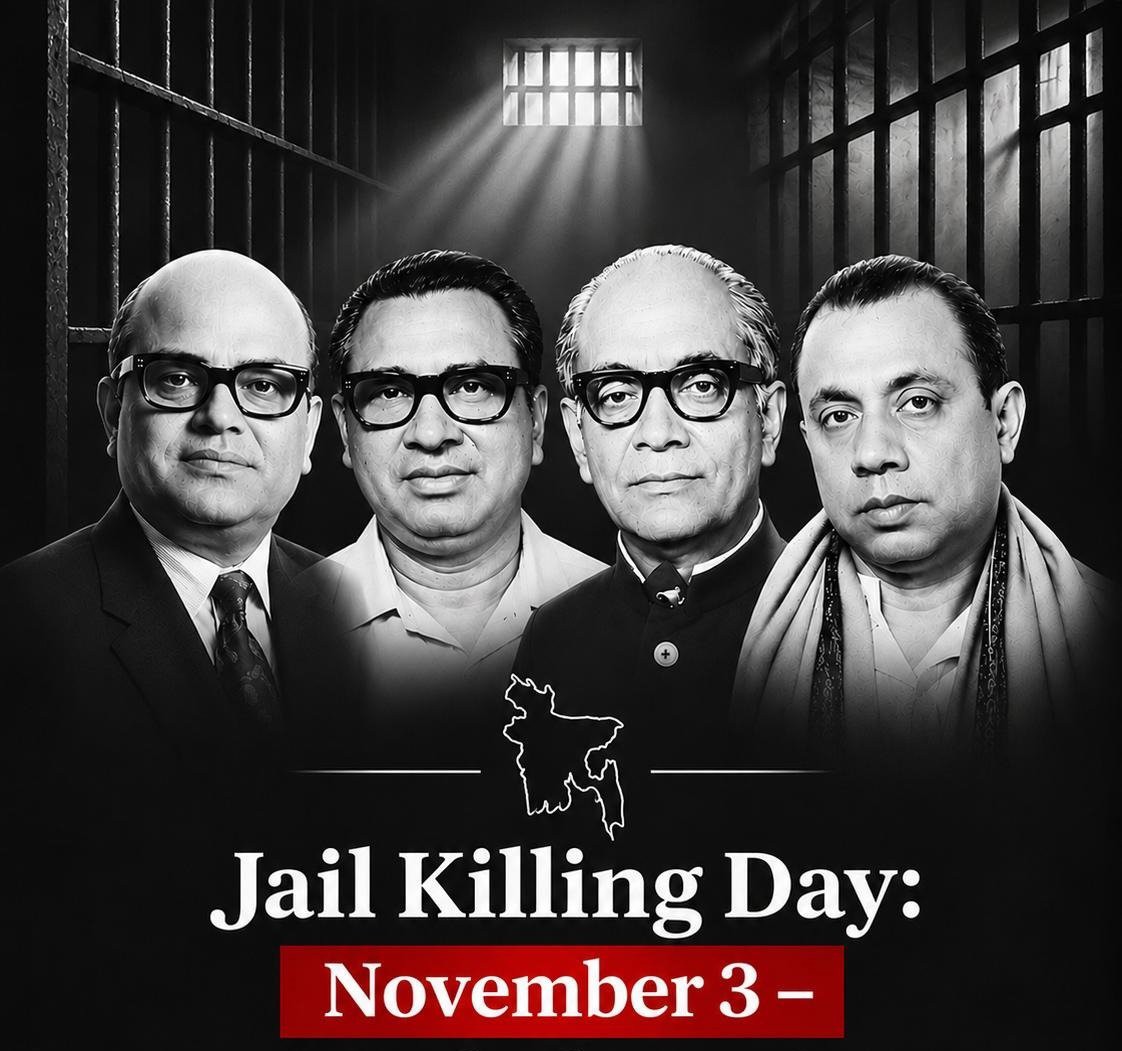
November 3, known as Jail Killing Day, is another blood-stained and shameful day in the history of the Bengali nation. It will forever remain one of the darkest days in the history of independent Bangladesh.
Among the events that obstructed Bangladesh’s journey towards its desired national aspirations, one of the most tragic took place on this day in 1975.
In the early hours of November 3, 1975, four great sons of the nation, who were imprisoned inside Dhaka Central Jail, were brutally and mercilessly murdered in an attempt to deprive the Bengali nation of its leadership. They were the four national leaders who had played pivotal roles in directing the Liberation War, led the struggle for independence, and stood as the closest and most trusted associates of Bangabandhu Sheikh Mujibur Rahman, the Father of the Nation.
The four leaders were:
- Syed Nazrul Islam – Bangladesh’s first Acting President.
- Tajuddin Ahmad – Prime Minister of the wartime provisional government.
- Captain M. Mansur Ali – Member of the Cabinet.
- A. H. M. Qamaruzzaman – Member of the Cabinet.
Such a heinous, brutal and barbaric massacre, committed against prisoners in the supposed safety of a prison, is an exceptionally rare atrocity in world history.
Earlier, on August 15 of the same year, Bangabandhu Sheikh Mujibur Rahman, the Father of the Nation, the principal architect of independent Bangladesh and the then President, had been assassinated. Following his murder, his four closest colleagues were arrested and confined to the dark cells of the prison.
Amid the ensuing political instability and bloody cycle of coups and counter-coups, a group of misguided military personnel, acting as accomplices of the same defeated forces and enemies of humanity responsible for Bangabandhu’s assassination, entered the prison and murdered the four national leaders. Since then, November 3 has been observed every year as Jail Killing Day.
The enemies of independence and the Liberation War did not stop at shooting these four outstanding sons of the motherland. In a cowardly act, they stabbed and mutilated their bullet-ridden bodies with bayonets, seeking to avenge their defeat in 1971. They pushed the Bengali nation backwards, away from the path of progress and prosperity.
This brutal massacre shocked not only the people of Bangladesh but the entire world. The assassinations of Bangabandhu and the four national leaders were successive acts of the same conspiracy. Today, the plans and motives of the treacherous assassins have become clear to the nation. The truth has emerged like the light of a new dawn, cutting through the clouds of deception and falsehood.
In reality, the killers and their accomplices sought revenge for the disintegration of Pakistan. They wanted to plunge a country that had won independence through a bloody Liberation War and immeasurable sacrifice into a vicious cycle of murder and conspiracy.
Their objective was to divert the newly independent country from the path of reconstruction and democracy and transform Bangladesh into a mini-Pakistan.
Nor did the enemies of independence abandon their conspiracy there. For years after 1975, attempts were made to erase every trace of Bangabandhu’s name and legacy. Evidence of General Ziaur Rahman’s direct and indirect involvement in the conspiracy behind the assassinations of Bangabandhu and the prison killings was also said to have emerged from the statements of the self-confessed killers themselves.
The Judicial Process and the Long Delay in Justice
Immediately after the Jail Killings, a case was filed at Lalbagh Police Station. However, following the assassination of Bangabandhu Sheikh Mujibur Rahman and most of his family members, the investigation and judicial proceedings into the prison massacre remained suspended for 21 long years.
After returning to power in 1996, the Awami League government revived the proceedings in the Jail Killing case.
Following more than eight years of judicial proceedings, the Dhaka Metropolitan Sessions Judge’s Court delivered its verdict on October 20, 2004, during the tenure of the then four-party coalition government.
Of the 20 accused, 15 former military officers were convicted, while the remaining five were acquitted. Among those convicted, three fugitives were sentenced to death, while the other 12 received life imprisonment.
Those sentenced to death were:
- Dafadar Marfat Ali Shah
- Risaldar Moslem Uddin, alias Hiron Khan
- LD Dafadar Md. Abul Hashem Mridha
- Those sentenced to life imprisonment were:
- Colonel (Retd.) Syed Farooq Rahman
- Colonel (Retd.) Syed Shahriar Rashid
- Major (Retd.) Bazlul Huda
- Lieutenant Colonel Khondaker Abdur Rashid (dismissed)
- Lieutenant Colonel Shariful Haque Dalim
- Lieutenant Colonel (Retd.) M. H. M. B. Noor Chowdhury
- Lieutenant Colonel (Retd.) A. K. M. Mohiuddin Ahmed
- Lieutenant Colonel (Retd.) A. M. Rashed Chowdhury
- Major (dismissed) Ahmed Shariful Hossain
- Captain (Retd.) Abdul Majed
- Captain (dismissed) Md. Kismat Hossain
- Captain (Retd.) Nazmul Hossain Ansar
- Those acquitted were:
- K. M. Obaidur Rahman, late BNP leader
- Shah Moazzem Hossain, Jatiya Party leader
- Taheruddin Thakur, former minister (deceased)
- Nurul Islam Manzur
- Major (Retd.) Khairuzzaman
On August 28, 2008, the High Court delivered its verdict, upholding the death sentence of only Risaldar Moslem Uddin. It acquitted Dafadar Marfat Ali Shah and LD Dafadar Md. Abul Hashem Mridha, who had previously been sentenced to death, along with four other convicts who had received life sentences: Lieutenant Colonel (dismissed) Syed Farooq Rahman, Lieutenant Colonel (Retd.) Shahriar Rashid Khan, Major (Retd.) Bazlul Huda and Lieutenant Colonel (Retd.) AKM Mohiuddin Ahmed.
The verdict was delivered by a High Court bench comprising Justice Nazrul Islam Chowdhury and Justice Ataur Rahman Khan after disposing of four appeals filed by the four life-sentenced convicts against the lower court’s verdict, along with the state’s death references.
However, despite the verdict being delivered after a prolonged delay, members of the families of the national leaders and various other quarters immediately described it as politically motivated and a travesty of justice. They also rejected the verdict, alleging that nobody had been punished for their role in the conspiracy behind the Jail Killings. They demanded a fresh investigation and retrial into what they described as one of the most brutal massacres in the nation’s history.
Although they had been acquitted in the Jail Killing case, four of the accused—Lieutenant Colonel (dismissed) Syed Farooq Rahman, Lieutenant Colonel (Retd.) Shahriar Rashid Khan, Major (Retd.) Bazlul Huda and Lieutenant Colonel (Retd.) AKM Mohiuddin Ahmed—had been sentenced to death in the Bangabandhu assassination case. Their death sentences were subsequently carried out on January 27, 2010.
Meanwhile, lawyers explained that the life sentences against the other eight convicted fugitives remained in force, as the High Court had not expressed any opinion regarding their cases.
Following the Awami League-led Grand Alliance’s victory in the December 29, 2008 general election, an opportunity emerged to pursue a retrial of the Jail Killing case.
On January 11, 2011, the Appellate Division accepted the government’s appeal and issued an order. The court directed Dafadar Marfat Ali Shah and LD (Dafadar) Abul Hashem Mridha, who had been sentenced to death by the lower court but subsequently acquitted by the High Court, to surrender immediately. It also directed law enforcement agencies to arrest them if they failed to surrender.
Finally, on April 30, 2013, the Appellate Division delivered its final brief judgment, overturning the 2008 High Court verdict and restoring the 2004 verdict of the lower court.
Consequently, the three fugitives—Risaldar Moslem Uddin, alias Hiron Khan; Dafadar Marfat Ali Shah; and LD Dafadar Md. Abul Hashem Mridha – were sentenced to death, while the remaining 12 convicts retained their life sentences.