


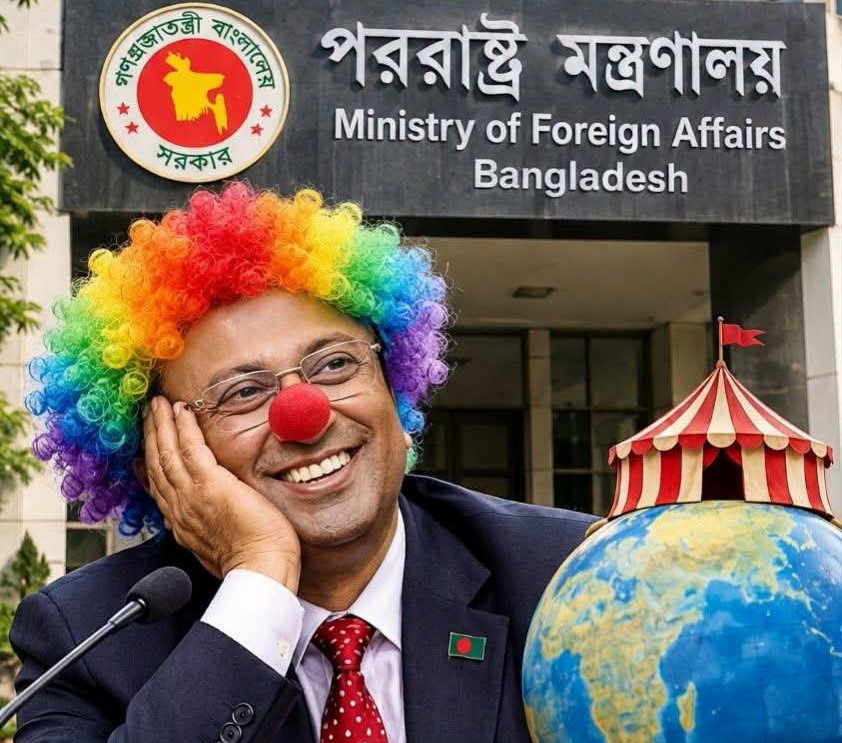
Veteran Bangladeshi journalist Anis Alamgir has sharply criticised the current government’s handling of high-profile fugitives in a Facebook post, accusing the Ministry of Foreign Affairs of continuing the same inconsistent “circus” that characterised the previous Awami League era.
In the post, Alamgir highlighted the government’s inability to bring back former Inspector General of Police Benazir Ahmed from the United Arab Emirates.
Ahmed was arrested in Dubai in June 2026 on an Interpol Red Notice linked to Anti-Corruption Commission cases involving alleged illicit wealth accumulation and related offences. He was later released on conditional bail by a UAE court (with restrictions including passport retention and a bar on leaving the country without permission). Dhaka has struggled to complete the extradition process, prompting Alamgir to mock the authorities for having “sent Benazir to the sheikhs in Dubai jail” yet failing to demonstrate the capacity to bring him home.
Alamgir contrasted this with the case of ousted Prime Minister Sheikh Hasina, who has been living in India since fleeing Bangladesh in August 2024 amid the mass uprising. Hasina has publicly stated her intention to return voluntarily (including remarks about returning around December to face legal proceedings).
Alamgir noted that India has not imprisoned her and has instead treated her as a “royal guest,” while the Bangladeshi government seeks her return under the bilateral extradition (or prisoner exchange) treaty without issuing or returning a passport.
The post ends with a pointed jab: “Awami League is gone, BNP has come; but the import of idiots into the Ministry of Foreign Affairs has not stopped. The circus of foreign policy has not changed either!”
Background: Humaiun Kobir’s remarks
Alamgir’s criticism comes against the backdrop of recent statements by State Minister for Foreign Affairs Humaiun Kobir. On November 5, after seeing off a Chinese delegation at Hazrat Shahjalal International Airport, Kobir explicitly ruled out issuing any passport or travel document to Hasina.
He told journalists: “We have an extradition treaty (with India) for apprehending terrorists and criminals. A passport is not required to bring back terrorists or criminals. It is a matter of handing them over.” Kobir described Hasina as “a fugitive and a terrorist” and sarcastically asked whether she was “coming to visit her in-laws in Rangpur” that a passport would be needed. He stressed that judicial warrants, established processes, and the existing Bangladesh-India extradition treaty provide the legal framework, and that Dhaka is demanding formal handover rather than facilitating ordinary travel.
Kobir has previously described Hasina’s presence and activities in India as a principal challenge to bilateral ties, calling for her restraint as the “norm” between the two countries and labelling her a terrorist responsible for deaths during the 2024 crackdown. Hasina was sentenced to death in absentia by Bangladesh’s International Crimes Tribunal in 2025 over crimes against humanity linked to the suppression of the July-August 2024 uprising. Bangladesh has repeatedly sought her extradition; India has said the request is under legal review involving its courts, without committing to a timeline.
The post by Alamgir, a former war correspondent known for outspoken commentary, reflects ongoing domestic frustration over the perceived gap between tough rhetoric on accountability for former regime figures and the practical outcomes of diplomacy with both the UAE and India. The government under Prime Minister Tarique Rahman has continued pressing for Hasina’s return while managing the Benazir extradition file, but critics like Alamgir argue the approach remains ineffective and inconsistent.