


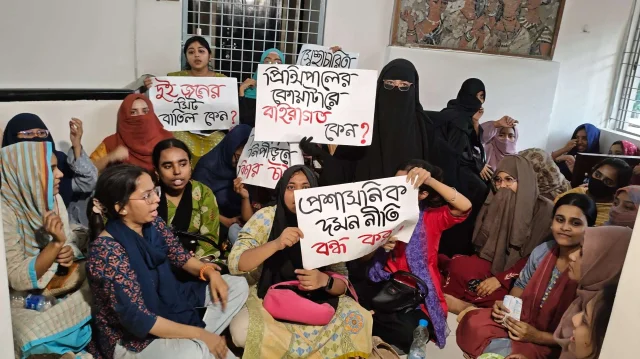
In a continuation of the wave of campus confrontations that has forced more than 3,000 teachers to resign since 2024 amid mob pressure at schools, colleges, universities, government offices, and media outlets, students at Dhaka’s Government College of Applied Human Science (Home Economics College) locked Principal Professor Dr. Meherunnesa inside her office for over eight hours on Thursday while demanding her immediate resignation.
The protest began around 10:30 a.m. on November 5 outside the principal’s office in the administrative building. Female students chanted slogans including “One point, one demand: principal’s resignation” and “Break the principal’s black hand, crush it.” They accused her of long-standing irregularities and arbitrariness, the recent cancellation of two residential students’ hostel seats, and a demand for a Tk 12,600 fine toward the auditorium’s electricity and air-conditioning bill.
According to the students, the dispute originated from a farewell event for master’s final-year students (2020-21 session) from five departments of three residential halls. The administration had ordered the event to end by 10 p.m.; after student requests the deadline was extended to midnight. The program nevertheless continued until 4–5 a.m. Principal Meherunnesa then cancelled the hostel seats of the two student coordinators. When the students went to apologize, they were told the seats would be restored only if they paid the overnight electricity bill of Tk 12,600.
One student, Tabassum (master’s first part, 2019-20 session), said the principal rejected their pleas and that when a student fell at her feet begging for waiver, “she pushed her with her foot and walked away—essentially kicking and shoving her.”
Students further alleged that since joining from Begum Badrunnesa Government Women’s College about a year earlier, the principal has imposed successive unreasonable rules, raised monthly hostel fees from Tk 600 to Tk 700 (with a further Tk 100 increase announced for next year) despite inadequate facilities, and improperly sublet her government bungalow to outsiders. They also claimed that at her previous college she had cut off refrigerators and electricity switches in two halls.
Vice-Principal Professor Habiba Yasmin gave a different account. She said she and the teachers’ council secretary were inside the principal’s room when students entered under the pretext of talking, pulled them out, and immediately locked the door from outside around 10:30 a.m., beginning the slogans.
On the seat cancellations, she explained that ongoing construction work on campus meant many outside laborers were present; for student safety the event was to finish by midnight. The seat cancellations were initially announced only as a disciplinary warning. After the Puja holidays, on the previous Sunday, the college decided not to cancel the seats of the two final-year students. The Tk 12,600 electricity bill (for air-conditioners and fans running until 5 a.m.) was to be collected at Tk 50–100 per hostel student.
Department heads and teachers repeatedly offered talks, but the students remained fixed on the single demand of the principal’s resignation and issued an ultimatum that she must not be seen on campus after 5 p.m.
Yasmin noted that as a BCS cadre appointment made by presidential order, a resignation cannot simply be accepted on plain paper. The matter has already been reported to the Director General of the Directorate of Secondary and Higher Education (DSHE) and the Education Secretary. College authorities said they were exercising maximum restraint to keep the situation calm.
Attempts to speak with Principal Meherunnesa were blocked by the students, who refused to unlock the door. Contacted later by phone, she said she was busy because the DG and principals of other colleges had arrived, and asked to be contacted later. DSHE Director General Professor Dr. Khan Moinuddin Al Mahmud Sohel was reported to be going to the college to free the principal.
The incident fits a broader pattern, documented since 2024, in which sustained student and outsider pressure—including confinement, slogans, and ultimatums—has repeatedly compelled educators to resign across educational institutions and related workplaces.