


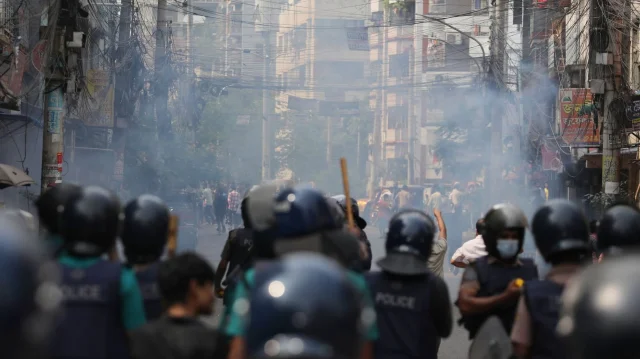
Bangladesh’s ready-made garment (RMG) workers have staged sustained protests demanding a minimum monthly wage of Tk 30,000 (roughly $240–245), up from the current Tk 12,500 set in December 2023. The sector employs about 4 million people (many women), accounts for over 80% of export earnings, and supplies major global brands.
Protests intensified amid high inflation and rising costs for food, housing, transport, healthcare, and education. Workers say current pay no longer covers basic needs and that they will not return to work on assurances alone.
Timeline of Recent Days
Protests and disruptions began in late October and continued into a fourth day by 3 November, with road blockades, factory walkouts, clashes, and arson in industrial hubs around Dhaka.
- Late October (around 29–31 October): Workers blocked roads in Mirpur (including Mirpur-10), Savar-Ashulia, and Gazipur (Dhaka-Tangail highway areas such as Chandra/Palli Bidyut). Dozens of factories declared holidays; some vandalism of factories and vehicles occurred. The government had signaled plans to form a new wage board.
- 1 November (Sunday): Large-scale blockades and clashes in Mirpur, Gazipur (Kaliakair and other points on Dhaka-Tangail and Dhaka-Mymensingh highways), Savar-Ashulia, and elsewhere. Workers blocked major roads; police used tear gas, water cannons, and other measures. Arson included a police vehicle under Mirpur-11 metro station and incidents in Gazipur/Savar. BGMEA reported about 529 factories closed or on holiday, affecting over a million workers. The government formed a six-member Minimum Wage Board (chaired by Senior District and Sessions Judge Sheikh Ashfakur Rahman; members included owner and worker representatives such as ABM Shamsuddin and Babul Akhtar, plus permanent and neutral members). PM Tarique Rahman held a meeting with relevant ministers. Police detained people in Mirpur and Gazipur, alleging involvement by banned Awami League (AL) leaders/activists and affiliates (Sramik League, Chhatra League). Labour Minister Ariful Haque Chowdhury and others pointed to political instigation.
- 2 November (Monday): Protests continued with highway blockades (Dhaka-Tangail, etc.), clashes, brick-throwing, and arson (including police vehicles in Gazipur). Hundreds more factories (reports of 650–700 total disruptions) suspended operations. Additional arrests; some cases filed against large numbers. Intensity of violence was reported as somewhat lower in places, but production remained heavily disrupted. Workers reiterated that board formation alone was insufficient without a clear wage announcement and timeline.
- 3 November (Tuesday): Clashes continued in Mirpur, Gazipur, Savar-Ashulia, and Narayanganj. In Mirpur, workers tried to occupy roads; police used batons, tear gas, and sound grenades; some workers threw bricks. A police officer was reportedly beaten at Kalshi intersection. In Gazipur, workers blocked Dhaka-Tangail and Dhaka-Mymensingh highways at multiple points; repeated chase-and-counter-chase incidents occurred. Traffic was severely disrupted for hours. Police and some sources alleged BNP leaders/workers also took positions with sticks in places, though this was not independently confirmed. Over 100 people (police and workers) were injured across sites. BGMEA data indicated further factory closures (hundreds more by mid-morning, with large numbers of workers affected). Owners discussed possible indefinite closures under labour law provisions if unrest continued (noting potential “no work, no pay” implications).
A specific evening incident in Gazipur’s Kashimpur area saw workers from a DBL Group factory chase police back toward Kashimpur Police Station after officers tried to disperse them. Workers threw bricks/stones, chanted slogans, and briefly besieged the station. Police fired tear gas and sound grenades; multiple teams restored order. Several police were injured; authorities said “miscreants” had joined the workers.
Worker Perspectives
Workers rejected claims of political conspiracy or third-party instigation. In Mirpur and elsewhere, they stated they took to the streets because rising prices made it impossible to run households on current wages.
- Shoeb Islam (Mirpur): Demands must be met; workers are not involved in sabotage; police should handle any such acts, but unjust arrests of workers will be protested. He accused police of unjust attacks.
- Shefali Begum (woman worker): Demands are just; they will not return on assurances alone—need a specific wage increase announcement and release of unjustly beaten/arrested workers. No external instigation reached them; police attacks provoked resistance. Blame should not fall on ordinary workers if outsiders mix in.
- Shamim and others: Announce Tk 30,000 minimum wage and everyone returns to factories.
They emphasized that board formation is not enough; they want rapid, concrete implementation (some hoped for January start if decisions come quickly) rather than prolonged processes.
Official, Police, and Some Labour Leader Accounts
Police (including Dhaka Range DIG Md Mostafizur Rahman and Dhaka District SP Shamima Parveen) claimed outsiders, including groups in burqas and helmets, had infiltrated to create disorder. They reported ~40 arrests across Dhaka, Gazipur, and Narayanganj, asserting none were actual garment workers. DIG Mostafizur said fair labour movements were being exploited by miscreants and that police were collecting evidence; genuine workers should stay vigilant.
SP Shamima alleged a group was instigating for instability and that authorities had information on funding sources. Mirpur Deputy Commissioner Hasan Mohammad Naser Rikabdar said those still protesting were not workers but seeking chaos despite the wage board.
Some labour leaders (e.g., Nazma Akter of Sammilito Garments Sramik Federation and Taslima Akter of Bangladesh Garments Sramik Songhoti) called the wage demand logical but condemned vandalism, arson, and looting. They alleged a “third party” was exploiting the movement for advantage and urged workers to return to work, noting the board had been formed and wages would rise.
Owners (BGMEA) expressed concern over security and production; some meetings discussed possible closures. Former BGMEA director Mohiuddin Rubel noted owner-side agreement on revisiting wages within three years (instead of five) and potential January implementation if the board finishes by December, while rejecting violence.
Awami League Statements
The BNP-led government and police have repeatedly alleged that banned Awami League elements and affiliates are behind or exploiting the unrest to destabilize the situation. AL figures have rejected this framing and accused the government of repression.
- Sajeeb Wazed (son of former PM Sheikh Hasina and former ICT advisor) described scenes from Mirpur and Gazipur as exposing a “brutal crackdown” on garment workers under the BNP government. He stated that the workers sustaining the export economy are being beaten, intimidated, and denied fair wages and dignity; “Workers are not enemies of the state. They are the backbone of the nation. Stop the repression. Respect workers’ rights.” He accused authorities and BNP cadres of branding underpaid workers as AL supporters instead of addressing demands, highlighted the human cost (especially for women workers), and called on global brands and the international community not to stay silent (#WhoMakesYourClothes, #RMGWorkersProtest).
- Mohammad A. Arafat (former State Minister for Information) argued that the right to protest against rising costs is not limited to wealthy countries: “From Europe to India, people demand relief from rising costs. Bangladesh’s workers deserve no less. When a struggle for bread is answered with violence, solidarity is a duty. Stand with them.”
Official AL accounts and supporters echoed calls for solidarity with workers’ rights and fair wages while criticizing the response.
Broader Impacts and Unresolved Issues
Highway blockades (especially Dhaka-Tangail and Dhaka-Mymensingh) caused severe public hardship for passengers and goods transport. Factory closures have directly hit production and risk export delays or order shifts. The wage board’s first meeting date remained unset as of early November, fueling worker distrust. Labour law provisions allow owners to close plants during illegal strikes with no pay for the period, a point raised in owner discussions.
The situation combines a longstanding wage-cost-of-living gap, post-2024 political transition dynamics, and competing narratives over who is driving violence or infiltration. Workers insist the core issue is economic survival; authorities and some leaders point to political exploitation. Rapid, transparent board action with a clear timeline is widely seen as necessary to restore calm and protect the sector.