


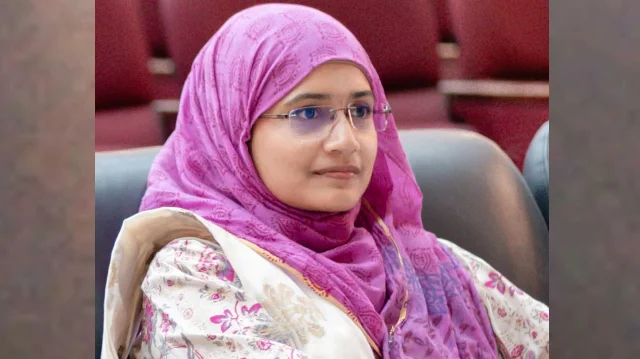
Samantha Sharmin has resigned from the National Citizen Party (NCP). She announced the decision in a Facebook post on Thursday (November 5).
Party sources said it is not known whether she has submitted a formal written resignation letter. Repeated attempts to contact her for comment were unsuccessful.
In her post, Samantha wrote that she had resigned from the National Citizen Party a short while earlier. She recalled that nearly a year ago she had taken a distinct position on the question of NCP forming alliances. She had argued that Jamaat-e-Islami was not suitable as an ally on either principled or strategic grounds, and that NCP would have to pay a heavy price for entering into an alliance with the party.
She noted that in the new committee announced by NCP last Friday (October 23), she was retained only as a Joint Convener. The move was widely viewed on social media as a demotion.
Explaining her decision, she wrote that over the past 11 months, whenever she had the opportunity, she had analysed the party’s past actions and future strategies according to her political understanding. She had submitted written complaints and proposals, and engaged in debates and discussions at various levels of the party. Because organisations face ups and downs, she considered it her political duty to try to prevent the party from taking a wrong path. She had chosen to wage an ideological struggle inside the party, as there was no other democratic way to challenge the party’s adopted policies in recognised forums and bring it back from the wrong path.
“Today I am announcing the end of almost a year of this struggle, because I no longer believe that NCP is capable of remaining sincere to the values with which the party began,” she wrote.
She added that she could have waited for a more suitable moment when her resignation could more easily be evaluated as a reaction to a particular decision or action of the party, but she considered such waiting meaningless. Even if NCP occasionally adopts different political roles (including a decision to abandon an alliance with Jamaat), she does not believe it will be able to develop its own identity, thinking, and programme outside the mould of old politics.
She stated clearly that parties of the old system will never help bring a new system for the state; rather, they will stand as obstacles. She said the time had come to inform party members and well-wishers outside the party structure about the differences of opinion and discussions that had taken place between her and the party.
She then outlined four main areas of disagreement:
1. Can Jamaat be a friend of reform?
NCP’s politics, as the party of the ordinary people’s aspirations, was reform. It was necessary to ensure that the existing power structure of the state would not obstruct the path toward a democratic state system. For this, reforms were needed in at least three areas:
- Constitutional reform (to change the autocratic and fascist foundations in the constitution);
- Legal reform (to shift laws and regulations from being anti-people to being oriented toward public welfare);
- Reform of politics and political parties (to change the colonial politics of this region by reforming the conventional structures of the old political parties).
Bangladesh Jamaat-e-Islami does not consider any of these three as part of its own politics or state project, and does not genuinely practise the politics of reform. The organisation’s philosophical foundation and proposed state project are not democratic. Whatever reform-related talk is heard from Jamaat is largely pretence, driven by the need to appropriate the aspirations of 2024.
Democratic reform originates from liberal democratic social values. Jamaat is not only contrary to a democratic state system; its political intention is to establish a fascist state by making use of all the advantages of democracy. That is why the core foundation of its politics has not changed. Jamaat considers even genocide justified for the implementation of its project. It stands on the organisational and philosophical basis of not treating Jamaat’s role in 1971 as a crime and of not seeking forgiveness from the nation for it.
When NCP treated Jamaat as a friend on the path of reform, ordinary people of Bangladesh — who are naturally liberal and democratic and who constitute the real force of reform — were forced to turn away from the politics of reform. Because NCP lacked a clear political line of its own, it has been getting lost within Jamaat and has had to play reactionary and supportive roles for Jamaat on various issues.
As a party born from the people’s aspirations, she repeatedly tried to warn the party about these problems and bring it back.
2. The election
The 2026 election had every possibility of being a political election. Such political elections have occurred repeatedly in this land — in 1946, 1954, 1970, and even 1990. These elections did not merely change the ruling party; they brought political change. Before the 2026 election, the old political parties sought to strip the election of the political character of the uprising and reduce it to a mere change of power.
NCP had the opportunity, even after the failures of the consensus commission, the election commission, and the interim government’s reform activities, either to ally with those who wanted to confront the old system politically or to advance alone toward a political election. Had it done so, NCP could have achieved better results than it has. The results of political elections are not determined by party strength; this is the lesson of all previous political elections in history. Instead of heeding this lesson, NCP participated in the election as the tail of the “big” political parties, exhausting both its own politics and the possibility of new post-uprising politics.
She said she had proposed five methods to the party leadership by which greater political influence could have been created than the results currently obtained, even without joining electoral strategies such as the 11-party unity. The party did not take that path. By prioritising electoral victory over political victory, NCP has also lost the credibility to object to election results under an unreformed system.
On the question of insecurity, she noted that martyred Osman Hadi had conducted a completely solo, new-style election campaign in a complex and risky seat in Dhaka against a strong rival, with the modest goal of securing at least 500 votes. Yet his death has been used as justification for the undemocratic and very old electoral strategy of “alliance with big parties” — something she described as completely illogical and motivated.
3. Women’s ownership and rights in the uprising
In the history of modern politics, movements in which women have actively participated have not been defeated. The history of struggle in Bangladesh is no exception. Women’s participation in the 2024 mass uprising is the most notable example. Women were important catalysts, frontline fighters, and protectors of the uprising.
Women’s political aspirations, demand for a fair share, and stand against discrimination and oppression formed the basis of their participation. In the mass uprising, women did not merely participate; they built resistance. Their position in front of the barricades, their courage, and their activity gave the uprising a universal character. Yet from the moment of victory, old conservative political forces and parties have been actively trying to remove women from that field of victory. Social norms that were not questioned during the movement, and obstacles that could not stop women’s participation while the movement was underway, have been used as weapons against women after victory. In this way, attempts have been made to corner women’s political aspirations and demands for a fair share and to restore the old, women-less political field.
Outside the old political parties, NCP had the opportunity to set a different political example. Had it wished, the party could have built a new political culture based on equality between women and men. Merely including women in the party was not enough; it was necessary to ensure their dignified position in numbers, leadership, decision-making, and organisational power. NCP did not choose that path. Instead, its role has aligned with anti-women conservative political tendencies. Through this, the anti-discrimination and inclusive character of the 2024 mass uprising has been degraded.
NCP did not want to carry forward the possibility the mass uprising had created for women to advance in the politics of future Bangladesh. Like the old parties, it has cornered women, failed to give proper importance to their protests, and taken decisions on the basis of male majority. Yet women constitute nearly 51 percent of the country’s population. Ignoring women’s voices does not mean merely ignoring the opinions of the party’s women members; it means keeping the political aspirations and experiences of more than half the country’s people outside decision-making.
In a society like Bangladesh, positive discrimination is needed for women’s advancement — that is, ensuring special opportunities and representation to advance historically lagging women is often not enough. The existing power structures of the state, society, and institutions actively suppress women. Bridging this gap requires not only equal opportunity but greater representation, greater power, and effective participation in decision-making. Even then, the full gap of established discrimination might not have been closed.
Jamaat and ultra-right forces have played a role in the process of pushing women back politically. NCP has in various respects become a follower and collaborator of their conservative positions. The problem is therefore not limited to a few isolated decisions; anti-women positions have also taken root within the party’s organisational structure and decision-making process.
The role women can play in a movement is one that even men cannot play in certain circumstances. When men stand as protectors of other men, the impact is of one kind; when women become protectors of men, that role can more deeply challenge conventional gender-based power relations and social expectations. In the 2024 mass uprising, women protected the movement by standing in front of the barricades. After victory, however, their dignity, political rights, and decision-making power have been ignored.
This contradiction raises a fundamental question: Was placing women at the front of processions during the movement recognition of their leadership and political capability, or was it a strategy of using their presence as a security shield in the face of danger? If women’s courage and sacrifice are accepted as necessary for the movement, yet after victory their power and fair share are denied, where is the real recognition of their participation?
A party that claims to carry the legacy of an uprising that stood against discrimination, oppression, and repression cannot reproduce discriminatory power relations within its own structure. In the 2024 mass uprising, women did not merely participate; they shaped the character of the movement. A political force that considers women’s courage and resistance necessary for victory, yet refuses to grant them equal dignity and power after victory, is not truly anti-discrimination.
4. Restructuring NCP by avoiding the council
In post-uprising Bangladesh, people expected a political party whose structure would differ from that of conventional parties. That novelty was not to be limited to leadership, political statements, or general conduct; it was also to be reflected in transparency in the party’s economic structure and the practice of democracy in its internal organisation.
In the old political parties, person-centric leadership, centralisation of power, family rule, nepotism in the distribution of posts, the influence of money and muscle power, opacity in party finances, disregard for grassroots opinion, the tendency to suppress dissent, and lack of leadership accountability have been observed. As a result, ordinary workers have limited participation in party decision-making, and the path to leadership change and the emergence of alternative leadership becomes constricted. Old-style parties also show a tendency to delay or avoid holding councils.
One of the most important processes for ensuring a party’s internal democracy is the timely holding of the council. If the council is not held on schedule, doubts arise regarding the legitimacy, accountability, and representativeness of the leadership, and the risk increases that organisational decisions will gradually depend on a limited number of people. The council is therefore not merely a formal event; it is one of the foundations of the party’s democratic practice and organisational accountability.
Restructuring the convener committee again without holding the party council has damaged the democratic environment inside the party — a tendency found in the old political parties. NCP has adopted the old method of suppressing dissenting opinion. Moreover, carrying out such major reshuffles before the election of party leadership clearly demonstrates the leadership’s indifference to NCP’s internal democracy and neutrality. At the same time, this will question the party’s political credibility and public trust when it seeks to build movements demanding democracy and neutrality in the national electoral system. How credibly can a party that cannot ensure democratic leadership selection within itself raise the demand for democracy and neutrality at the state level?
After repeatedly calling for reconsideration of the above matters, and finding that NCP was unwilling to change course, she is resigning from the National Citizen Party. She noted that further explanations and reasons might be needed, but there was no time at this moment. She then outlined her political direction.
Bangladesh needs the politics of unity against the politics of division
Bangladesh is today being driven into various divisions. Yet the greatest need of post-uprising Bangladesh was to create a political dream and possibility that would not set people against one another, but would unite them around a common national aspiration despite differences of opinion, belief, and identity. NCP could have created that possibility. People expected that the political force built under the leadership of the youth would give rise to a new kind of politics outside conventional political divisions. Through narrow political calculations and decisions, however, that possibility is gradually being lost. The loss of the possibility of one party or a few leaders does not mean the death of that political aspiration, nor the end of the people’s need.
A political force is still needed whose main goal is not to divide people but to unite them. This unity cannot be based on any particular ideology, religious identity, or single political belief; its foundation must be a common commitment to the journey of building a democratic state.
Those who lead this unity must place the interest of Bangladesh and its people at the centre of their political thinking, not their own narrow interests. Taking America’s side while opposing India, or aligning with China’s interests while opposing America, cannot be the politics of an independent and self-respecting Bangladesh. Bangladesh’s foreign policy must be determined on the basis of Bangladesh’s interest, sovereignty, and the welfare of the people — not on the basis of loyalty or aversion to any other state. Just as one must speak out against any agreement with India that harms Bangladesh’s interest, the same standard must be applied to agreements with the United States, China, or any other country. Uncompromisingness toward one country and silence toward another is not a Bangladesh-oriented position; it is a double standard. A genuine Bangladesh-oriented approach follows the same policy on questions of the interest of the state and the people, regardless of friend or adversary.
At the same time, this political force must not confine women’s political and social participation to formal representation. Women’s independent participation, leadership, decision-making power, and equal citizenship rights must be established as an inseparable part of the political structure.
The force must also take a clear position on the development and protection of national capital, the expansion of domestic production and employment, the reduction of economic inequality, and the protection of the people’s interest in the country’s resources and policy-making. Protecting the national interest does not mean only opposing foreign influence; it also means standing against those power structures and interests inside the country that constrict the people’s rights and economic possibilities.
People had united behind the youth in the expectation of a political force that would not repeat the old power structure, but would create the path of a new political culture, democratic institutions, and politics based on national interest.
Questions of democracy, sovereignty, women’s equal participation, economic justice, and national interest are still awaiting new political initiatives.
The challenge before the youth of Bangladesh is not merely to form a new party, but to build a political unity in which differences of opinion will exist, yet division will not be the driving force of politics; differences of ideology will exist, yet they will not devour the common goal of establishing democracy; international relations will exist, yet no foreign power’s position will stand above the interest of Bangladesh. If the youth take the initiative to organise again with this goal in view, it must not be a repetition of any past party — it must be a new effort to build Bangladesh’s democratic future.
Samantha wrote that she is committed to working as part of this effort. She invited all who wish to exchange detailed views with her on the matter to contact her, saying she wants to advance the project of building a democratic Bangladesh by taking them along.