


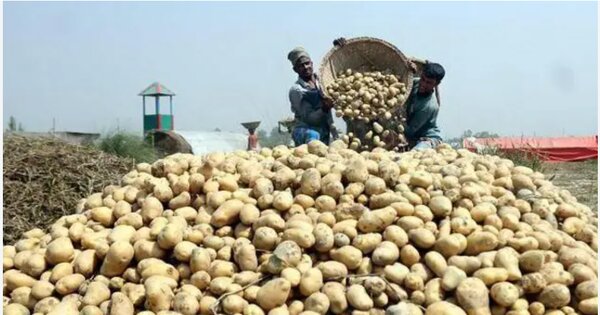
Potatoes were once a reliable cash crop for Bangladeshi farmers. After the harvest, the money from selling potatoes covered household expenses for the year, helped repay loans, and funded the next season’s cultivation. Now, for many farmers, potatoes have become a burden. Selling prices are so far below production costs that growers are losing interest in even removing their stock from cold storage. Many are worried about how they will afford to plant potatoes in the coming season after bearing such heavy losses.
The same picture is visible across the northern districts of Rangpur, Thakurgaon and Joypurhat, as well as in Sreenagar of Munshiganj. At some cold-storage gates, potatoes are selling for Tk 9 to Tk 9.50 per kg; elsewhere the price is Tk 11 to Tk 14. In contrast, the combined cost of production, transport and cold-storage rent is Tk 20 to Tk 25 per kg. Farmers are therefore losing Tk 10 to Tk 15 per kg, and in some places even more. With early-variety new potatoes already arriving in the market, prices may fall further.
Aminul Islam, a potato farmer from Amrulbari village in Badarganj upazila of Rangpur, is losing Tk 12 per kg on the 300 bags of potatoes he has in cold storage. He said: “Rice prices are low. Potatoes have broken my back. Since 2014 I have made losses on potatoes seven times. This time I have 300 bags in the cold store. Tell me, what will happen if I take them out? Let them rot in the corner.”
To reduce farmers’ losses, the government set a price of Tk 22 per kg at cold-storage gates on 27 August. That price is not being realised. In Rangpur region cold stores, potatoes are currently selling at an average of Tk 12 per kg; in some places the rate has dropped to Tk 9–9.50.
According to local agriculture offices and farmers, production cost in the Rangpur region in the 2025-26 season was about Tk 16 per kg. Buying bags and transporting the crop from the field to the cold store added another Tk 2, while cold-storage rent cost Tk 6. The total cost thus reached Tk 24 per kg, and rises further when other expenses are included. Potatoes are being sold at the cold-storage gate for roughly half that amount.
According to the Department of Agricultural Marketing, national potato production this season reached 11.785 million tonnes. Of this, about 3.39 million tonnes (28.77 percent) were stored in 402 government and private cold stores and 703 non-refrigerated model storerooms. The Bangladesh Cold Storage Association says more than 1.5 million tonnes still remain in its member facilities.
The crisis is especially acute in the Rangpur region. Agriculture department data show that 3,230,682 tonnes of potatoes were produced on 119,739 hectares. At the start of the season, 1,109,692 tonnes were stored in the region’s 116 cold stores; even at the end of the season, 936,283 tonnes remain in storage.
Mostafa Azad Chowdhury Babu, president of the Bangladesh Cold Storage Association, said the fall in potato prices to Tk 13 has slowed the movement of stock out of cold stores. With production costs around Tk 25 per kg, farmers are unwilling to take the crop out for fear of further losses. “If farmers do not take their potatoes, we will not get the rent, and we will also have to keep the machines running to prevent rotting, which increases operating costs,” he said.
Rangpur Agricultural Marketing Office figures show that 488,638 tonnes were stored in the district’s 42 cold stores in the 2025-26 season. As of 20 October, 284,617 tonnes of table potatoes were still in stock.
The situation is similar in Thakurgaon, where about 105,000 tonnes remain in the district’s 19 cold stores. Farmer Abdul Quddus of Nargun area said he had stored his potatoes hoping prices would rise later. Including cold-storage rent and other costs, his outlay was Tk 19–20 per kg, but he is now selling at Tk 14.
Trader Abdus Sattar of Thakurgaon Sadar upazila noted that large volumes of potatoes should have left cold stores by this time of year, yet weak demand means roughly two-thirds of the stock is still inside. Further delay in marketing will increase losses.
In Joypurhat the picture is the same. Of the 237,000 tonnes stored in the district’s 22 cold stores at the beginning of the season, about 110,000 tonnes (roughly 55 percent) had been released by the 15th of the current month. Storage and related costs come to about Tk 1,300 per bag, yet a 60-kg bag is currently selling for a maximum of Tk 680.
In Bogura, falling prices have put farmers, traders and stockists in difficulty. Many cannot recover their costs by selling stored potatoes and are therefore leaving them in cold stores, where some stock has begun to rot. According to the Agricultural Marketing Department, 235,737 tonnes remained in Bogura’s 51 cold stores as of Tuesday, compared with a total of 497,842 tonnes stored last season—meaning nearly half is still unsold. Wholesale prices from cold stores stand at Tk 12 per kg, while retail prices are Tk 17. In response to demands from storers, cold-storage rent has been reduced from Tk 550 to Tk 400 per bag, but losses continue.
Rezaul Karim, general secretary of the district potato traders’ association, said abnormally low prices have led many traders to leave potatoes in cold stores. When new potatoes begin arriving in about 20 days, prices of the old stock are expected to fall further.
Because of the low prices, the agriculture department is trying to reduce potato acreage. Last year potatoes were grown on 54,540 hectares in Bogura; this year’s target has been cut to 52,901 hectares. Sohel Md Shamsuddin Firoz, deputy director of the district agriculture office, said increased production of other vegetables has reduced demand for potatoes, so farmers are being encouraged to grow mustard instead.
In Sreenagar of Munshiganj, a 50-kg bag of stored potatoes is selling for Tk 400–450. After paying Tk 300 in cold-storage rent, the farmer is left with only Tk 100–150—and after production, transport and other costs the loss is even greater.
Agricultural economist Dr Jahangir Alam suggested that the government could subsidise 50 percent of cold-storage rent and also provide price support to reduce farmers’ losses.
M Arif Pasha, Director General of the Department of Agricultural Marketing, said current prices are not satisfactory for farmers, but he hopes the situation will improve in the near future.
Agriculture Minister Mohammad Aminur Rashid told Samakal that when production exceeds demand, prices fall. To address the problem, the government is working on region-wise demand assessment and data-based production planning. A farmer-card initiative is being introduced so that growers can produce according to market demand. The government had tried to sell potatoes through the Trading Corporation of Bangladesh (TCB), but low open-market prices meant buyers showed little interest in TCB potatoes.