


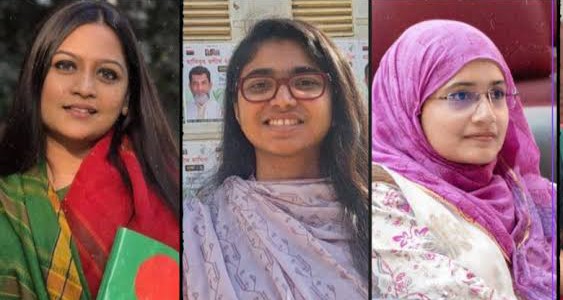
After Tajnuva Jabin and Tasnim Jara, another well-known face of the National Citizen Party (NCP), Samantha Sharmin, quit the party in a statement on Thursday.
Samantha cited differences over the reconstruction of the central committee without a council, the alliance with Jamaat-e-Islami, and the party’s position on women’s issues as reasons for her resignation. Her resignation letter has already been submitted to the party’s convener, Nahid Islam.
Samantha Sharmin had been associated with the NCP since its inception. About two weeks ago, the NCP reconstituted its central convener committee. At that time, she was removed from the post of senior joint convener and made a joint convener. She did not comment directly on the demotion. However, in the statement she issued upon leaving the party, she criticized the process of reconstituting the committee.
Also Read: Samantha Sharmin quits NCP, finally, over Jamaat row
The NCP has not yet given any immediate reaction regarding the resignation of this well-known female leader of the July mass uprising and her allegations.
Difference in political position between Jamaat and the NCP is becoming unclear
In her statement, Samantha Sharmin said: “Over the past 11 months, I have submitted written complaints and proposals to various levels of the party analyzing the NCP’s past activities and future course of action. Alongside that, I have tried to change the party’s principled position through discussions and debates. Considering it my political responsibility to bring the party back if it goes on the wrong path, I have continued an internal ideological struggle.”
She had previously warned that forming an alliance with Jamaat-e-Islami would force the NCP to pay a heavy price. Now she believes the NCP can no longer remain sincere to the values with which the party was founded.
In the statement, Samantha Sharmin alleged that by forming an alliance with Jamaat, the NCP has moved away from the politics of reform.
In her words, constitutional reform, legal reform, and structural reform of politics and political parties are necessary to establish a democratic state system. But Jamaat-e-Islami does not consider these reforms as part of its own politics and state project.
She claimed that Jamaat does not actually practice the politics of reform. Rather, the party talks about reform only because it needs to use the aspirations of the mass uprising for its own benefit.
She also commented that Jamaat’s political philosophy and proposed state structure are not democratic. According to Samantha Sharmin, the difference between Jamaat’s political position and the NCP’s own position is gradually becoming unclear. As a result, liberal democrats have been forced to turn away from the NCP.
Before the 13th National Parliament election, six female leaders of the NCP had taken different positions on forming an alliance with Jamaat. Apart from Samantha Sharmin, Tasnim Jara, Tajnuva Jabin, Nusrat Tabassum, Monira Sharmin, and Nahida Sarwar Niva had gone to convener Nahid Islam’s house two days before the announcement of electoral unity and raised objections. In addition, at least 30 central leaders had submitted a memorandum to the top leaders.
Also Read: Arafat calls Humaiun Kobir a clown, says extradition treaty does not apply to Sheikh Hasina
Samantha Sharmin also mentioned in the statement that the NCP had the opportunity to contest the election independently. Another major allegation of hers is that the party did not properly recognize the contribution and political aspirations of women in the mass uprising.
She said: “In the mass uprising, women were frontline fighters, partners in resistance, and important protectors of the movement. But after the uprising, the old conservative political forces tried to keep women away from political rights and fair share. The NCP has also followed that tendency in various cases.”
Criticizing the reconstitution of the central committee without a council, Samantha Sharmin said: “Reconstituting the committee without a council has damaged the democratic environment of the party. This has also raised questions about leadership selection, neutrality, and the decision-making process.”
At the same time, she highlighted the need for the politics of unity instead of the politics of division.
Tasnim Jara’s resignation
In the last week of December 2025, the then senior joint member secretary of the NCP, Tasnim Jara, left the party. At that time, the party was discussing seat-sharing with Jamaat. Multiple sources in the NCP said at the time that she had strongly opposed an alliance with Jamaat. Eventually, she resigned before the announcement of electoral unity.
Immediately after leaving the party, Tasnim Jara did not react on the matter. However, in the second week of January, at an event titled “National Election and Citizens’ Expectations,” she said: “The people want change. They are no longer ready to accept the old political arrangements. From this desire for change, I have decided to step away from the party and contest the election as an independent candidate.”
The NCP had nominated Tasnim Jara for the Dhaka-9 seat in the 13th National Parliament election. Later, she contested as an independent candidate. In that seat, BNP’s Habibur Rashid won with 1,11,212 votes. Tasnim Jara came third with 44,684 votes.
What Tajnuva Jabin said
In the context of forming an alliance with Jamaat, the then joint convener of the NCP, Tajnuva Jabin, also left the party. She also withdrew from the election. Later, she explained the reasons for leaving the party in a long post on social media.
At the beginning of that post, Tajnuva wrote: “This is being labeled as political strategy, electoral alliance, etc. I would say this was planned. It has been arranged and brought to this point.”
Tajnuva Jabin claimed that all political alternatives were gradually closed off so that there would be no way other than forming an alliance with Jamaat. According to her, the entire process was planned.
Hinting at Jamaat’s ideology, she wrote: “But those who did not even want this country or this parliament—wanting to become an MP through compromise with them right at the beginning, or accepting the leadership of those who are trying hard to become MPs through their favor—is simply impossible for me in the year after the mass uprising.”
She further wrote: “I cannot even digest this thing and die. My leader will be the one who carries July politics. But in the name of political strategy, the entire July is being handed over to Jamaat.”
After the schedule of the National Parliament election was announced, the NCP had initially declared that it would field candidates in 300 seats. However, after forming an alliance with Jamaat at the last moment, the party got the opportunity to field candidates in 30 seats. Tajnuva Jabin had commented that this decision was taken as a strategy not to allow other leaders of the party to contest the election.
Among the female leaders who opposed forming an alliance with Jamaat were Monira Sharmin and Nusrat Tabassum. Later, Nusrat Tabassum became a member of the reserved women’s seat in the National Parliament. Although Monira Sharmin was initially nominated for that seat as a candidate of the Jamaat-led alliance. However, since three years had not passed after she left government service, she could not take the oath. Eventually, Nusrat Tabassum was nominated.