


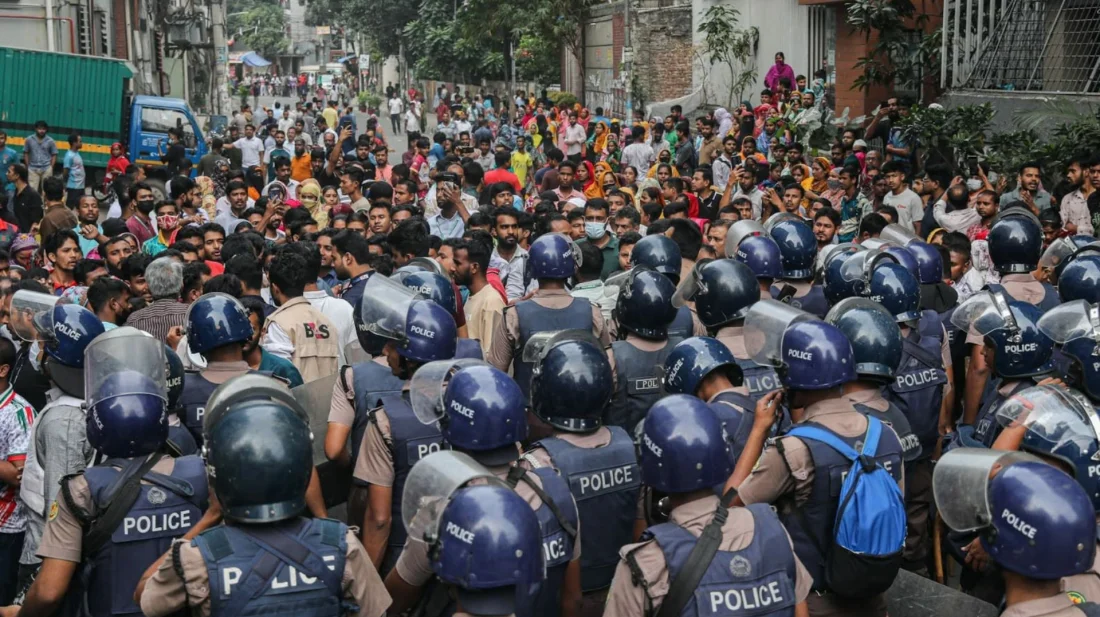
Days of sustained protests by ready-made garment (RMG) workers demanding a minimum monthly wage of Tk 30,000 have inflicted severe damage on Bangladesh’s vital export sector. Factory closures, strikes, highway blockades, clashes, vandalism and arson have disrupted production across industrial hubs around Dhaka, including Gazipur, Ashulia, Savar, Mirpur and Narayanganj.
According to the Bangladesh Garment Manufacturers and Exporters Association (BGMEA), production halted at 529 factories on 1 November, disrupting roughly $30 million (about Tk 373 crore) in export activity. On 2 November the figure rose to 690 factories, affecting around $40 million more. Over the two days, export activity worth approximately $70 million (roughly Tk 850 crore) was hit. BGMEA separately estimated about Tk 850 crore in financial losses in Gazipur alone over six days of unrest (some overlap with the export disruption figures is possible). Direct property damage from vandalism and arson has not yet been fully quantified.
On 3 November, protests and road blockades continued in Gazipur, with another 55 factories declaring holidays (following 150 the previous day). Factory owners continue to bear fixed costs for power, gas, maintenance and administration even while lines are idle. Shovon Islam of Sparrow Group said two of his factories (45 production lines) incur about $90,000 daily in operating costs regardless of whether they run. Delayed shipments risk air-freight premiums, lost orders and eroded buyer confidence during the critical November–February ordering season.
Industry leaders, including BKMEA executive president Fazle Shamim Ehsan, warn that the violence is damaging Bangladesh’s image and employment prospects in a sector already under pressure from inflation, energy costs and external demand.
Also Read: Home Minister Salahuddin blames political conspiracy behind RMG protests
Workers are seeking more than a doubling of the current minimum wage of Tk 12,500 (set in 2023), citing high inflation and rising costs of food, rent, transport and healthcare.
The government formed a six-member minimum wage board on 1 November; its first meeting took place on 4 November. Board chairman Syed Azad Subhani said a second meeting is planned for the following week, when owners, workers and the neutral member will submit proposals. Workers’ representative Babul Akhter (Bangladesh Garments and Industrial Workers Federation) and owners’ representative ABM Shamsuddin indicated agreement that a new structure could be finalised by December and paid from January.
The exact amount remains undecided, and protests have continued despite the board’s formation. Authorities have pledged security for workers willing to return to factories while warning of legal action against those creating disorder.
Violence, police response, worker death and arrests
Clashes involved brick-throwing, vehicle torching (including police vehicles and a police box in Gazipur’s Konabari), factory and warehouse fires (including Mondal Group and a Tropical Knitex jute warehouse), bank vandalism and highway blockades on the Dhaka-Tangail and Dhaka-Aricha routes. Metro stations in Mirpur were temporarily closed. Police and journalists were among those injured; police used tear gas, sound grenades, water cannons and batons. At least 15 vehicles were reported damaged in Gazipur alone.
A 21-year-old garment worker, Toufiq Sheikh (also reported as Toufiq Hossain), from Gaibandha, who worked at Laila Styles Ltd in Gazipur, died in hospital after being severely beaten on 2 November while filming or photographing clashes/vandalism near a factory in the Bahadurpur/Joydebpur area. Labour Minister Ariful Haque Choudhury pledged swift justice.
An attempt by NCP members to hold an absentee funeral prayer was dispersed with sound grenades, injuring more than 20 people.
Also Read: Awami League condemns workers’ leader Nazma Akter for shifting stance on RMG protests
Dozens of arrests have been made (reports cite figures in the 30–90+ range across days and areas, including dozens alleged to be Awami League, Chhatra League and Sramik League activists). Cases have been filed against thousands of unidentified people. Workers and unions continue to demand an end to blacklisting, reinstatement of dismissed workers, release of detainees and withdrawal of what they call harassment cases—echoing patterns from the 2023 wage protests.
The unrest and police actions have drawn international media coverage from outlets including Reuters, Al Jazeera, BBC, AFP, The Independent and others. Human rights groups such as JusticeMakers Bangladesh in France have condemned alleged police torture, baton charges and arbitrary arrests of workers (including women) and bystanders, calling for independent investigations and releases.
Political reactions
The BNP-led government has blamed the banned Awami League and associated elements (including some former factory owners, MPs and labour leaders) for infiltrating protests, funding sabotage and seeking to destabilise the industry and government ahead of December. Home Minister Salahuddin Ahmed and others have cited intelligence on AL-linked instigation; arrests of AL-affiliated individuals have been highlighted.
BNP activists have positioned themselves in some areas to counter alleged outsiders and were seen beating up the protesters in Dhaka, Gazipur and Narayanganj. Jamaat-e-Islami Amir Shafiqur Rahman warned of a conspiracy by vested interests to destroy the garment industry through unrest.
Support or solidarity with workers’ demands has come from sections of left-leaning labour groups, the National Citizen Party (NCP)—whose figures such as Hannan Masud and its labour wing Jatiya Shramik Shakti have criticised the wage board as politicised, demanded an end to police force, fair wages matching living costs, release of workers and abolition of blacklisting—and other worker platforms.
Also Read: Gazipur RMG worker Toufiq succumbs to injuries
Some reports also note limited or alleged involvement by elements linked to the Awami League and other parties, alongside warnings from the ruling side and Jamaat against violence that harms the sector.
The full extent of economic losses, including potential long-term order cancellations, remains higher than immediate export-disruption figures. Balancing workers’ demand for a living wage with the need to keep the industry—which employs roughly 4 million people and accounts for over 80% of Bangladesh’s export earnings—stable is now the central challenge.