


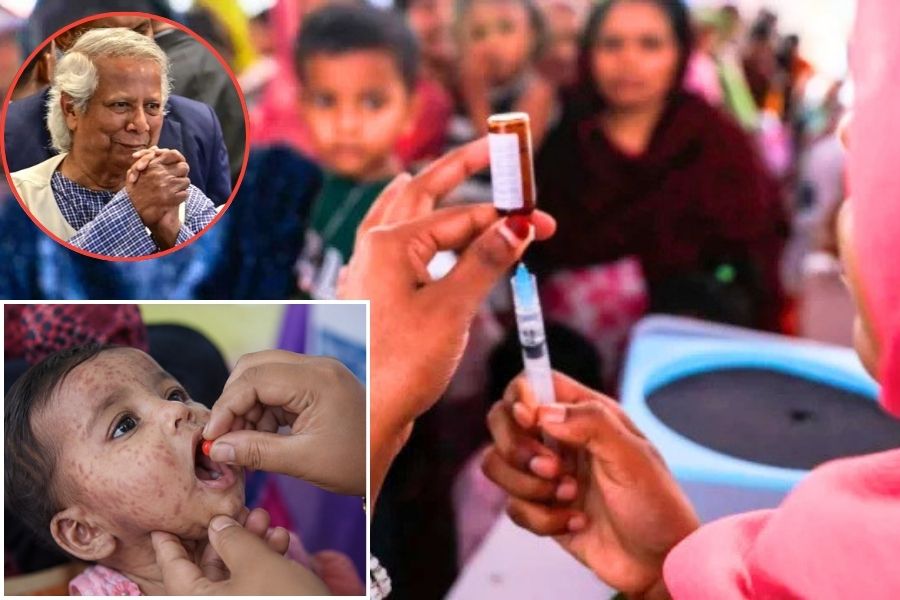
The government has constituted a three-member commission to investigate delays, irregularities, and administrative failures in the procurement and distribution of measles vaccines, amid the country’s worst measles outbreak in decades that saw nearly 1,300 child deaths in less than eight months.
A Cabinet Division gazette issued on Wednesday (November 4) established the commission under the Commission of Inquiry Act, 1956. It is tasked with determining the liability of the interim government that held office from August 8, 2024, to February 17, 2026, over allegations that procurement and distribution lapses caused adverse public health impacts.
Former High Court Division Justice Mamnoon (Mamnun) Rahman has been named chairman. The other members are Professor Dr. Mawdood Hossain Alamgir, president of the Bangladesh College of Physicians and Surgeons (BCPS), and A.N.M. Moinul Islam, additional secretary of the Health Services Division.
Terms of Reference and Powers
According to the notification, the commission will identify the causes of delays and any irregularities or administrative failures in measles vaccine purchase and distribution, and name those responsible. It will recommend measures to prevent recurrence and may offer advice on related issues. It has powers to inspect any location in the country and to summon and question individuals.
The commission must complete its work and submit a report to the government within 60 working days of the gazette. The Health Services Division will provide secretarial support and assign officials as needed to cover costs and facilitate the inquiry.
Context of the Outbreak and Procurement Issues
The move comes as Bangladesh grapples with a large-scale measles outbreak that began in mid-March 2026.
As of Wednesday (November 4), the Directorate General of Health Services reported a combined toll of 1,269 confirmed and suspected measles-related deaths (105 laboratory-confirmed), with more than 234,000 suspected cases and over 24,000 confirmed infections since mid-March. Hundreds of thousands have been hospitalised.
Multiple independent reviews, media investigations, and official statements have linked the crisis to systemic gaps that developed before and during the interim government’s tenure. Key issues highlighted in prior reporting include:
- A shift in September 2025 from the long-standing UNICEF-supported procurement system (funded largely by Gavi) to an open-tender process, despite strong warnings from UNICEF. UNICEF Representative Rana Flowers was quoted in a Science report as having urged health authorities not to make the change, warning of risks to routine immunisation.
- Resulting bureaucratic delays that caused measles-rubella (MR) vaccine stockouts in 2025 and stalled routine immunisation. Coverage reportedly fell sharply; some government data indicated only about 59% of eligible children received measles vaccines in 2025, well below the 95% threshold needed for herd immunity.
- Postponement and eventual delay of the supplementary MR campaign (last conducted in 2020; planned for 2024 but deferred, then further delayed until April 2026), partly amid prioritisation of other campaigns such as typhoid vaccination and post-political-transition priorities. Between 2023 and 2025, reports indicated procurement of significantly fewer MR doses than required for routine needs.
- Disruptions linked to changes in health sector financing mechanisms (including shifts from operational plans to Development Project Proposals), funding gaps, and incomplete attention to routine immunisation during the interim period. Officials and reviews have also noted high numbers of unvaccinated children accumulated over years, vacant posts in the Expanded Programme on Immunization (EPI), and cold-chain capacity issues.
An independent joint review team earlier this year identified gaps in childhood immunisation, depleted 2025 vaccine stocks, and campaign delays as major contributors, while also noting shortcomings in the subsequent response.
Petitions had previously been filed with the Supreme Court and Anti-Corruption Commission seeking probes into alleged procurement irregularities involving senior interim-government figures.
Health officials under the current administration have publicly attributed the shortage and lapses primarily to negligence and policy decisions during the interim period, though some argued the causes were already sufficiently clear without a formal inquiry.
The commission’s mandate focuses specifically on the August 2024–February 2026 window and the public-health consequences of the alleged failures. Its findings are expected to address accountability and propose safeguards for future vaccine supply and distribution systems.