


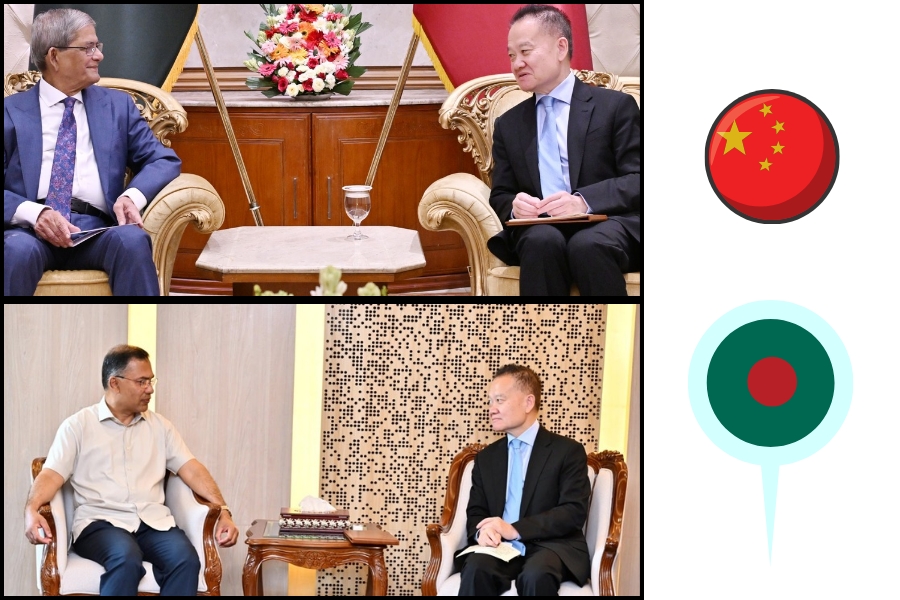
China reaffirmed its commitment to strengthening longstanding ties with Bangladesh through enhanced political engagement, expanded economic cooperation and broader people-to-people exchanges, as Liu Haixing, Minister of the International Department of the CPC Central Committee, held talks with President Mirza Fakhrul Islam Alamgir and addressed a high-level seminar in Dhaka on Wednesday.
During a courtesy call on the President at Bangabhaban this morning, Mirza Fakhrul described China as a trusted friend and important strategic partner and called for greater Chinese investment in key sectors to accelerate Bangladesh’s economic development, industrialization and technological advancement.
The President highlighted recent progress, including the framework agreement for the Mongla Port Modernization and Expansion Project and the groundbreaking of the China Economic and Industrial Zone (CEIZ), saying these would boost connectivity and industrialization. He welcomed Chinese President Xi Jinping’s proposals for multidimensional connectivity, including the Kunming-Chattogram corridor and the China-Myanmar-Bangladesh Economic Corridor, and invited Xi to visit Bangladesh at a mutually convenient time.
Mirza Fakhrul urged Chinese companies to invest more in areas that promote technology transfer, create jobs and diversify Bangladesh’s export base. He thanked China for financing and constructing the 1,000-bed Bangladesh-China Friendship General Hospital, sought continued support on the safe repatriation of Rohingyas to Myanmar, and expressed appreciation for China’s assistance amid the ongoing energy crisis.
Recalling historic visits to China by Shaheed President Ziaur Rahman in 1977 and 1980, the President said those trips laid a strong foundation for bilateral friendship. He also noted that Prime Minister Tarique Rahman’s visit to China in June, including meetings with President Xi Jinping and Premier Li Qiang and the signing of several MoUs, would help elevate relations further.
Liu Haixing assured continued Chinese cooperation in renewable energy, education, cultural exchanges and on the Rohingya issue. He noted that the foundation of diplomatic relations was established during Ziaur Rahman’s tenure and strengthened under former Prime Minister Khaleda Zia, expressing hope that ties would grow stronger and broader under Prime Minister Tarique Rahman.
Earlier, the President welcomed the Chinese minister with floral bouquets. The Chinese side included Chargé d’Affaires Liu Yuyin and Peng Xiubin, Director-General of the Bureau of Southeast and South Asian Affairs. State Minister for Foreign Affairs Shama Obaed Islam and Foreign Ministry Secretary (Coordination) Salahuddin Noman Chowdhury were also present.
Following the meeting, a video was screened of the presentation of credentials by Liu Haixing’s father, former Ambassador Liu Shuqing, to then President Ziaur Rahman in 1980.
Later in the day, Liu addressed a high-level seminar at InterContinental Dhaka titled “Where History Illuminates the Future: China-Bangladesh ‘Political Parties Plus’ Roundtable & Inauguration Ceremony of Bangladesh-China Centre for Party and State Governance Studies,” organised by the Chinese Embassy.
“Standing at a new historical starting point, we stand ready to work together with all sectors of society in Bangladesh to carry forward friendship, foster consensus, deepen exchanges and mutual learning,” Liu said.
He recalled living in Dhaka for two-and-a-half years as a child when his father served as China’s second ambassador about 46 years ago, saying the warmth of the Bangladeshi people had left a deep impression.
Liu identified historical trust, respect for sovereignty, expanding economic cooperation and growing cultural exchanges as the main pillars of the relationship. He noted that bilateral trade had risen from about US$15 billion to nearly US$23 billion in recent years and described Bangladesh as an important partner in the Belt and Road Initiative, citing Chinese-supported infrastructure projects.
He pointed to opportunities in the Mongla Port Industrial Park and the Teesta River restoration initiative, and said China was ready to import more high-quality products from Bangladesh. On political cooperation, Liu said the CPC was keen to strengthen exchanges with Bangladeshi political parties on governance and party-building experiences, including sharing outcomes from its recent plenary session and Xi Jinping Thought on Party Building.
He stressed the need to expand engagement beyond government-to-government ties to include political parties, youth, educational institutions, media, think tanks and the business community. Recalling historical cultural links through Buddhist scholars Xuanzang and Atisa Dipamkara Srijnana, and citing the nine China-Bangladesh Friendship Bridges, Liu said both countries should work together for international peace and stability amid global uncertainties.
BNP Acting Secretary General Rahul Kabir Rizvi addressed the seminar as chief guest, with Chargé d’Affaires Liu Yuyin conducting the proceedings. Attendees included Prime Minister’s Adviser Nazrul Islam Khan, State Minister Shama Obaed Islam, and senior leaders from the BNP, Bangladesh Jamaat-e-Islami and the National Citizen Party (NCP).
Liu concluded by expressing hope that the friendship between the two countries would grow stronger through sustained cooperation, saying: “No matter how the international situation evolves, China and Bangladesh will always stand by each other and work together to ensure global peace, security and development.”