


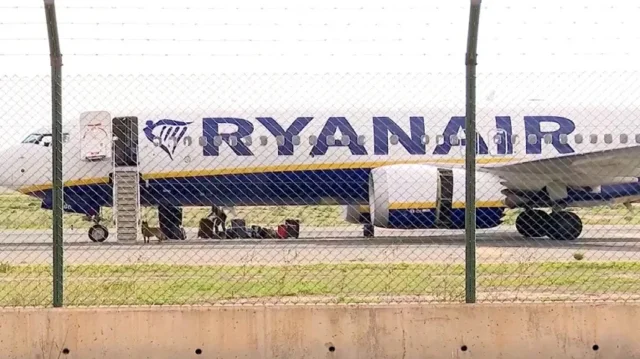
A series of bomb threats targeting passenger flights across Europe on Tuesday, November 3, 2026, forced diversions, brief airport closures, military escorts, and extensive security searches. All incidents proved to be false alarms, with authorities finding no explosive devices on any aircraft or related vessels.
At least seven to ten flights operated by Ryanair, Wizz Air, Scandinavian Airlines (SAS), and LOT Polish Airlines were affected. Ryanair faced the heaviest impact, with multiple services targeted. An Israel-bound cruise ship was also searched after a separate threat. No one claimed responsibility, and officials have not attributed the incidents to any specific group or state.
Key Incidents
In Poland, a LOT flight from London Heathrow (carrying 181 people) bound for Warsaw Chopin Airport was diverted to nearby Warsaw-Modlin Airport, which was temporarily closed for inspection. An SAS flight from Copenhagen landed as scheduled at Chopin, where a runway was briefly affected during checks. Nothing was found in either case, and normal operations resumed.
In Italy, two Ryanair flights landing at Rome’s Fiumicino Airport (from Lisbon and Dublin) triggered anti-bomb procedures. Italian Air Force Eurofighter jets escorted the Dublin flight until landing. Checks of passengers, crew, luggage, and aircraft were negative.
In Spain, a Ryanair flight from Manchester to Murcia activated emergency protocols upon arrival. Police and sniffer dogs inspected the plane and baggage (114 passengers and crew); the threat was ruled a hoax.
In Bulgaria, a Wizz Air flight from Bergamo (Milan) and a Ryanair flight from Dublin, both bound for Sofia, were searched after landing. No devices were found. These followed a Monday incident in which a Wizz Air flight from London Luton to Sofia was diverted to Budapest and escorted by Hungarian Gripen fighter jets after a mid-air threat; again, nothing was discovered.
Separately, the Panama-flagged cruise ship Crown Iris (bound for Haifa, Israel, with roughly 1,500 people aboard) was evacuated while anchored off Syros, Greece, after a bomb threat. No device was found, and the vessel was expected to continue its voyage.
Official and Expert Reactions
The UK government described threats involving British departures (from Heathrow and Manchester) as “malicious hoaxes.” A spokesperson emphasized that the UK has “one of the most robust aviation security systems in the world, with well-tested processes for dealing with any potential threats, as well as malicious hoax threats.” London’s Metropolitan Police confirmed awareness of multiple threats involving Heathrow and Manchester flights but stated that “no security issues were identified” after airline assessments. Counter-Terrorism Policing said there was no active UK investigation into the broader European incidents.
Aviation security analysts noted the unusual volume of confirmed threats in a single day. Rhys Jones of Osprey Flight Solutions called seven threats exceptional and observed that “the lack of clear target state, airline or route indicates that general disruption to aviation operations is the aim.” Matthew Borie of the same firm outlined possibilities including copycat actions, a single actor or group, or hybrid warfare by state actors or proxies, while urging travelers not to be alarmed given coordinated national responses (including occasional fighter-jet escorts). Some experts and commentators noted patterns of low-cost disruption against European infrastructure, though authorities have not officially linked the events to any foreign state. Moscow and Tehran have denied involvement in broader hybrid campaigns cited by European officials.
Passengers on several flights, including the Manchester-Murcia service, reported being unaware of the threats until after landing, when they encountered security teams. Airports quickly returned to normal operations once searches concluded. Investigations continue across affected countries, with authorities sharing information to determine whether the threats were coordinated.