


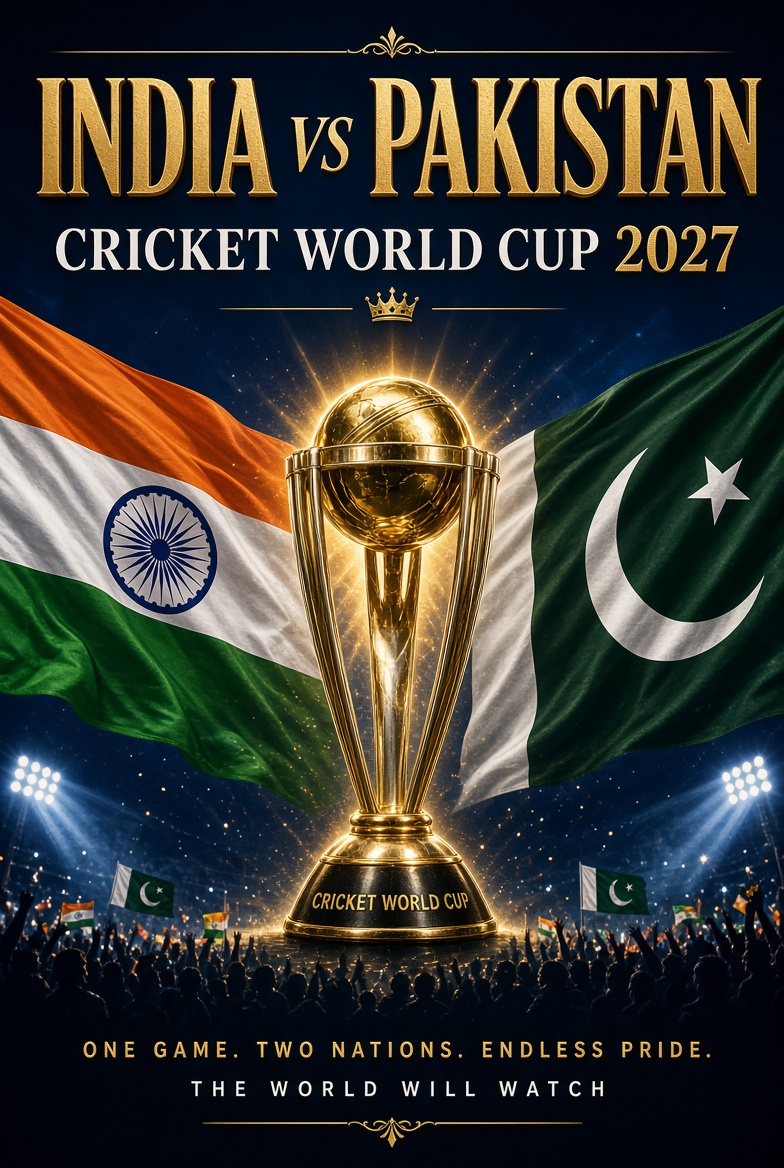
The enduring commercial and emotional pull of an India-Pakistan cricket match has been reaffirmed by ticket demand for the 2027 ICC Men’s Cricket World Cup.
Nearly 8.4 million applications have been submitted for the group-stage fixture between the two sides on 10 October 2027 at Johannesburg’s Wanderers Stadium — outstripping even the tournament final at the same venue, which has attracted around 8 million applications.
Organisers said on Monday that roughly 3 million fans from 193 countries have entered the lottery system so far, with applications remaining open until 21 November. The 14-team tournament, co-hosted by South Africa, Zimbabwe and Namibia, runs from 2 October to 21 November 2027. Total ticket applications for the entire event have already exceeded 120 million.
India and Pakistan are drawn together in Group A (alongside Australia, Afghanistan, Zimbabwe and a qualifier). The top three teams from each group, plus the best fourth-placed side, advance to a new Super 7 stage before semi-finals and the final.
India-Pakistan relations and cricket since the Pahalgam attack
The high demand comes against a backdrop of sharply deteriorated relations following the 22 April 2025 terrorist attack in the Baisaran meadow near Pahalgam in Indian-administered Jammu and Kashmir. Three militants linked to the Pakistan-based Lashkar-e-Taiba (and its proxy, The Resistance Front) killed 26 civilians — mostly Hindu tourists — by singling out non-Muslim men. India blamed Pakistan-supported groups; Pakistan denied involvement.
The attack triggered a major crisis. India suspended the 1960 Indus Waters Treaty, expelled Pakistani diplomats, reduced mission strength and closed the Attari border crossing. Pakistan responded by suspending the 1972 Simla Agreement and restricting trade and airspace. Tensions escalated into a four-day military conflict in early May 2025, when India launched Operation Sindoor (missile and air strikes on alleged terror camps in Pakistan and Pakistan-administered Kashmir). The two sides exchanged strikes before a ceasefire on 10 May. The three Pahalgam attackers were later killed by Indian forces in Operation Mahadev in July 2025; India’s National Investigation Agency subsequently filed a detailed chargesheet against Lashkar-e-Taiba/The Resistance Front and others.
Bilateral diplomacy and people-to-people ties remain largely frozen more than a year later. Trade is suspended, formal political engagement is minimal, and India’s stated Pakistan policy has not changed, even as limited multilateral contact continues.
Cricket has reflected this freeze. India and Pakistan have not played a bilateral series since 2012-13. Shortly after the Pahalgam attack, BCCI vice-president Rajeev Shukla confirmed that India would not play bilateral cricket with Pakistan going forward, in line with government policy; matches would continue only in ICC and other multilateral events. India’s sports ministry has maintained the same position: no bilateral contests in each other’s countries, though both sides may participate in multi-nation tournaments.
India refused to travel to Pakistan for the 2025 Champions Trophy (playing its matches in Dubai instead). Their first meeting after the conflict — in the September 2025 Asia Cup in Dubai — was marked by a deliberate refusal by the Indian team to shake hands before or after the match. Captain Suryakumar Yadav said the decision was aligned with the Indian government and BCCI and dedicated the victory to the armed forces and the families of the Pahalgam victims. Pakistan protested the snub and lodged a complaint with the ICC over sportsmanship.
The 2027 World Cup fixture will take place under ICC auspices at a neutral venue in South Africa. The overwhelming ticket demand demonstrates that the rivalry retains enormous global interest and commercial value even as political and bilateral sporting ties remain severely restricted.