


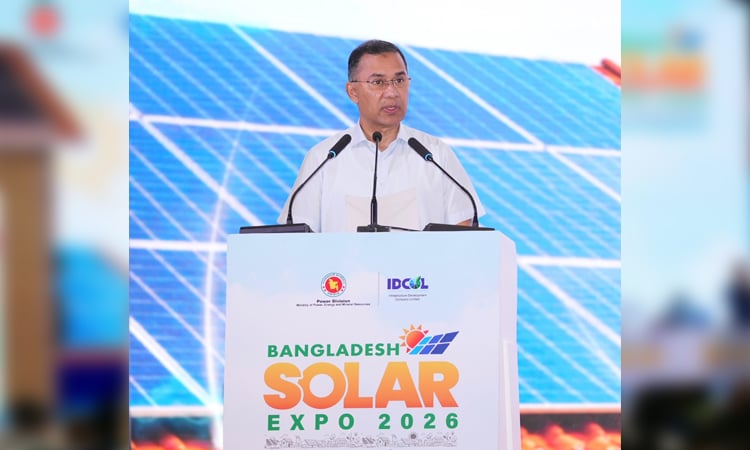
Prime Minister Tarique Rahman on Tuesday used the inauguration of the Bangladesh Solar Expo 2026 to attack the previous Awami League government’s quick-rental power plants as “looting,” while promising 3,000–4,000 megawatts of solar capacity before next summer and renewable targets of 20 percent by 2030 and 30 percent by 2040.
Critics and senior observers immediately dismissed the remarks as recycled propaganda that ignores the record of successive governments and conceals the current administration’s own opaque project awards.
Speaking at the Bangladesh-China Friendship Conference Centre, Rahman said the electricity crisis could be solved through “affordable solar and other cost-effective measures rather than ‘looting’ in the name of quick-rental power plants.”
He cited Tk 1,500 crore already allocated for solar financing, the Special Solar Power Installation Ordinance 2026, net-metering rates of Tk 10.50 per unit from February 2027, and plans to convert irrigation pumps to solar. The government also reported providing Tk 43,000 crore in power subsidies in the 2025-26 fiscal year amid heavy reliance on imported energy.
Senior journalist Probir Kumar Sarker and other analysts note that neither the interim Yunus administration nor the present BNP government has produced evidence of systemic irregularities in the quick-rental schemes launched under the Awami League. Those plants were introduced precisely because chronic shortages required rapid capacity additions; generation rose sharply and load-shedding declined for years. Labeling the entire approach “looting” without new findings, they argue, serves political messaging more than energy policy.
The contrast with the BNP’s own record is stark. Since taking office after the 2026 election, the government has awarded major contracts in solar power, LNG imports, aircraft procurement, and metrorail expansion to political allies and connected firms without open tender, according to observers tracking procurement. These deals have been accompanied by persistent allegations of commission or “chanda” payments.
At the same time, the administration has declined to hold the preceding Yunus regime accountable for the cancellation of dozens of solar and other power projects—cancellations that contributed directly to the supply shortfalls the current government now cites as justification for its renewable push.
Rahman’s personal anecdote of installing solar panels at his residence and exporting surplus power does little to address the larger pattern. While expanding rooftop solar, improving net metering, and reducing diesel dependence are sensible long-term goals, framing them as a clean break from “looting” while shielding both prior interim decisions and current no-tender awards undermines the transparency the government claims to champion.
The Power Division, IDCOL, and development partners present at the expo heard repeated calls for financing and collaboration; what remains missing is a parallel commitment to open competition and independent audits of both past quick-rental contracts and present mega-projects.
Until the BNP government publishes clear findings on the quick-rental schemes it continues to denounce, and subjects its own solar, LNG, and infrastructure awards to the same scrutiny, the solar expo rhetoric will be read by many as political positioning rather than a credible energy strategy.