


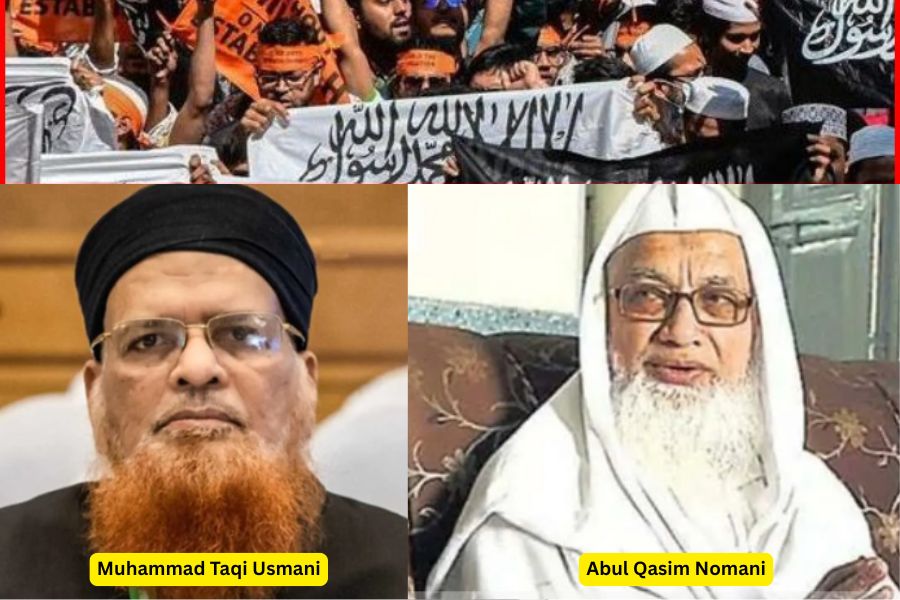
Dhaka is preparing to host two high-profile Deobandi Islamic scholars from Pakistan and India in late November 2026, prompting security analysts and observers to raise concerns about the timing of the visits and the rise of Qawmi extremists under Hefazat-e-Islam.
The arrivals coincide with documented increases in extremist activity involving some Qawmi madrasa teachers and students linked Hefazat-e-Islam and Jamaat-Shibir, as well as the resurgence of banned militant outfits such as JMB, Ansar al-Islam, and Hizb ut-Tahrir, and the revival of ties to Pakistan-based militant groups like Lashkar-e-Tayyiba and Teherik-e-Taliban (TTP).
According to Bangladeshi media reports, including BD Today, Allama Mufti Muhammad Taqi Usmani — a prominent Pakistani Islamic jurist, former judge on Pakistan’s Shariah Appellate Bench, president of Wifaqul Madaris al-Arabia Pakistan, and head of Darul Uloom Karachi — is scheduled to arrive in Dhaka on 22 November for a week-long visit ending on 28 November. He is set to appear as chief guest at the 15th annual Dastar Bandi (graduation turban ceremony) conference organised by the Shaikh Zakariya Islamic Research Centre in Kaula Namapara, Dhaka, after Zuhr prayers on the day of arrival.
He is expected to address other religious gatherings and seminars involving Bangladeshi ulema. Accompanying him is Maulana Hanif Jalandhari, secretary-general of Pakistan’s Wifaqul Madaris al-Arabia and muhtamim (principal) of Khairul Madaris in Multan.
Separately, reports from Kalbela and other outlets indicate that Mufti Abul Qasim Nomani, the muhtamim (vice-chancellor) and Sheikhul Hadith of India’s historic Darul Uloom Deoband, is due to arrive around 25 November for a short two-day visit. He is expected to participate in religious programmes at several Qawmi madrasas, including those in Faridabad and other locations, before returning to India.
Both scholars are leading figures in the Deobandi tradition, which underpins the vast majority of Bangladesh’s Qawmi (unregulated, traditional) madrasa system. Bangladesh has an estimated 25,000 Qawmi madrasas enrolling around 7 million students, according to official statements. While the vast majority of these institutions focus on religious education, a subset has long been flagged by security agencies for links to radicalisation.
Qawmi madrasa-based platform Hefazat has gained strength since the August 2024 political changeover that ousted the secularist Awami League as the Yunus regime spared the extremists like Jasimuddin Rahmani and termed them Islamic scholars. Its top leaders became influential and carried out violent actions against the Awami League, minorities, and the symbols of the 1971 Liberation War and Bangali culture with impunity. Recently, Hefazat formed a seven-party alliance with radical Islamist parties in the government and an opposition alliance with the support of the BNP-led government. Extremist Hefazat leaders include former Deoband student Mufti Harun Izhar, who is linked to LeT, and Maulana Mamunul Haque, who works with the Taliban.
Recent militant incidents have heightened concerns after the Kalema flag campaign and raids in militant dens.
In December 2025, a powerful explosion at Ummul Qura International Madrasa in South Keraniganj, on the outskirts of Dhaka, revealed the site was being used as an improvised explosive device (IED) manufacturing hub by Sheikh Al Amin, identified as the Dhaka regional commander of Islamic State Bengal/Neo-JMB.
Al Amin, who has a prior history of arrests linked to JMB/Neo-JMB activities (including in 2017), fled after the blast that injured family members; large quantities of chemicals and bomb-making materials were recovered. Analysts have described this as evidence of a resurgent network capable of producing sophisticated explosives, with reports of dozens of IEDs already moved to safe houses beforehand.
Other developments include the reported reopening of a madrasa previously associated with JMB founder Shaikh Abdur Rahman, increased organisational activity by groups such as Neo-JMB, Ansar al-Islam, and HuJI-B since the political changes of August 2024, and a UN Security Council report noting concerns about al-Qaeda in the Indian Subcontinent (AQIS) seeking to exploit Bangladesh. Security assessments have also pointed to recruitment patterns in which some Qawmi madrasa students and teachers have historically been drawn into militant networks, alongside a broader post-2024 environment of greater freedom for Islamist groups, attacks on Sufi shrines, and moral policing.
Observers note that visits by senior Deobandi figures from Pakistan and India — countries with their own histories of Deobandi-linked militancy networks — occur against this backdrop. Past events in Dhaka involving similar circles have drawn participation from more radical elements, and the open nature of Qawmi gatherings can create platforms that extremists seek to exploit for recruitment or legitimacy.
While the visiting scholars themselves are widely recognised as traditional religious authorities rather than operational militants, the lack of robust government oversight of Qawmi institutions and the recent use of madrasa premises for militant logistics have fuelled calls for closer monitoring of such high-profile visits and the networks they engage.
Bangladeshi authorities have not publicly commented in detail on the security implications of the upcoming arrivals. With elections approaching and reports of ongoing militant regrouping, the visits underscore ongoing debates about the dual role of the Qawmi system: a major provider of religious education for millions, and, in a minority of cases, a vector for extremist influence.