


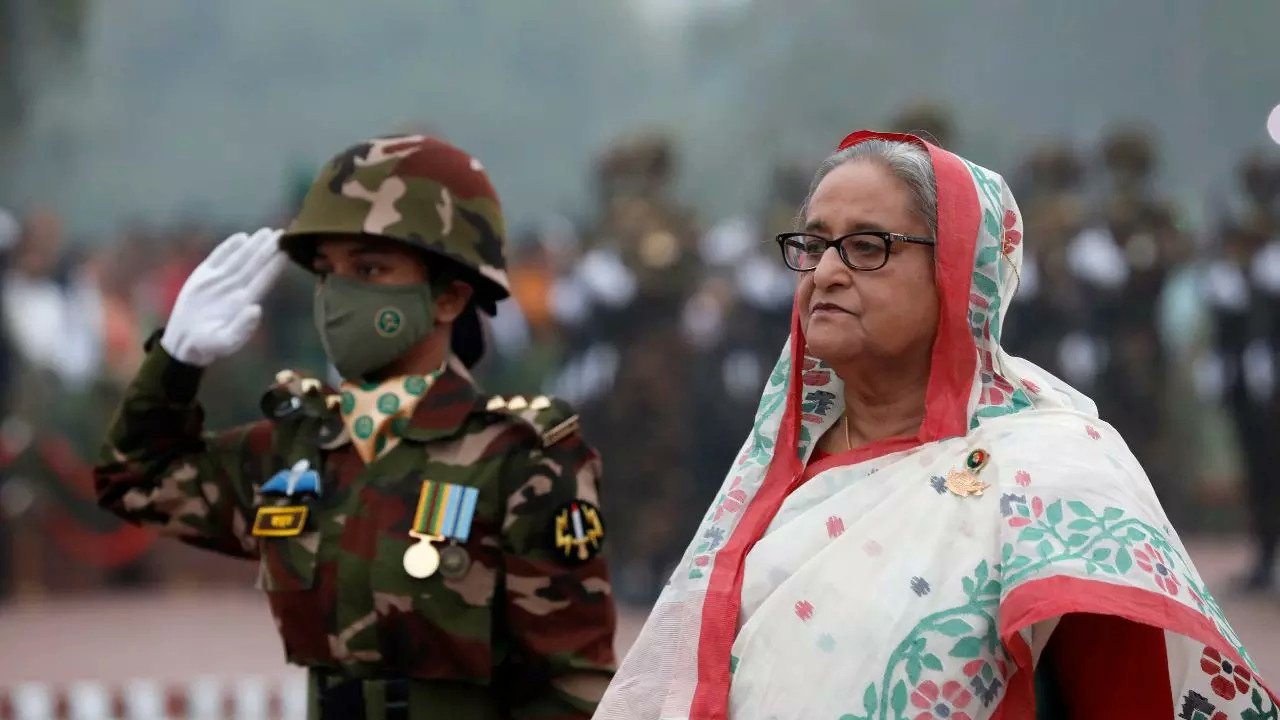
Former Prime Minister Sheikh Hasina has sharply criticised the post-August 2024 situation in Bangladesh, highlighting political persecution, a measles outbreak that has killed more than 1,250 children, violence against women and girls, economic hardship, and what she described as a resurgence of extremism.
She was speaking at a virtual address on Monday at an online seminar titled “Bangladesh at a Turning Point: Democracy, Human Rights, and Extremism,” organised by the Global Center for Democratic Governance (GCDG).
Addressing the gathering, Hasina said she had watched “with great pain” developments in Bangladesh for more than two years. She claimed democratic rights are under threat, political persecution continues, law and order have deteriorated, and ordinary people are suffering.
She singled out the situation of women and children, citing a human rights report that 253 women and girls were raped between July and September this year, of whom 154 were children, and that 12 victims were killed after being raped.
She described a “terrible health crisis,” stating that more than 1,250 children have died of measles since March.
Hasina contrasted this with the extensive immunisation system under her government, which she said substantially reduced child mortality, and called the deaths from a preventable disease “heartbreaking.”
On the economy, she said hundreds of factories have closed over the past two years, leaving thousands unemployed, including women who depended on their earnings.
Extortion, violence, and insecurity have made ordinary life difficult, she added, and even speaking out can bring punishment. She pointed to the recent arrest of a woman entrepreneur in Mymensingh (identified in local reports as Sathi Akter) after she criticised the government on social media over repeated thefts at her business, asking: “What kind of democracy sends a woman to prison for expressing her frustration?”
Hasina defended her government’s record, citing poverty reduction from 41% to 18.6%, the establishment of around 14,000 community clinics, expanded girls’ education, stronger women’s rights policies, and improved maternal and child healthcare, along with broader gains in electricity, education, and women’s employment and public participation.
She recalled the 1997 Chittagong Hill Tracts peace accord, Bangladesh’s sheltering of Rohingya refugees fleeing Myanmar in 2017, and a policy of zero tolerance toward terrorism.
She expressed concern that extremist groups are regaining influence while experienced counter-terrorism officers have faced prosecution and imprisonment, warning that this threatens Bangladesh’s secular foundation and regional security.
Hasina accused the current authorities of denying the Awami League—the party that led the 1971 liberation war—its normal political rights, with thousands of its leaders and workers arrested, attacked, or forced into hiding.
She said persecution now extends to freedom fighters, religious minorities, journalists, lawyers, cultural activists, and ordinary citizens.
She alleged a systematic campaign using AI-generated images, fabricated stories, graffiti, and school textbooks to destroy her reputation and discredit her government’s achievements, questioning how quickly and widely such materials appeared.
On the July–August 2024 events, she rejected the figure of 1,400 deaths used to hold her and her government responsible and denied ordering the killing of innocents. She noted that on 18 July 2024 she established a judicial inquiry commission headed by a High Court judge, expanded it on 1 August into a three-member commission, but said Muhammad Yunus’s administration later stopped the inquiry.
She cited Yunus’s reported description of the movement as “meticulously designed” as raising questions about organised forces behind the protests, killings, arson, and destruction. She questioned why the inquiry was halted, why participants received legal protection for acts classified as political resistance, and why murder cases were brought against her and Awami League figures instead.
Referring to the 1975 assassination of her father Bangabandhu Sheikh Mujibur Rahman, her mother, brothers, and most of her family, as well as her own imprisonment and assassination attempts, she said she knows the pain of political violence and would never wish it on others. Those experiences, she said, strengthened her determination to stand with the people of Bangladesh for justice, peace, and democracy.
Hasina appealed to the United Nations, European Union, democratic governments, and human rights organisations to end political persecution, release political prisoners, withdraw restrictions on the Awami League, restore freedom of speech and peaceful political activity, and ensure equal protection for women, children, and religious minorities.
She called for independent justice, action against violent extremism, and a genuinely inclusive democratic process.
She concluded by expressing her desire for a Bangladesh where mothers no longer fear for their children’s safety, women can work and live with dignity, and citizens can speak freely without fear of arrest—the Bangladesh she said she has worked for throughout her life. She ended with “Joy Bangla, Joy Bangabandhu. May Bangladesh live forever.”