


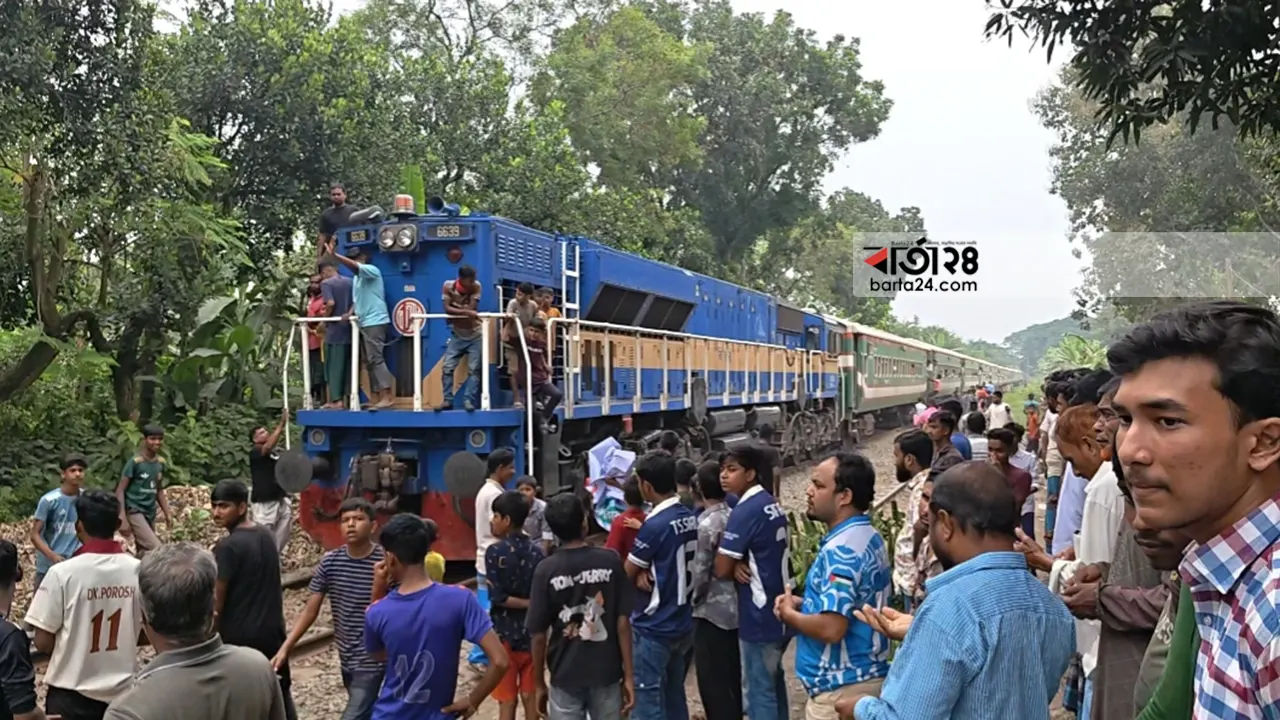
Local residents in Jibannagar upazila of Chuadanga have been protesting by blocking the railway line with a three-point demand, including the full operation of Ansarbaria Railway Station.
On Wednesday (4 November) at 10:13 am, they stopped the Rupsha Express (bound for Rajshahi from Khulna) and began the programme. As a result, direct train communication between Dhaka and Khulna has been suspended.
A railway delegation from Chuadanga reached the spot after learning of the pre-announced blockade. However, the protesters have declared that they will continue the movement until their demands are met.
The three-point demands include: fully operationalising Ansarbaria Railway Station with the appointment of at least two station masters and necessary staff; infrastructure development of the station including a modern platform, waiting room and other facilities; and ensuring up-and-down stoppages of intercity trains on the Dhaka-Khulna and Khulna-Rajshahi routes.
Present at the blockade were Jibannagar Upazila BNP President Anwar Hossain Khan Khokon, Upazila Jamaat-e-Islami Nayeb-e-Ameer Sakhawat Hossain, Abdulbaria Union BNP President Atiyar Rahman, Andulbaria Union Jamaat-e-Islami Amir Harun-or-Rashid, and people from various walks of life.
Chuadanga Railway Station Master Mizanur Rahman said locals have been holding the Rupsha Express for about three hours over the demand to open Ansarbaria station. This has disrupted rail links between Khulna and other parts of the country. Passengers who came to the station for various destinations are waiting. Besides delays in normalising train movement, there is a risk of disruption to the overall railway schedule.
Meanwhile, passengers have faced extreme hardship due to the train being stuck for a long time. Unable to reach their destinations on schedule, many expressed anger.
This specific report concerns a local demand-based rail blockade in Chuadanga (far from Dhaka’s main industrial belts). It has already caused clear public suffering: passengers stranded, schedules disrupted, and widespread frustration.
Separately, ongoing RMG (ready-made garment) wage protests in and around Dhaka (Mirpur, Ashulia/Savar, Gazipur, Narayanganj and nearby areas) have been causing broader public hardship for several days. Workers demanding a minimum monthly wage of Tk 30,000 have blocked major highways (including Dhaka-Tangail and others), leading to factory closures (hundreds reported), traffic gridlock, clashes with police, and significant inconvenience for ordinary commuters, travellers and residents in those districts. Security forces have been deployed, and some metro services have been affected.
In short, both the Chuadanga rail action and the RMG road blockades illustrate how protests are imposing severe disruption and suffering on the general public through halted transport and delayed journeys.