


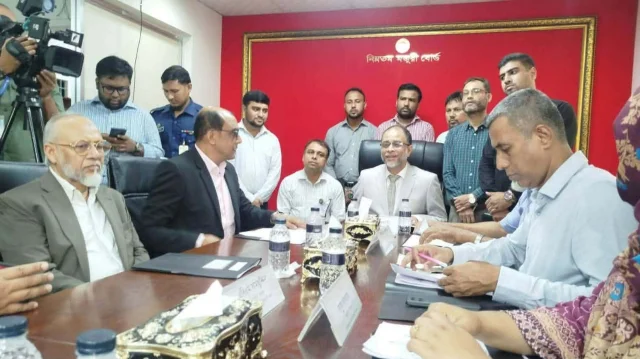
Workers and employers’ representatives on Bangladesh’s Minimum Wage Board for the ready-made garment (RMG) sector agreed at their first meeting on Wednesday to finalise a new wage structure by December, with workers set to receive revised salaries from January.
The meeting, held at the board’s office in Segunbagicha, Dhaka, was chaired by the newly appointed chairman, Syed Azad Subhani, a District and Sessions Judge previously serving at the Child Violence Prevention Tribunal in Pirojpur.
Subhani replaced Sheikh Ashfakur Rahman, who was transferred the same day to the post of Director (Training) at the Judicial Administration Training Institute under a Law and Justice Division notification.
Speaking to reporters after the meeting, workers’ representative Babul Akhter said both sides had reached consensus on the timeline. “The new wage structure will be determined by December, and workers will receive their salaries under the new structure from January,” he stated.
He urged garment workers to end ongoing protests and return to factories, emphasising that continued agitation would disrupt production and that maintaining a normal industrial environment was everyone’s responsibility.
Employers’ representatives expressed similar optimism, confirming there was no hesitation about completing the process within the agreed timeframe.
The board, formed by the government on November 1 amid widespread labour unrest, is tasked with recommending a revised minimum wage structure. Workers have been demanding an increase from the current Tk 12,500 to Tk 30,000 per month, citing rising living costs, while also calling for an end to blacklisting and unjust layoffs. Protests have disrupted production and led to clashes and road blockades in industrial areas including Mirpur, Gazipur, Savar, and Ashulia.
While the first meeting produced agreement on the timeline, the actual wage amount remains undecided. The board’s second meeting is scheduled for next week, when both sides will submit written proposals.
Chairman Subhani said the board would avoid the prolonged delays of previous wage reviews and would seek a swift decision that balances workers’ legitimate dues with the overall condition of the industry.
Board members expressed hope that timely finalisation of the structure would reduce worker discontent and restore normal production in the RMG sector, Bangladesh’s largest export industry. The six-member board also includes independent member Professor Mosleh Uddin Ahmed of Dhaka University, along with employer and worker representatives.