


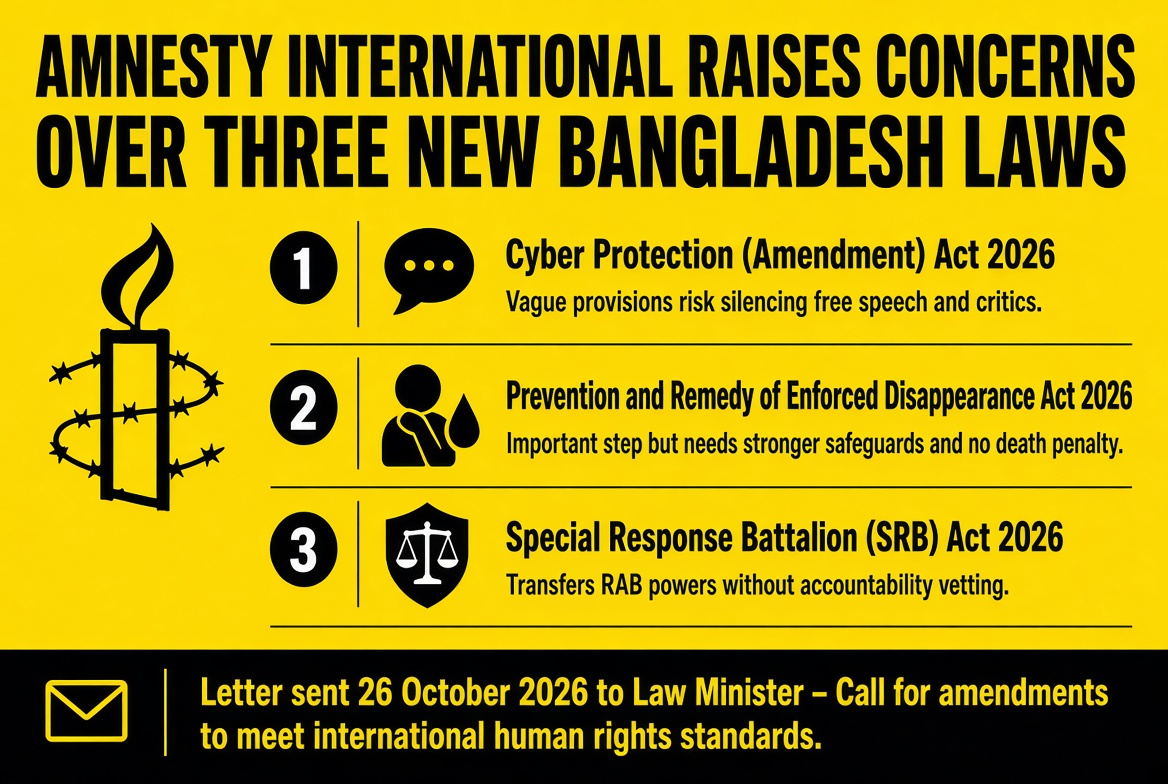
London-based Amnesty International has urged Bangladesh’s government to withdraw a proposed cyber law amendment and revise two recently enacted statutes to bring them into line with international human rights standards.
In a letter dated October 26, 2026, to Law, Justice and Parliamentary Affairs Minister Md Asaduzzaman, the organization detailed concerns over the Cyber Protection (Amendment) Act, 2026; the Prevention and Remedy of Enforced Disappearance Act, 2026; and the Special Response Battalion (SRB) Act, 2026.
The letter, signed by Amnesty’s South Asia Regional Director Smriti Singh, followed a September meeting between Amnesty Secretary General Agnès Callamard and the minister on the sidelines of the UN General Assembly. Amnesty framed the intervention as constructive engagement amid Bangladesh’s post-2024 reform efforts, which include ratification of the International Convention for the Protection of All Persons from Enforced Disappearance.
Cyber Law Amendments Risk Free Speech Restrictions
Amnesty expressed the strongest objections to the proposed Cyber Protection (Amendment) Act, 2026. It warned that the measure expands powers for the Ministry of Information and Broadcasting and other agencies to block or remove online content on broad grounds including threats to national security or public order, incitement of religious or communal hatred, defamation, and “disrespect to the state.” Terms covering “false, distorted, misleading, insulting or harmful” information were described as insufficiently precise.
The organization further criticized the removal of a requirement for tribunal approval within three days to continue content restrictions, shifting the burden onto individuals seeking restoration. Expanded criminal offences related to defamation, bullying, disinformation, and rumours—carrying penalties of up to 10 years’ imprisonment and fines of Tk 4 million—were said to fall short of requirements for legality, necessity, and proportionality under international law. Amnesty noted that earlier statutes, including the Information and Communication Technology Act 2006, Digital Security Act 2018, and Cyber Security Act 2023, had been used to restrict expression, and called for the amendments to be withdrawn entirely.
Enforced Disappearance Law Welcomed but Incomplete
Amnesty welcomed the Prevention and Remedy of Enforced Disappearance Act, 2026, as an important step after Bangladesh’s 2024 accession to the relevant international convention. However, it identified multiple gaps. A provision permitting authorities to withhold information about an arrest, location, or condition on national security grounds (provided the person is produced before a magistrate within 24 hours) was deemed inconsistent with international standards and should be removed.
The organization opposed retention of the death penalty and urged a moratorium en route to full abolition. It also called for stronger command responsibility so that superiors face accountability for failing to investigate or report suspected cases; independent investigations free from institutional conflict of interest; elimination of short fixed timelines (90–120 days) that risk compromising complex cases; and removal of a clause criminalizing “false and vexatious” reports with up to five years’ imprisonment, which could deter families from coming forward. Additional concerns covered the definition of a victim and provisions allowing trials in absentia.
SRB Act Seen as Rebranding of RAB Without Accountability
On the Special Response Battalion Act, 2026, Amnesty noted that the measure dissolves the Rapid Action Battalion (RAB) while transferring its personnel, powers, assets, and operational framework to the newly named force under the police without independent human rights vetting. RAB has faced long-standing credible allegations of extrajudicial killings, enforced disappearances, torture, and excessive use of force; the force and several leaders were sanctioned by the U.S. Treasury Department in 2021.
Amnesty argued that specialized units with such a history should not simply inherit broad powers of search, seizure, arrest, and investigation. It questioned the independence of the grievance redress mechanism, which includes senior SRB and government officials, and recommended that credible allegations of violations be referred for prompt, independent criminal investigation. Overall, the organization stated that ordinary police functions subject to effective civilian oversight would better serve accountability.
Amnesty has called on the government to amend the disappearance and SRB laws and withdraw the cyber amendments so that Bangladesh’s legislative framework fully meets its international obligations. The letter was publicized by Amnesty’s South Asia office on November 2.
No immediate response from the Ministry of Law has been reported. The interventions come as Bangladesh continues institutional reforms following political transitions and commitments to address past patterns of enforced disappearance and restrictions on expression.