


Attacks Follow Religious Defamation Allegation; Two Arrested as Awami League Demands Justice and Stronger Protection for Minorities
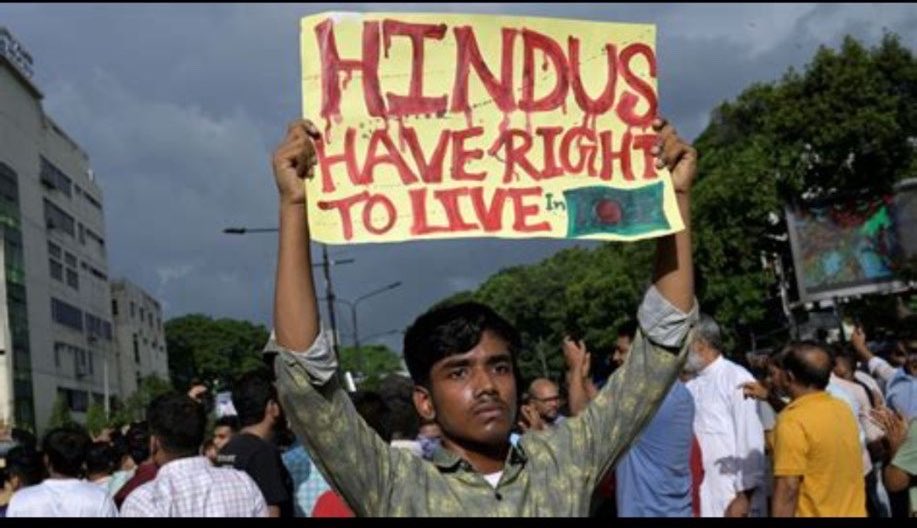
The reported attack on three Hindu households in Pirganj, Rangpur district, on Monday evening, 26 October, has renewed concerns over the security of religious minorities, the spread of religiously charged accusations, and the effectiveness of law enforcement in Bangladesh. The incident has also revived longstanding demands for stronger constitutional safeguards, equal citizenship and accountability for communal violence, amid continuing political tensions following the change of government in August 2024.
According to reports, the violence occurred in Chak Karim (Telipara) village after allegations circulated on Facebook that a video mocking Islam had been posted by a 22-year-old Hindu youth, Sourav Chandra Mahanta, son of Bishu Chandra Mahanta.
Following the circulation of the allegations, a group of people allegedly attacked three Hindu households, including the home of the young man accused of posting the video. The attackers reportedly damaged homes, smashed furniture and two televisions, and caused damage to kitchens and other structures. One affected resident also alleged that three goats and other household belongings were stolen.
Jagadish Chandra Mahanta told local sources that a group attacked his home after the Maghrib evening prayers. Because the electricity supply had been interrupted, residents could not identify the attackers. Another affected resident, Dinesh Chandra Mahanta, described the destruction of household property and alleged theft.
The attacks spread fear among residents. More than 100 police personnel were deployed to maintain order and prevent further violence.
Rangpur Superintendent of Police Mohammad Mozammel Haque, Pirganj Upazila Executive Officer Abdullah Al Bakiul Bari, District Council Administrator Saiful Islam and local BNP leaders reportedly visited the affected area. Authorities said the situation had been brought under control.
Two Separate Cases and Two Arrests
Police registered two separate cases following the incident. One concerned the allegation of religious defamation, while the other concerned the attacks, vandalism and alleged looting.
The case concerning the attacks reportedly names eight individuals and lists another 60–70 unidentified people as accused. Police subsequently arrested Shafiqul Islam in connection with that case.
Separately, a complaint concerning alleged religious defamation was filed by Aminul Islam Dafadar, a resident of Mokimpur village. District detective police arrested the young man accused in that case during an operation in Bogura district.
Pirganj Police Station officer-in-charge Nazmul Haque confirmed the two arrests and said both individuals had been sent to court on Tuesday, 27 October.
The allegations remain subject to investigation and judicial determination. The available reports do not establish the guilt of either arrested individual, nor do they establish that the person accused of posting the video was responsible for the violence that followed.
The distinction is essential: an allegation of religious defamation must be investigated through lawful procedures, while anyone responsible for violence, intimidation, vandalism or theft must likewise face an impartial investigation and due process.
No allegation of religious offence can provide a lawful justification for mob violence or collective punishment.
Awami League Condemns the Attacks and Demands Accountability
In a statement published on its official social media account, the Bangladesh Awami League portrayed the Pirganj incident as part of a wider pattern of intimidation and persecution affecting religious minorities.
The party alleged that politically motivated religious accusations and misleading online content were being used to provoke attacks against Hindu communities. It attributed responsibility to elements associated with the BNP–Jamaat political camp and described the incident as part of a broader threat to Bangladesh’s secular and pluralistic traditions.
The Awami League called for those responsible for the attacks and alleged looting to be identified, arrested and brought to justice. It also demanded the recovery of stolen belongings and stronger action to protect minority communities.
The party’s statement invoked the atrocities committed during Bangladesh’s 1971 Liberation War, drawing a historical parallel between past persecution and contemporary concerns about religious intolerance and minority security.
These claims represent the Awami League’s political position and require independent verification. The supplied news reports do not establish that the BNP, Jamaat-e-Islami or any particular political organisation directed or organised the Pirganj attacks. The reported presence of local BNP leaders at the scene does not, by itself, demonstrate involvement in the violence.
Nevertheless, the incident raises legitimate questions about whether the authorities are adequately protecting vulnerable communities, whether those responsible for communal violence are being held accountable, and whether preventive measures are sufficient to stop rumours and religious accusations from escalating into attacks.
The essential demand is not merely for arrests after violence has occurred, but for a system in which every citizen can rely on the law for protection regardless of religious identity or political affiliation.
Minority Security Under Scrutiny
Bangladesh’s political transition in August 2024 intensified public debate about the security of religious minorities and the capacity of law enforcement agencies to prevent communal violence.
Since the transition, concerns have been raised about attacks, threats, vandalism and intimidation affecting minority communities. Political actors, including the Awami League, have accused the BNP–Jamaat camp and radical Islamist elements of contributing to an environment in which minorities are increasingly vulnerable.
Such allegations must be examined against independently documented evidence. Establishing whether persecution has increased, identifying recurring patterns and determining political or institutional responsibility require reliable incident records, police data, court proceedings and credible human-rights investigations comparing conditions before and after August 2024.
At the same time, the need for effective protection does not depend on proving the claims of any particular political party. An attack on a minority household warrants a serious investigation in its own right.
The broader concern is that religious minorities may become especially vulnerable when political instability weakens public confidence in law enforcement, inflammatory allegations circulate rapidly on social media, or crowds believe they can impose punishment outside the judicial system.
Where religious accusations are used to mobilise violence, authorities must investigate both the original allegation and the subsequent attacks. Neither should be used to excuse, obscure or displace accountability for the other.
Longstanding Demands for Constitutional Protection and Equal Citizenship
The Pirganj incident highlights longstanding demands by Bangladesh’s Hindu, Buddhist, Christian and other minority communities for effective protection, equal treatment under the law, security of property and the freedom to practise their religions without intimidation.
Bangladesh’s Constitution already contains important guarantees relevant to these concerns.
Article 27 establishes equality before the law and equal protection of the law.
Article 28 addresses discrimination by the state on grounds including religion, subject to the Constitution’s provisions.
Article 31 guarantees protection of the law and requires treatment in accordance with law.
Article 41 protects freedom of religion, including the right to profess, practise or propagate a religion, subject to constitutional limitations.
Article 2A establishes Islam as the state religion while also providing for the equal status and equal rights of other religions in the practice of their respective religions.
These provisions establish an important constitutional framework. The continuing challenge is ensuring that constitutional guarantees translate into effective protection in communities where residents may face threats, intimidation or communal violence.
Minority advocates have long called for stronger implementation of these guarantees, equal access to justice, impartial investigations and accountability for perpetrators regardless of their political connections.
Their concerns extend beyond the immediate danger of physical attacks. They also include land grabbing, unlawful dispossession, destruction of property, threats designed to force families to abandon their homes, and the vulnerability of religious institutions during periods of political or communal tension.
The alleged looting in Pirganj underscores why protection must include property rights and practical remedies. The affected families need the damage to their homes documented, stolen belongings recovered where possible, and access to appropriate legal remedies and compensation for established losses.
Protection must also extend to witnesses and complainants who may face intimidation for cooperating with investigators.
Constitutional rights cannot be meaningful if citizens are unable to rely on the state to protect their lives, homes, property and religious freedom.
Preventing Mob Violence
The Pirganj incident also demonstrates the dangers associated with inflammatory claims circulating on social media.
According to the reports, allegations concerning a Facebook video preceded the attacks. The available information does not independently establish the video’s authenticity, its precise content or the circumstances in which it was created and circulated.
Authorities should therefore investigate the original content, establish the facts and identify the individuals responsible for any unlawful conduct.
At the same time, they must act against those who organise, incite or participate in attacks against individuals or communities.
A credible response requires several complementary measures: verification of disputed online content, timely communication to counter demonstrably false rumours, preventive protection when credible threats emerge, and impartial prosecution of those responsible for violence.
The law must protect freedom of religion while ensuring that allegations of religious offence are not used as a pretext for extrajudicial punishment.
These principles are equally important in cases involving members of any religious community. Equal protection requires consistent enforcement rather than selective intervention based on political pressure or religious identity.
Beyond Police Deployment: The Need for Institutional Accountability
The deployment of more than 100 police personnel in Pirganj may help prevent further immediate violence. However, restoring order is only the first step towards justice.
A comprehensive response should establish who organised and carried out the attacks, whether any individuals encouraged the violence, what property was taken or destroyed, and whether the authorities received advance warnings that could have enabled them to intervene earlier.
If evidence indicates negligence, deliberate inaction or political interference by public officials, those allegations should also be investigated through appropriate procedures.
The government should ensure that the affected families receive protection, that stolen property is recovered where possible, and that those responsible for violence are prosecuted through fair and transparent proceedings.
More broadly, Bangladesh would benefit from stronger institutional mechanisms for monitoring communal violence, publishing reliable information about investigations and prosecutions, providing legal assistance to victims, and examining allegations of official negligence.
Such mechanisms should operate independently of partisan interests and apply equally to all communities.
A durable minority-protection framework must also ensure that security does not depend on whether an incident attracts national attention or whether the victims belong to a politically influential group.
The Awami League’s Demands and the Broader Minority Rights Agenda
The Awami League’s demands for arrests, prosecution and the recovery of stolen property address important aspects of the immediate incident. Its wider warnings about minority persecution also raise questions that merit examination through reliable evidence.
However, a lasting solution requires a broader agenda that extends beyond partisan accusations.
The immediate priorities in Pirganj should be to establish the facts, protect the affected families, investigate the attacks and alleged looting, and ensure that the separate religious-defamation allegation is handled lawfully.
The longer-term priorities are equally important: effective enforcement of constitutional protections, impartial law enforcement, secure property rights, protection against religiously motivated intimidation, and accountability for anyone who organises or participates in communal violence.
These measures should apply regardless of whether alleged perpetrators are affiliated with the BNP, Jamaat-e-Islami, the Awami League, another political organisation or no political party.
Similarly, allegations of negligence by government officials must be examined on their merits rather than dismissed or accepted according to political affiliation.
The protection of minorities should not become a privilege granted by the party in power or a weapon used by political opponents. It must be a consistent responsibility of the state.
Equal Citizenship Must Be Enforced, Not Merely Promised
The reported attack on three Hindu households in Pirganj is a reminder that religious minorities require more than expressions of sympathy after violence occurs. They need dependable protection, effective access to justice, security of property and confidence that their constitutional rights will be upheld.
The incident also presents the authorities with an opportunity to demonstrate that allegations of religious offence will not be allowed to legitimise mob violence, and that those responsible for attacks will face the law regardless of their political or religious affiliations.
The Awami League has demanded accountability and stronger protection for minorities. Those demands should be assessed through the evidence and pursued within a broader framework of equal citizenship, constitutional enforcement and institutional responsibility.
For Bangladesh’s religious minorities, the central questions remain whether they can live safely in their homes, practise their faith without fear, retain their property and seek justice when their rights are violated.
The ultimate test of Bangladesh’s commitment to constitutional democracy is whether every citizen—regardless of religion, ethnicity or political affiliation—can depend on the state for equal protection under the law. Minority protection is not a partisan concession. It is a constitutional responsibility.