


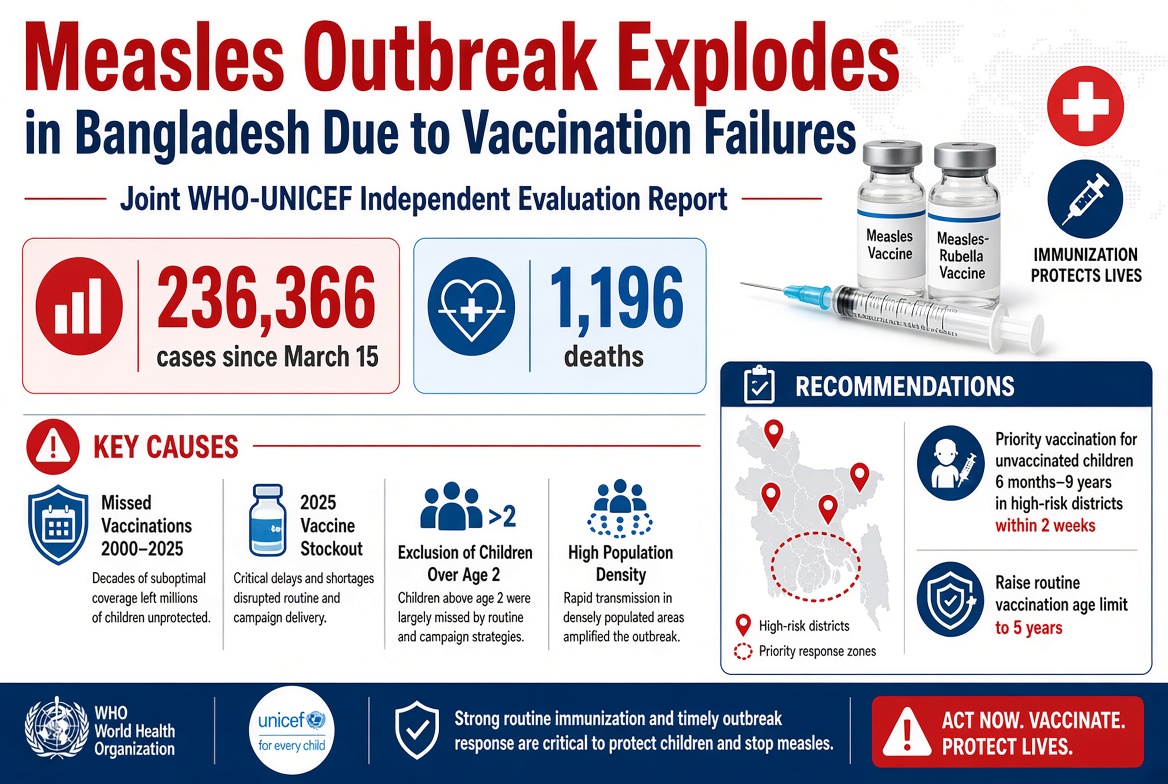
A joint independent evaluation team—formed with representatives from the World Health Organization (WHO), UNICEF, the international platform for vaccine procurement and distribution, along with local public health experts and government officials—has said that the measles outbreak in Bangladesh has exploded due to failures in vaccination.
The explosion occurred because a large number of children were left out of vaccination between 2000 and 2025, the measles-rubella vaccine stock ran out in 2025, and children over two years of age were excluded from routine vaccination. In addition, the country’s high population density and inadequate response to the outbreak have allowed it to reach this stage.
This year’s measles outbreak began in March and shows no signs of ending. The government had assumed it could bring the situation under control through vaccination. The national measles-rubella vaccination campaign that started on 5 April ended on 20 May. Afterward, the health department continued vaccinating children missed during the campaign alongside routine immunization, yet measles has not come under control. In this situation, public health experts consider the recommendations of the joint independent evaluation team especially important.
A press release issued yesterday by the Integrated Control Center of the Directorate General of Health Services stated that in the last 24 hours (from 8 a.m. Saturday to 8 a.m. Sunday), seven children died with measles symptoms. During the same period, 1,319 children arrived at hospitals with measles or measles symptoms. From 15 March until now, a total of 236,366 patients have come to hospitals with measles or measles symptoms.
During this period, 1,196 children have died from measles symptoms or confirmed measles.
The recommendations further include the immediate priority-based vaccination of left-out children in districts with high infection rates in order to reduce the outbreak. The age limit for routine vaccination of children should be raised to five years. Planning for the next national measles-rubella vaccination campaign must also be completed on schedule.
The joint independent evaluation team has issued a series of such recommendations to combat the measles outbreak in the country. The 70-member team, comprising national and international experts, was formed as part of the review of the Expanded Programme on Immunization (EPI) and vaccine-preventable disease surveillance. The evaluation was presented at a workshop held last Wednesday at the Sonargaon Hotel in the capital.
To combat the measles outbreak, the joint independent evaluation team has recommended priority vaccination of unvaccinated children aged six months to nine years. It has called for priority to be given to districts with high numbers of infections and unvaccinated children, and has recommended that this activity be implemented within two weeks.