


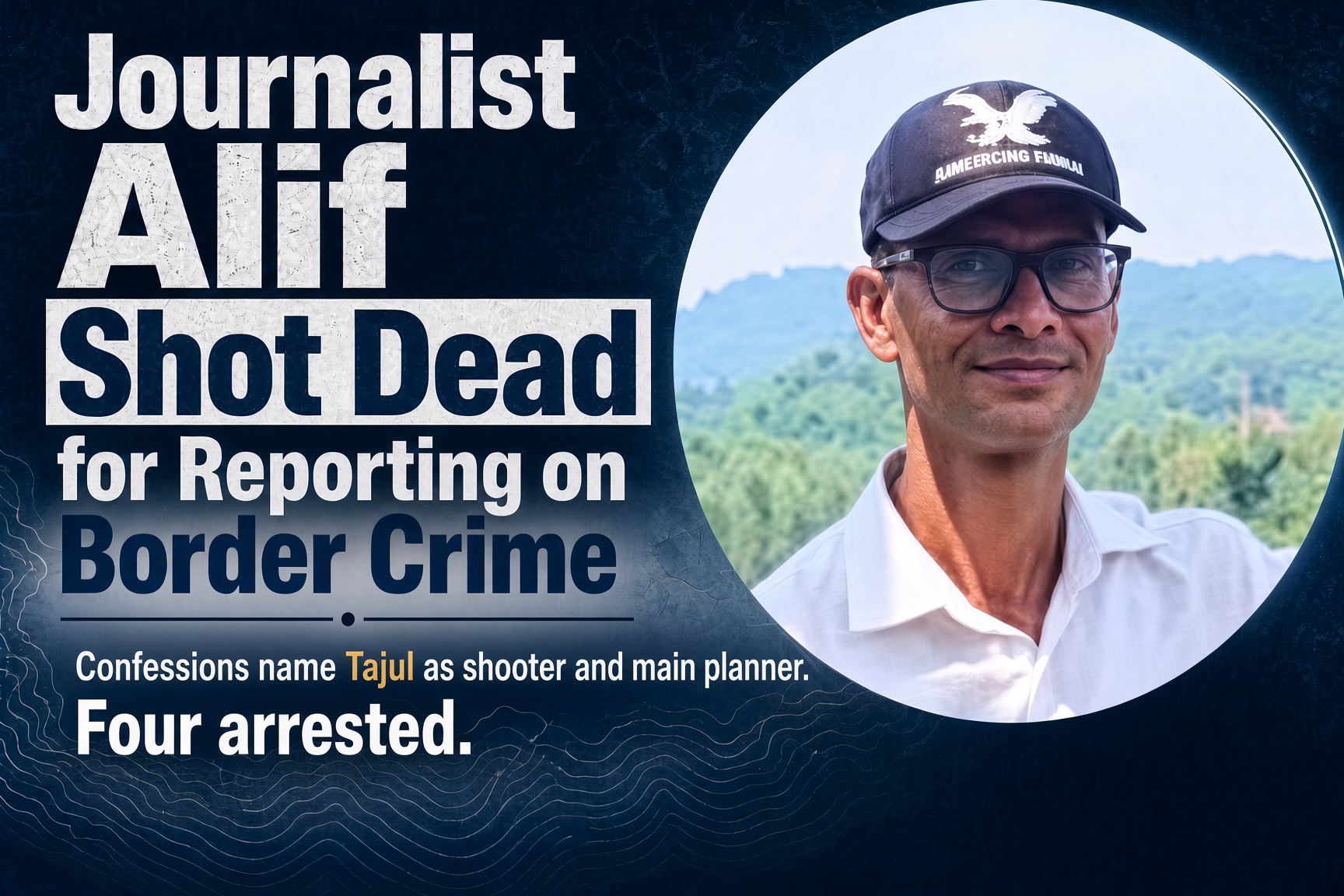
In the murder case of journalist Lutuzzaman Alif in Durgapur, Netrakona, two accused have given confessional statements in court. They said that Tajul Islam is the main planner of the killing. Five people took part directly, and among them Tajul shot Alif with a pistol. Police provided the details citing the statements.
On Sunday afternoon, Imran Islam alias Imon, 24, and Sabbir Ahmed, 25, recorded confessional statements under Section 164 before Senior Judicial Magistrate Nurul Amin Bhuiyan at the Durgapur Chowki Court. Recording began around 3:45 pm and continued until 7 pm. The magistrate later ordered both men sent to jail.
Officer-in-Charge of Durgapur Police Station Khandaker Shaker Ahmed told Prothom Alo that the two accused stated there had long been a dispute between Tajul Islam and Alif. The murder stemmed from that dispute. The accused worked as Tajul’s associates and ran various businesses in the border area. Alif obstructed those businesses and passed information to police, which created resentment among them as well.
According to the statements, five people participated directly in the killing. Tajul Islam shot Alif with a pistol. Once they confirmed he was dead and people began to gather, they fled the scene. Names of several others besides Tajul also appeared in the statements. Police are not disclosing those names for now in the interest of the investigation, saying they want to arrest everyone involved.
Police said Tajul faces at least 13 cases involving murder, attempted murder, arms, drugs, explosives, kidnapping, extortion, robbery, theft and other offences. His group is also linked to border smuggling, and he is said to run a local criminal force under his own name. Earlier, Alif’s wife Anondita Sangma (Khadija Akter) had told Prothom Alo that Alif had obtained information about Tajul’s smuggling and arms activities and passed it to RAB. About four years ago RAB, now known as SRB, arrested Tajul.
In the last week of October, the same officer-in-charge said Alif collected information on Tajul’s activities and posted photos and videos of his houses on Facebook. Tajul believed Alif had also given details of weapons in his possession to law enforcement agencies. That grievance had led to an earlier attack on Alif as well.
Alif was shot dead on the night of 15 October in the Telenjia area next to Utrail Bazar on the Shyamganj-Birishiri road in Durgapur upazila. He worked as the Netrakona correspondent for the private channel Ruposhi Bangla and ran a Facebook page called Detective Article, where he published investigative reports on smuggling, crime, and irregularities along the border. The day after the murder, his wife filed a case at Durgapur Police Station naming seven to eight unidentified people as accused.
On Saturday morning a district detective police team arrested Imran and Sabbir from the Dhanpur Bazar area of Bishwambharpur upazila in Sunamganj. That brings the total number of arrests in the case to four. Sajibul Islam, alias Apurbo, was arrested on 18 October, and Ashikur Rahman, alias Prangan, on 20 October. Netrakona Superintendent of Police Tarikul Islam said the investigation has advanced considerably, and police are now confident about who else was involved. He expects further arrests soon and said a press conference will follow once they are in custody.
Meanwhile, Alif’s wife, Anondita Sangma (Khadija Akter), has joined a private hospital in Dhaka’s Dhanmondi area as a nurse. The job was arranged by Qaiser Kamal, the Member of Parliament for Netrakona-1 (Kalmakanda-Durgapur) and Deputy Speaker of the National Parliament. She began work last Thursday and has moved to Dhaka with her two children and mother.
Anondita, who belongs to the Garo community, had a relationship with Alif before their marriage. She converted to Islam at the time of the wedding and took the name Khadija Akter.
he told Prothom Alo by phone on Saturday night that she will never get her husband back, but she wants to see those who shot him dead, orphaned her two children, and left her a widow receive punishment. She wants them hanged.
She added that after the news appeared in Prothom Alo, many people offered help, including one woman who asked for her bank account number. Others also called promising support. Because a job has now been arranged, she said she does not need financial assistance from anyone else for the time being.
The killing of Alif, who reported on border smuggling and crime, comes amid continuing high levels of violence and legal pressure on journalists in Bangladesh since the fall of the Sheikh Hasina government on 5 August 2024.
Transparency International Bangladesh recorded at least 1,073 journalists and media workers subjected to attacks, lawsuits, threats, harassment, detention, or job loss in 476 incidents between 5 August 2024 and 1 November 2025, including 459 attacked, 99 threatened, 70 harassed, 27 detained, six killed, and 189 dismissed or forced to resign.
The Rights and Risks Analysis Group reported 878 journalists targeted from August 2024 to July 2025, a roughly 230 percent increase on the previous year, with 195 criminal cases filed (a 558 percent rise), about 431 facing violence or intimidation, 167 denied accreditation, and 107 subjected to Bangladesh Financial Intelligence Unit inquiries.
An earlier count by the same group for the first eight months put the number targeted at 640.
The Human Rights Support Society documented 1,034 journalists facing repression in 523 incidents from September 2024 to April 2026, including 862 under the interim government (six killed, 402 injured, 94 assaulted, and 105 threatened, with 222 accused in 49 cases and 33 arrested).
Ain o Salish Kendra recorded 381 journalists abused or harassed in 2025 alone. Three was killed by miscreants, four bodies recovered under mysterious circumstances, 118 attacked while working and 123 facing legal cases.
In the first nine months of 2026, the Human Rights Support Society reported 518 journalists targeted in 288 incidents, leaving 297 injured, 87 physically harassed or humiliated, 77 threatened, and 20 detained, while 51 were named in 19 cases under the Cyber Security Act 2026. That figure already approached the full-year total for 2025.
Local monitors and international organisations including the Committee to Protect Journalists and Reporters Without Borders has noted the persistence of physical attacks, threats, cyber-law cases, accreditation denials, and prolonged pre-trial detention of journalists on serious charges linked to the 2024 uprising, often described as lacking credible evidence.
Impunity for attacks remains a central concern, and Bangladesh continues to rank poorly on global press-freedom indices. Alif’s murder is among the more recent killings.