


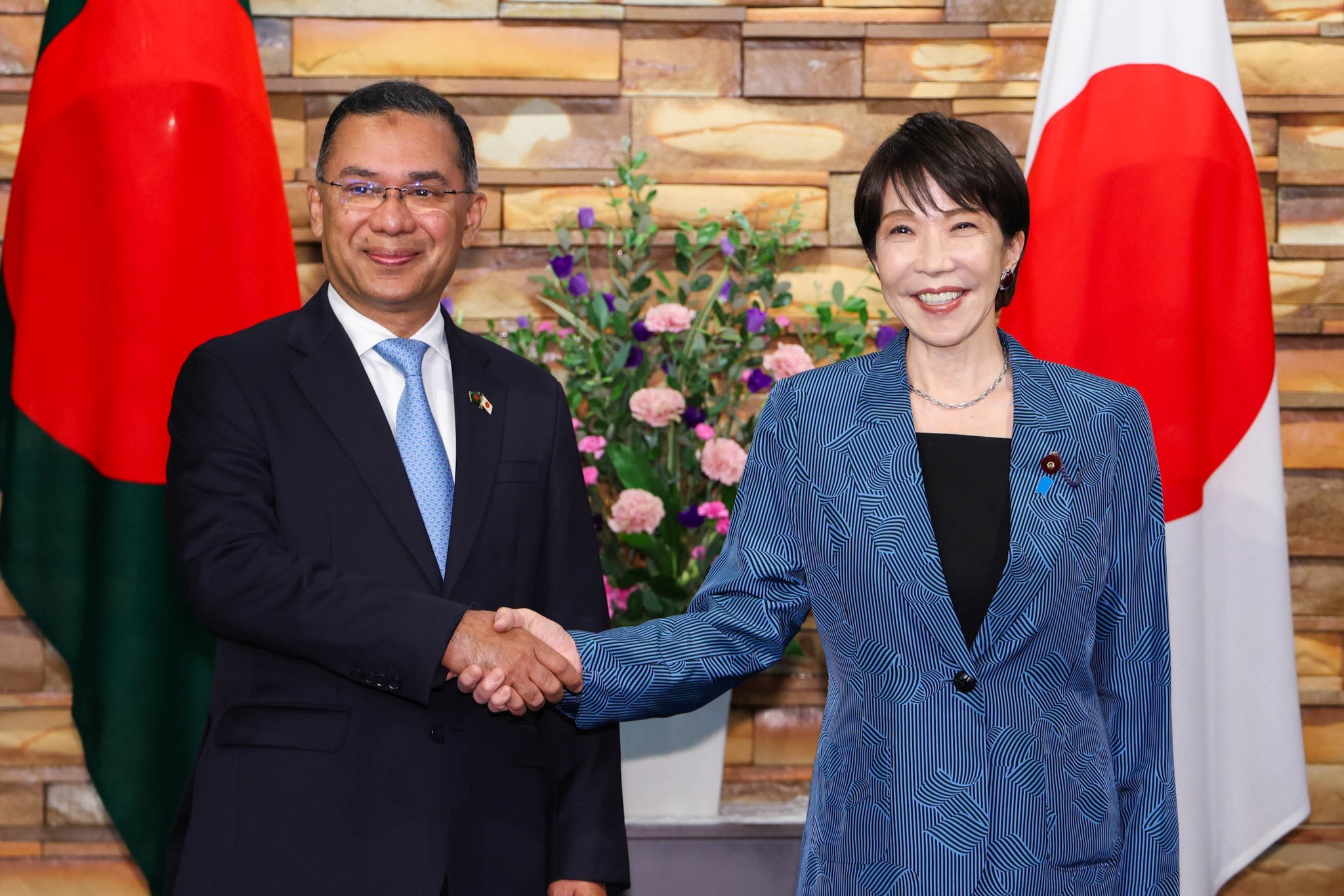
Japan’s decision to deepen its industrial and connectivity footprint in Bangladesh through an upgraded Bay of Bengal Industrial Growth Belt (BIG-B) framework carries clear implications for trade routes, regional influence, and India’s Act East policy.
As outlined in an October 28, 2026, India Today Global assessment, Tokyo has projected roughly $6.36 billion in Japanese private investment over five years following the October 27 summit between two allies of the US—Japanese Prime Minister Sanae Takaichi and Bangladesh’s Prime Minister Tarique Rahman.
The two sides elevated the long-standing BIG-B initiative—originally launched during Sheikh Hasina’s rule in 2014—into “BIG-B for Shared Prosperity,” centering development on the Matarbari-Maheshkhali area and its Japan-backed deep-sea port.
The core logic is straightforward. Matarbari is designed as Bangladesh’s first deep-sea port capable of handling larger vessels, reducing reliance on transshipment hubs such as Singapore or Colombo. Combined with related energy, logistics, and industrial infrastructure, it aims to turn the area into a regional gateway linking South and Southeast Asia. Japanese private capital is expected to target manufacturing, automobiles, energy, and ICT, with estimates of up to 200,000 jobs.
For India, improved Bangladeshi infrastructure could theoretically open more efficient overland or multimodal routes from the Northeast to the Bay of Bengal, supporting Act East connectivity goals that have long been constrained by geography and politics.
Yet the strategic picture is more complicated than infrastructure alone. India-Bangladesh relations have cooled since Sheikh Hasina’s departure in 2024 and the subsequent political transition. Earlier high-level ties under Hasina produced the 2014 Comprehensive Partnership, the 2023 Strategic Partnership upgrade, and substantial Japanese ODA for projects including Matarbari and urban rail—developments previously highlighted by analysts tracking the bilateral relationship. Those foundations persist, but New Delhi now faces a Dhaka government whose priorities and external balancing may differ.
Japan’s emphasis on supply-chain resilience and “freedom of decision” in the joint statement signals an interest in reducing vulnerabilities without necessarily aligning exclusively with any one partner.
This creates a dual-edged outcome for India. On one hand, Japanese investment that expands Bangladesh’s capacity as a trade and logistics node can complement Indian connectivity ambitions if political conditions allow cooperation on cross-border infrastructure, standards, or multimodal corridors. On the other, a more autonomous Bangladeshi hub with significant Japanese commercial presence could reduce New Delhi’s relative leverage in the Bay of Bengal at a moment when India is also managing broader Indo-Pacific competition. Maritime trade competition, energy security, and the Northeast’s economic isolation remain live issues; Japan’s moves accelerate options for Dhaka while leaving the extent of Indian integration dependent on bilateral political will.
The India Today Global framing correctly identifies the open question: whether Japan’s capital and projects function as a bridge that facilitates regional cooperation or as a parallel track that leaves India watching from the sidelines. Realization of the investment projections will depend on Bangladesh’s investment climate, project execution at Matarbari (still targeting later-decade operations), and the evolution of Dhaka’s relations with both Tokyo and New Delhi. In the near term, the upgrade formalizes Japan’s longer-term stake in the Bay of Bengal while underscoring that infrastructure connectivity in the region remains as much a political as a technical challenge.