


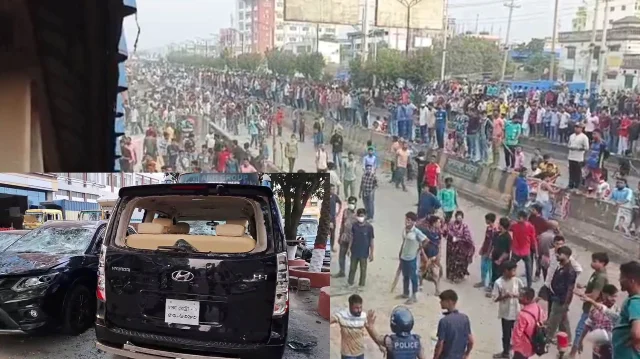
Prime Minister Tarique Rahman held an emergency meeting on Sunday evening at the Secretariat to determine steps for resolving ongoing unrest in the ready-made garment (RMG) sector.
The meeting began at 6 pm at the Prime Minister’s Office and involved the Home Minister, Labour Minister, Labour Adviser, and several parliamentarians and advisors.
The gathering followed a day of protests, road blockades, clashes, vandalism, and arson in Mirpur (Dhaka), Savar/Ashulia, and Gazipur’s Kaliakair, even after the government formed a new wage board earlier in the day.
Labour and Employment Minister Ariful Haque Chowdhury announced the six-member board on Sunday morning. Chaired by Senior District and Sessions Judge Sheikh Ashfaqur Rahman, it includes a neutral member (Professor Mosleh Uddin Ahmed of Dhaka University), employer representatives (including from BGMEA and the Bangladesh Employers’ Federation), and worker representatives (including from Jatiyatabadi Sramik Dal and the Bangladesh Garments and Industrial Workers Federation). The minister urged workers to return to factories and said the board would work quickly to recommend a new pay structure. Workers are demanding a minimum monthly wage of Tk 30,000 (more than double the current Tk 12,500), citing rising costs of food, housing, transport, and healthcare.
Despite the announcement, protests continued. In Mirpur, workers gathered in processions at Mirpur-10 roundabout from around 9 am and blocked roads while demanding the wage hike. Clashes broke out around 11:15 am when police tried to clear the area; workers vandalised nearby shops and the glass of Jamuna Bank. Police used tear gas, sound grenades, and water cannons. By midday in Mirpur-11, protesters broke road dividers, set fire to a police vehicle under the metro rail, and chased a fire service vehicle. Mirpur-10, Mirpur-11, and Pallabi metro stations were closed for about two hours. The situation was brought under control by early afternoon and traffic resumed.
In Ashulia’s Narsinghpur area, workers occupied the Abdullahpur-Baipail road before shifting to one side following requests from industrial police. Factories including Sharmin Group, Ha-Meem Group, and Newage declared holidays. Ashulia Industrial Police Superintendent Mohammad Mominul Islam Bhuiyan reported that over 50 factories in Savar closed due to the unrest.
In Gazipur’s Kaliakair, workers from factories such as Karni Knit Composite and Knit Asia blocked highways near Safipur Bazar. Between 11:30 am and 12:30 pm in the Chandra Palli Bidyut area, a jute godown of a Tropical factory and a pickup van were set on fire. Fire services could not reach the scene promptly because of the protests. At least 30 factories declared holidays. Gazipur Industrial Police Superintendent Amjad Hossain said efforts were continuing to restore order. At least 80 factories across Savar and Gazipur closed in total from the day’s unrest, according to police and local reports; broader BGMEA figures indicated hundreds of closures across industrial belts, leaving large numbers of the sector’s roughly four million workers idle. The RMG industry generates more than 80% of Bangladesh’s export earnings.
Police pointed to possible outside incitement. Dhaka Metropolitan Detective Branch Deputy Commissioner Mohammad Rakib Khan said 11 members of the banned Awami League, Jubo League, and Chhatra League were arrested in Mirpur. These individuals, from districts including Barishal, Patuakhali, Cox’s Bazar, and Gaibandha, were not local factory workers.
Authorities alleged that elements of the banned party and the Jamaat-led opposition alliance were exploiting the wage demand to create instability through violence, attacks on property, and arson.
The Home Ministry warned of strict action against those disrupting public order. Mirpur Deputy Police Commissioner Mohammad Nasher said continued agitation after the wage board announcement suggested possible group instigation.
By around 2 pm the situation in Mirpur had stabilised, with workers clearing the roads. Authorities continued efforts to identify and arrest those involved in vandalism and arson. Border Guard Bangladesh personnel were deployed in Gazipur to help maintain order.
The RMG sector’s importance means prolonged disruption risks delays in export shipments and damage to buyer confidence. The government has stressed that the tripartite wage board is the proper channel for addressing wage demands while insisting on the restoration of industrial peace.