


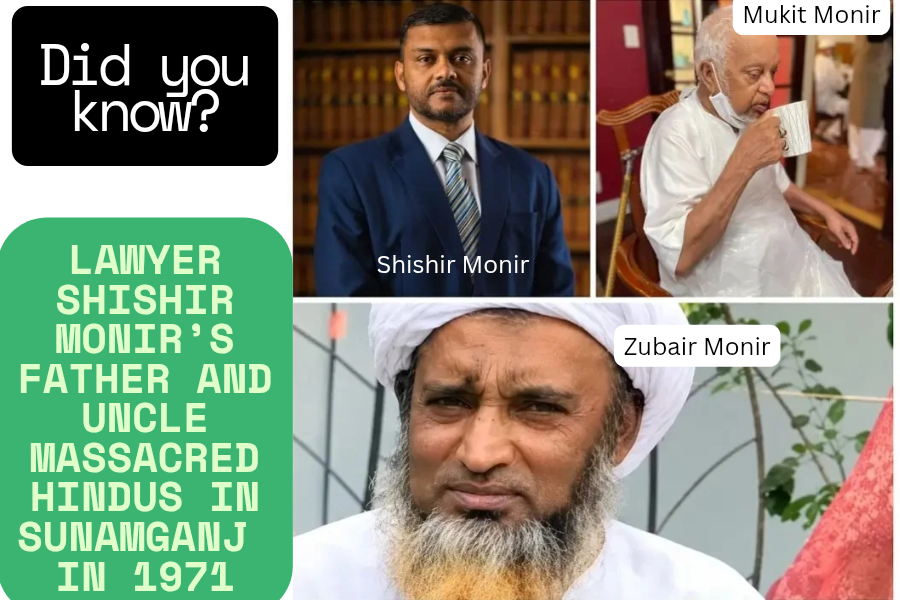
The Daily Star journalist and researcher Ahmad Ishtiaq has alleged that Supreme Court lawyer and former Jamaat-e-Islami candidate Mohammad Shishir Monir’s father and uncle were leading local Razakars responsible for the Perua massacre of Hindus in Sunamganj on 6 December 1971, along with other atrocities including killings, looting, rape, and forced conversions during the Liberation War.
In a detailed Facebook post, he responds to recent comments by Jamaat and Islami Chhatra Shibir supporters claiming that Hindus withhold votes from Jamaat candidates solely because of the party’s name, and that this cost Shishir Monir the Sunamganj-2 seat in the recent election.
Ishtiaq argues the family’s 1971 record explains local Hindu reluctance.
According to the post, on 6 December 1971—when much of Sunamganj was celebrating liberation—local Razakars under the leadership of Abdul Khalek (described as the founder of the local Razakar force and a failed PDP candidate in the 1970 election), his brother Mukit Monir, and Abdul Khalek’s son Zubair Monir rounded up Hindus from surrounding villages in Dirai upazila’s Perua area.
They were gathered on the banks of the Surma River, forcibly converted, and then machine-gunned. Bodies were thrown into the river.
Ishtiaq identifies Mukit Monir as Shishir Monir’s father and Abdul Khalek as his uncle. He further claims the group commanded a force of around 300 Razakars responsible for numerous massacres, lootings, rapes, and forced conversions across Dirai and Shalla.
The post cites testimony by two Biranganas—Jamila Khatun and Sakhi Kulsum Begum—who described atrocities before the International Crimes Tribunal.
After independence, freedom fighters reportedly killed Abdul Khalek; Mukit Monir and Zubair Monir fled.
Cases under the Collaborators Act were filed but the pair were later released. They returned and regained influence.
In 2018, freedom fighter Rojoni Das filed a case; police arrested Zubair Monir and others, while Mukit Monir fled to the United States, according to the post.
Ishtiaq alleges that after the fall of the Awami League government, Shishir Monir became highly influential in the area.
Witnesses and victim families faced harassment and Shibir-linked mob attacks, with many refusing to speak out for fear of retaliation. In the recent election, Shishir Monir lost to veteran BNP leader and freedom fighter Nasir Uddin Chowdhury.
Related reporting supports parts of the account. A 2022 Samakal report noted that two Biranganas testified in a crimes-against-humanity case against Mukit Monir (also known as Mukit Mia) and others, and identified him as the father of Supreme Court lawyer Shishir Monir, a former central secretary-general of Islami Chhatra Shibir.
Wikipedia lists Mohammad Mukit Monir as Shishir Monir’s father. Historical accounts of the Perua (or Peru) massacre on 6 December 1971, including from Songramer Notebook, describe Razakars (linked to Khalek Mia of nearby Daulatpur) killing around 23 people—mostly local Hindus, including teachers, a doctor, and others—after a clash with freedom fighters, with forced conversion preceding the shootings. Some versions place related killings on 15 December.
Shishir Monir, a senior Supreme Court advocate known for representing Jamaat leaders and others in high-profile cases (including before the International Crimes Tribunal), has not issued a public response specifically addressing these family allegations in the material reviewed. He contested the 2026 national election from Sunamganj-2 as a Jamaat candidate and lost. During the election campaign, he made a controversial remark equating Islamic fasting with Hindu Puja festivities.