


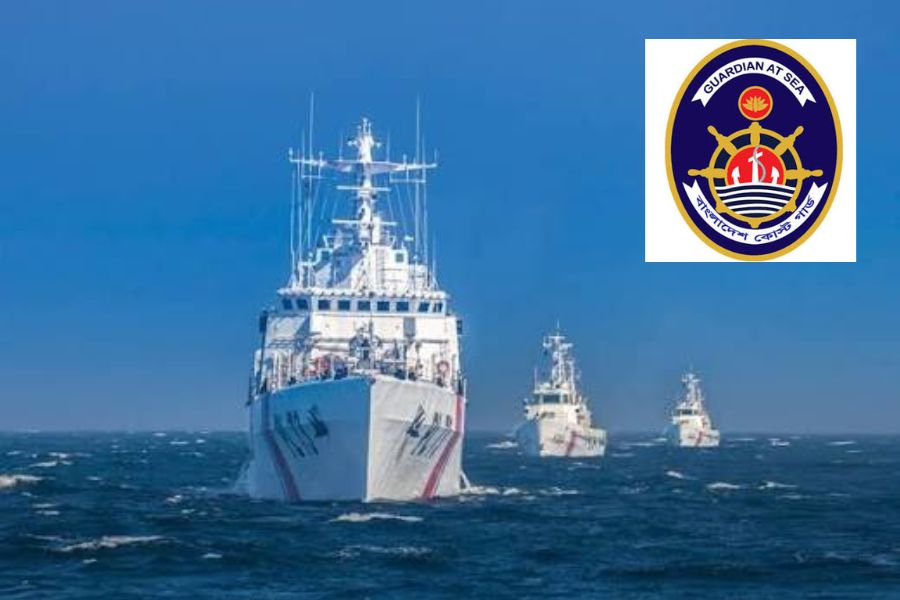
The Bangladesh government has renamed five vessels of the Bangladesh Coast Guard, including one previously called BCGS Joy Bangla and four named after the country’s four national leaders from the 1971 Liberation War.
The new names took effect immediately following a notification issued on Thursday (November 5) by the Border-3 Branch of the Ministry of Home Affairs.
According to the official notification, signed by Senior Assistant Secretary Masfika Hossain, the changes are as follows:
- BCGS Joy Bangla → BCGS Adomya Bangla (অদম্য বাংলা, meaning “Indomitable Bengal”)
- BCGS Syed Nazrul → BCGS Firoz Kabir
- BCGS Tajuddin → BCGS Nurul Islam
- BCGS Mansur Ali → BCGS M Humayun Kabir
- BCGS Kamruzzaman → BCGS Ashraf Siddiqui
The notification states that the renaming was approved by the “appropriate authority.” It does not elaborate on the reasons.
The decision came just two days after Jail Killing Day (November 3), which commemorates the 1975 assassination of the four national leaders inside Dhaka Central Jail. The government suspended the commemoration programmes his year, following the path of the interim government.
Those leaders—Syed Nazrul Islam (acting president of the Mujibnagar government), Tajuddin Ahmad (prime minister), M Mansur Ali (finance minister), and AHM Qamaruzzaman (home affairs, relief and rehabilitation minister)—played central roles in the 1971 Liberation War provisional government.
The four ships bearing their names are Leader-class offshore patrol vessels (pennant numbers PL 71–74), while BCGS Joy Bangla is a Sobuj Bangla-class inshore patrol vessel (PC 208).
A Bangladesh Coast Guard official, Lt Commander Sabbir Alam Suzan (assistant director, intelligence), told The Daily Star that the four new personal names honour naval personnel who died in the line of duty. Firoz Kabir, a lieutenant commander and commanding officer of the vessel Shaheed Farid, died during a severe nor’wester in the Sundarbans. Nurul Islam and Ashraf Siddiqui were killed during anti-smuggling operations, while M Humayun Kabir died in 2006 while fighting pirates in the Sundarbans.
Broader Context of Renamings After the 2024 Changeover
The Coast Guard renamings form part of an Islamization process that began after the August 2024 political changeover, when former Prime Minister Sheikh Hasina resigned and left the country amid mass protests, leading to the formation of an interim government under Chief Adviser Muhammad Yunus.
In March 2025, the Ministry of Defence (under the Chief Adviser) renamed eight military establishments previously named after Sheikh Hasina, Sheikh Mujibur Rahman (Bangabandhu), or associated figures. These included three Bangladesh Navy facilities:
- BNS Bangabandhu (New Mooring, Chattogram) → BNS Khalid Bin Walid
- BNS Sheikh Mujib (Khilkhet, Dhaka) → BNS Dhaka
- BNS Sheikh Hasina (Pekua, Cox’s Bazar) → BNS Pekua
Other changes covered Air Force bases and centres (including BAF Base Bangabandhu renamed after Bir Uttam A K Khandaker), the Sheikh Hasina Complex at the Defence Services Command and Staff College (now DSCSC Complex), and the Bangabandhu Memorial Museum (now Defence Museum).
Shortly afterward, 16 more Bangladesh Army establishments were renamed. Key examples include:
- Bangabandhu Cantonment (Bhuapur, Tangail) → Jamuna Cantonment (or Jamuna Nibas)
- Sheikh Hasina Cantonment (Lebukhali, Barishal) → Barishal Cantonment
- Sheikh Russel Cantonment (Zajira, Shariatpur) → Padma Cantonment
- Various complexes, museums, schools, and units previously named after Bangabandhu, Sheikh Mujib, Sheikh Hasina, Sheikh Russel, or Sheikh Kamal were given neutral or location-based names (e.g., Bangladesh Military Museum, Artillery Centre and School, EBRC Academic Complex).
These steps followed a January 2025 advisory council decision to review and change names of institutions associated with the previous government. Officials have described the process as removing political associations and standardising nomenclature across the armed forces and related services. The Coast Guard moves continue that pattern, shifting from political and Liberation War-era figures to operational martyrs and a non-slogan name for the fifth vessel.
The new Coast Guard names are already being applied to ship markings, flags, logbooks, call signs, and official documents. The vessels continue their roles in maritime security, anti-smuggling, and coastal patrol duties.