


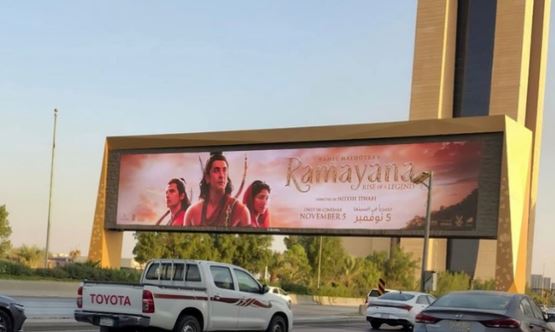
Promotional posters for the Bollywood film Ramayana: Rise of a Legend have appeared on streets and at cinema complexes in Saudi Arabia, drawing mixed online discussion. The two-part epic, directed by Nitesh Tiwari and starring Ranbir Kapoor as Lord Ram, Sai Pallavi as Sita, and Yash as Ravana, is based on the Hindu epic. Advance ticket sales opened at several Saudi cinema complexes ahead of its international theatrical release (reported around early November 2026).
The posters’ public display in the predominantly Muslim kingdom prompted varied reactions. Some social media users questioned the presence of imagery drawn from Hindu mythology in the country that hosts Islam’s holiest sites. Others treated it as routine commercial promotion reflecting the expanding international footprint of Indian cinema.
This fits a broader pattern under Saudi Arabia’s Vision 2030 programme. Since Crown Prince Mohammed bin Salman launched the reforms, the kingdom has reopened commercial cinemas (banned for roughly 35 years until 2018), expanded live entertainment, concerts, and mixed-gender leisure options, and sought to diversify the economy beyond oil by developing tourism, culture, and consumer markets. By the mid-2020s the country operated hundreds of cinema screens and hosted large-scale international events, with household entertainment spending and the sector’s economic contribution growing as explicit targets. Films and promotions continue to face content review so they remain “in line with values and principles” and do not contradict Sharia law and local moral standards, as officials stated when cinemas were re-licensed.
Saudi Arabia remains an absolute monarchy whose legal system is grounded in Sharia, particularly in criminal, family, and personal-status matters. The entertainment openings are framed domestically as economic modernisation and quality-of-life improvements rather than a shift away from Islamic legal foundations.
The appearance of a large-scale Hindu-epic film’s marketing is therefore consistent with the commercial liberalisation of the past decade—opening markets to global content while retaining regulatory oversight aligned with the kingdom’s existing legal and religious framework—rather than evidence of unrestricted cultural change.
The film’s campaign has also drawn notice among Hindu communities outside India, including in Karachi. Overall, the episode illustrates both the practical effects of Vision 2030’s entertainment push and the continuing sensitivity around religious imagery in public space.