


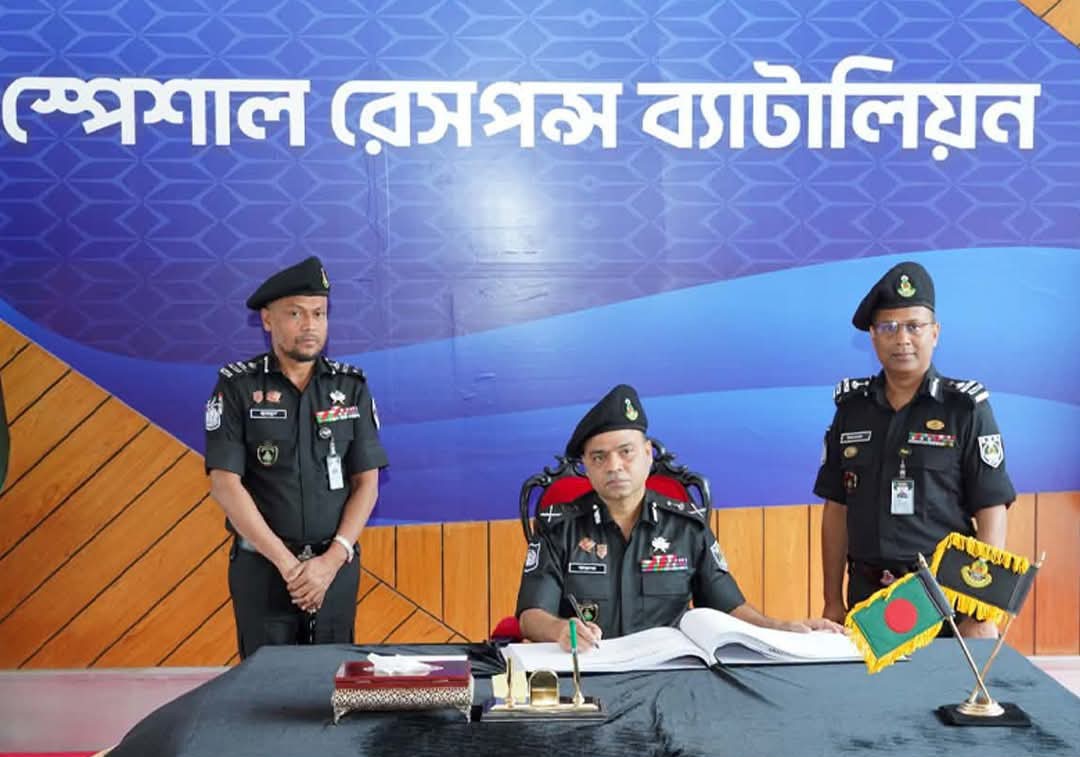
Additional Inspector General of Police (Additional IGP) Faruk Ahmed has assumed the role of Director General of the Special Response Battalion (SRB).
He took over the new responsibility on Sunday, November 8, 2026. He had been appointed as the new DG of SRB on November 3.
Faruk Ahmed joined the Bangladesh Police in 1998 through the 17th BCS as an Assistant Superintendent of Police. He completed a one-year basic training course at the Bangladesh Police Academy in Sarda, Rajshahi. Over his long career, he has served in various important units and positions in the Bangladesh Police.
He has previously served as Superintendent of Police (SP) in Mymensingh, Kishoreganj, and Moulvibazar districts. He also held the posts of Additional Commissioner (Administration) of the Dhaka Metropolitan Police (DMP), Additional Director General (Administration) at RAB Forces Headquarters, and Chief of the Highway Police. He has experience serving in United Nations peacekeeping missions in Liberia and Sudan.
Academically, Faruk Ahmed obtained a BSc Engineering degree in Electrical and Electronic Engineering (EEE) from Rajshahi University of Engineering and Technology (RUET).
After joining as Director General of SRB Forces, a welcome ceremony was held. Addressing the force members, he instructed them to perform their assigned duties with sincerity, professionalism, accountability, and in a systematic manner for the welfare of the people. He also directed members at all levels of the force to take initiatives to build SRB Forces as a role-model institution in ensuring public security in Bangladesh and establishing the rule of law.
Crossfire Debate, Security Operations, and Awami League
Faruk Ahmed’s assumption of charge comes against a backdrop of ongoing law-and-order challenges and recent public debate. In late October, Inspector General of Police (IGP) Md Ali Hossain Fakir remarked that police would conduct “crossfire” if necessary and if the government permitted it. The comment drew criticism from human rights groups and others, who linked the term to past allegations of extrajudicial killings.
Police Headquarters later clarified that the IGP had used the word in its literal sense to emphasise firm, lawful action and self-defence amid attacks on officers, not to endorse extrajudicial killings. Home Minister Salahuddin Ahmed and other government figures distanced the administration from any such interpretation, stating that the government has no mandate for extrajudicial killings and that officers cannot carry out unlawful orders.
Separately, the government has repeatedly stated that it has no plans to launch a special drive modelled on the controversial 2002 “Operation Clean Heart.” Instead, Home Minister Salahuddin Ahmed has said that existing law-enforcement agencies — including the police, SRB, Border Guard Bangladesh (BGB), and Ansar — will intensify coordinated operations against crime, extortion, drugs, and related threats as part of regular duties.
These security measures continue amid concerns over activities by the now-banned Awami League and its affiliates. Authorities have conducted surveillance and arrests of individuals linked to the banned party, and some recent unrest (including aspects of garment-sector protests) has been attributed by officials and ruling-party figures to elements associated with the Awami League. The new SRB leadership is expected to play a key role in maintaining public order and responding to such threats within the legal framework.