


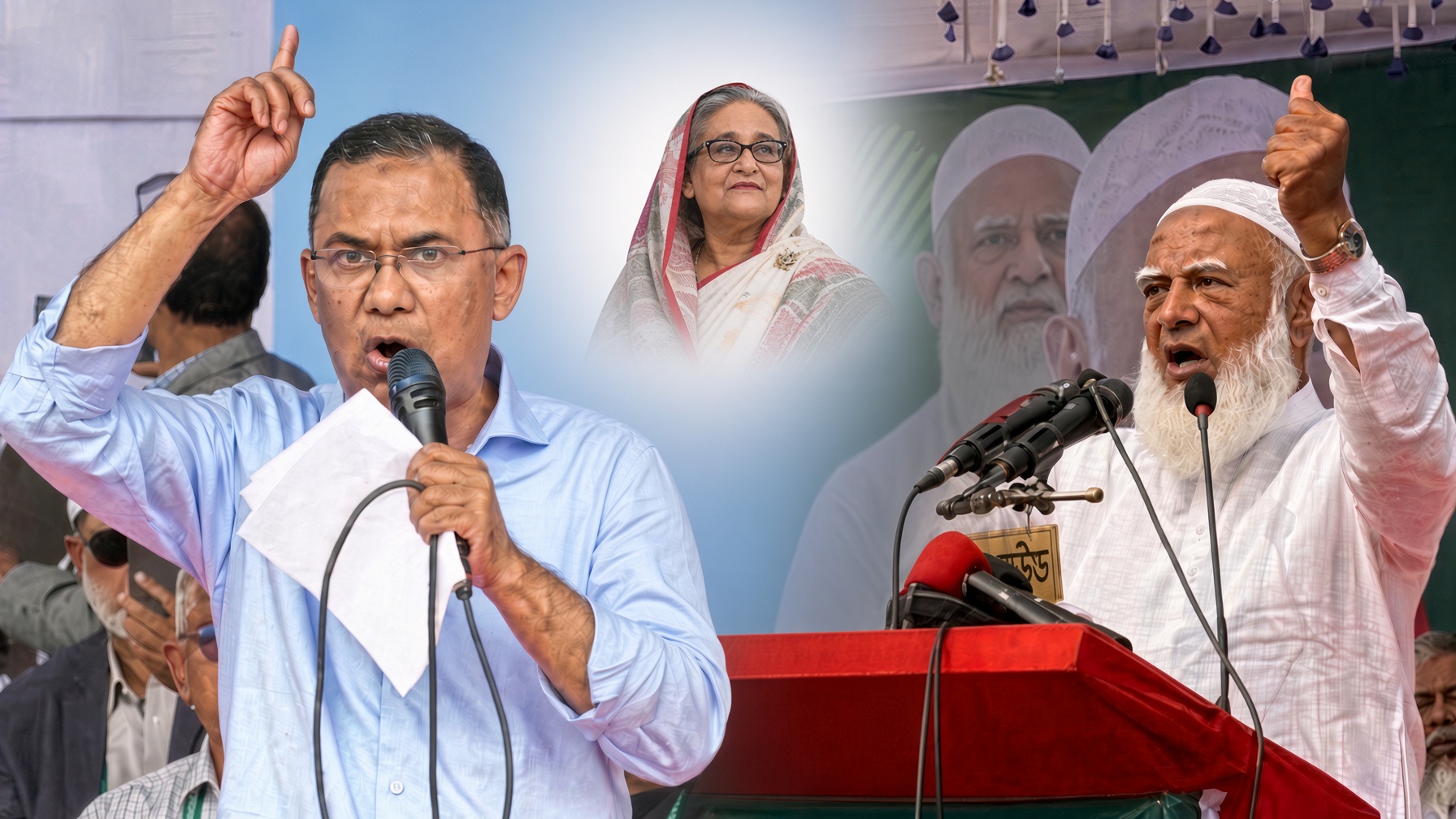
Bangladesh’s Prime Minister Tarique Rahman, speaking at a public rally on Tuesday, pointed to the Awami League and Jamaat-e-Islami and said he has clear intelligence information that the two sides have joined forces. His remarks have reignited debate over the role of intelligence agencies in the country’s politics.
Awami League leaders and political observers have firmly rejected claims that the party is negotiating or colluding with either the BNP or Jamaat. According to the announcement of former prime minister Sheikh Hasina, she will return to Bangladesh in December to face the courts and challenge her convictions. She has also demanded that the ban on her party’s activities be lifted immediately and that its leaders and activists be released from jail.
BBC Bangla reported that the question of intelligence agencies’ political use is particularly sensitive because, during the Awami League’s continuous 16-year rule until its fall in August 2024, the then-opposition BNP repeatedly accused the government of using intelligence agencies against it. After the mass uprising that ousted the Awami League government, many are now asking whether the agencies are once again being deployed in the same political manner.
Following Tarique Rahman’s statement, leaders of Jamaat-e-Islami and the National Citizen Party (NCP) responded quickly. Jamaat accused the government of shifting blame onto the opposition to cover up its own failures and corruption. BNP leaders, however, insisted that the prime minister spoke from a position of knowledge and that the information he cited is specific.
What the Prime Minister’s Remarks Signalled
On Tuesday, Prime Minister Tarique Rahman attended several programmes, including visits to puja mandaps in Rangpur, Rajshahi and Chattogram. In the afternoon, addressing a rally at Rajshahi Madrasa ground, he gestured toward the banned Awami League and the parliamentary opposition party Jamaat-e-Islami, saying they were “trying to create instability in the country” and that the government possessed intelligence on the matter.
He said: “We have information from the intelligence agencies. You have surely seen that in several places in the country, in some factories, attempts have been made to create labour unrest.” Citing intelligence, he added that there was “clear intelligence information” that the “autocrat who fled” was supplying money from across the border. “The two sides have become one. One is sending money from the other side of the border, and the other is sitting here trying to create instability.”
BNP leaders noted that the banned Awami League has been involved in various destructive and subversive activities recently, yet the opposition has not reacted strongly. Joint Secretary General Emran Saleh Prince told BBC Bangla: “We have said before that there is collusion between the Awami League and Jamaat. From the position of prime minister, he must have such information; otherwise he would not have said these things. A prime minister does not speak without knowing.”
Prince and others recalled historical instances of cooperation between the Awami League and Jamaat—in 1986, when both helped legitimise the Ershad government, and in 1996, when they joined movements against the BNP government. Some within the BNP therefore believe the two parties could again unite against it. At the same time, a few BNP leaders argued that statements alone are not enough and that action should be taken against those involved in criminal activities to maintain law and order. Vice-Chairman Asaduzzaman Ripon told BBC Bangla: “According to the prime minister’s statement, the Awami League is sending money from the other side and someone from Jamaat is receiving it here. It is now the responsibility of the intelligence agencies to bring them under the law.”
Why Questions Are Being Raised About Intelligence Use
The activities of intelligence agencies in Bangladeshi politics, and their use under different governments, have long drawn criticism. BBC Bangla spoke to several former senior intelligence officials. One officer who spent a long career in military intelligence said the National Security Intelligence (NSI) is meant to be the primary civilian agency responsible for collecting intelligence for the state, but it was never particularly strong. As a result, the military intelligence agency DGFI has at times been used for political purposes.
The officer and a security analyst both stressed that governments need intelligence to run the state and that successive administrations have used it. The issue arises, they said, when it is deployed for political ends. Retired Major General Fazle Elahi Akbar told BBC Bangla: “A government can use the intelligence agencies or their information if it needs to. The question is whether it will use them for political purposes—that depends on the government.” He added that when the head of government publicly reveals sources, the agencies can later face difficulties in their work.
What the Opposition Is Saying
Jamaat-e-Islami took a strong stand immediately after the remarks. On the same day, Secretary General Mia Golam Parwar said at a press conference that by ignoring the opposition’s movement, the government was deliberately creating space for the Awami League to re-enter. Later that night, Jamaat Amir Shafiqur Rahman wrote on his verified Facebook page that instead of addressing public suffering and curbing misdeeds, the BNP government was busy character-assassinating the opposition.
NCP leaders also reacted. Hasnat Abdullah posted on Facebook: “Can a prime minister publicly announce that he is using the state’s intelligence agencies to spy on the opposition?”
Jamaat’s Assistant Secretary General Ehsanul Mahbub Zubayer told BBC Bangla that despite the ban, the Awami League has been holding processions in places such as Gulshan and conducting other activities, yet the intelligence agencies appear to have no information about them. “We are disappointed to see a prime minister make such statements. Just as the Awami League used to shift the blame for its failures onto the opposition in the past, the BNP is now doing exactly the same with the Awami League.”