


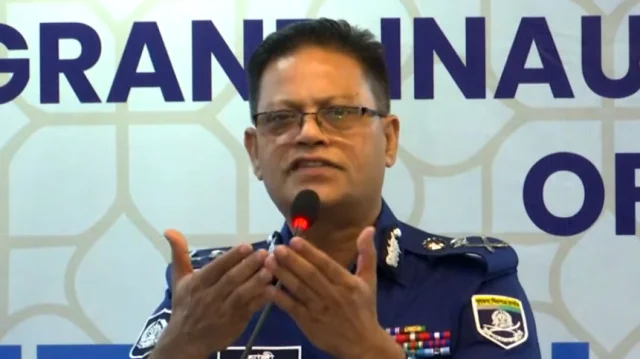
Bangladesh’s Inspector General of Police (IGP), Md Ali Hossain Fakir, has come under fire after suggesting that police could resort to “crossfire” killings if authorised by the government and making sweeping allegations against journalists. Police headquarters has since issued a clarification, while rights groups and journalist organisations have condemned his remarks and demanded accountability.
In a statement issued on Monday (October 26), police headquarters said the IGP had used the term “crossfire” in its literal sense to emphasise the need for firm law enforcement. It denied that he intended to endorse extrajudicial killings or punishment outside the judicial process.
The clarification followed media reports about the IGP’s remarks at an event marking the inauguration of the Islamic banking services of Community Bank in Dhaka’s Chawkbazar area earlier in the day.
The IGP’s comment came amid a special operation to arrest the Awami League supporters, extortionists, drug peddlers, terrorists, and other criminals. In September, the home minister hinted at launching Operation Clean Heart-like steps but backtracked after failing to convince the Bangladesh Army. Rights activists opposed the operation while reminding the BNP of its brutal operations and crossfire deaths by the Rapid Action Battalion (RAB) after its formation in 2004.
According to police headquarters, the IGP, who was trained in the US and also served in UN Peacekeeping missions, was expressing the police force’s commitment to taking effective action against drug dealers, terrorists, extortionists and others who pose threats to public safety.
The statement described the Bangladesh Police as the country’s principal law enforcement agency, responsible for preventing crime, arresting offenders, maintaining public order and protecting people’s lives and property.
It also cited figures showing that police faced 176 attacks during the first 10 months of this year while carrying out official duties, including law enforcement operations and criminal arrests. Four police officers were killed and 370 were seriously injured in those attacks, it said.
Police headquarters further noted that the Penal Code of 1860, the Code of Criminal Procedure of 1898 and the Police Act of 1861 provide for police officers’ right to self-defence.
IGP accused of making threatening remarks
At Monday’s event, Fakir said the police faced criticism regardless of how they performed their duties, arguing that officers were branded fascists when they used force and weak when they remained restrained.
He said the police needed an enabling environment and greater authority to carry out their responsibilities. He also stated that, with government approval, the police would resort to “crossfire” if necessary.
The term “crossfire” has frequently been used in Bangladesh to describe killings by law enforcement agencies that are reported as occurring during gunfights but have drawn allegations of extrajudicial executions.
The remarks prompted concern among human rights organisations, which called on the government to clarify its position on extrajudicial killings.
Rights groups condemn the statement
The Human Rights Support Society (HRSS) expressed concern and condemnation over the IGP’s comments, demanding a clear explanation from the government regarding the remarks and its position on extrajudicial killings.
Transparency International Bangladesh (TIB) also condemned the statement, calling for its withdrawal and accountability for remarks it said were inconsistent with the government’s stated position against extrajudicial killings.
The human rights organisation Ain o Salish Kendra (ASK) issued a separate condemnation, describing the remarks as deeply concerning and incompatible with the rule of law, constitutional rights and fundamental human rights principles.
ASK said law enforcement agencies were responsible for preventing crime, arresting suspects, conducting impartial investigations and bringing accused individuals before the courts. Suggesting the possibility of extrajudicial killings in the name of law enforcement, it argued, was unacceptable.
The organisation pointed to Articles 31 and 32 of Bangladesh’s Constitution, which protect the right to legal protection and the right to life and personal liberty. It also cited international human rights obligations concerning the protection of life, prevention of torture and access to justice.
ASK stressed that no government order or authorisation could override these constitutional and international obligations. Allegations of criminal activity, it said, must be resolved through lawful judicial proceedings rather than the unilateral decisions of law enforcement agencies.
The organisation further argued that the IGP’s remarks contradicted the government’s electoral pledge to end extrajudicial killings.
ASK called on the government to issue an unequivocal statement ruling out any authorisation or tolerance of such killings, review the IGP’s comments and take appropriate action. It also urged the authorities to provide clear instructions ensuring that law enforcement agencies operate in accordance with the Constitution and international human rights standards.
Police headquarters addresses comments about journalists
Police headquarters also sought to clarify the IGP’s remarks about journalists, saying his comments had not been intended as a blanket criticism of the profession.
“Strictly speaking, he did not intend to make a sweeping statement about journalists; it happened inadvertently,” the clarification said.
At the Chawkbazar event, Fakir had alleged that journalists published reports portraying the police as ineffective when they did not receive money from drug-related sources.
His comments drew strong criticism from the Dhaka Reporters Unity (DRU), which demanded that he withdraw the remarks and issue a public apology within 24 hours.
In a statement issued on Monday, DRU President Abu Saleh Akon and General Secretary Mainul Hasan Sohel condemned the IGP’s comments, describing sweeping allegations about journalists’ professionalism and integrity as contrary to the principles of independent journalism.
The organisation said reporting on drug trafficking, crime, irregularities and corruption was a fundamental part of journalists’ professional responsibilities.
It added that any allegations against individual journalists should be supported by specific evidence and addressed through legal procedures rather than broad, disparaging statements that undermine the reputation of the entire profession.
The DRU warned that failure to withdraw the remarks and apologise publicly within 24 hours would prompt the organisation to announce tougher programmes to defend press freedom and journalists’ dignity.
Police headquarters reiterated that the Bangladesh Police remained committed to protecting citizens’ lives and property, upholding human rights and establishing the rule of law through professional and impartial policing.