


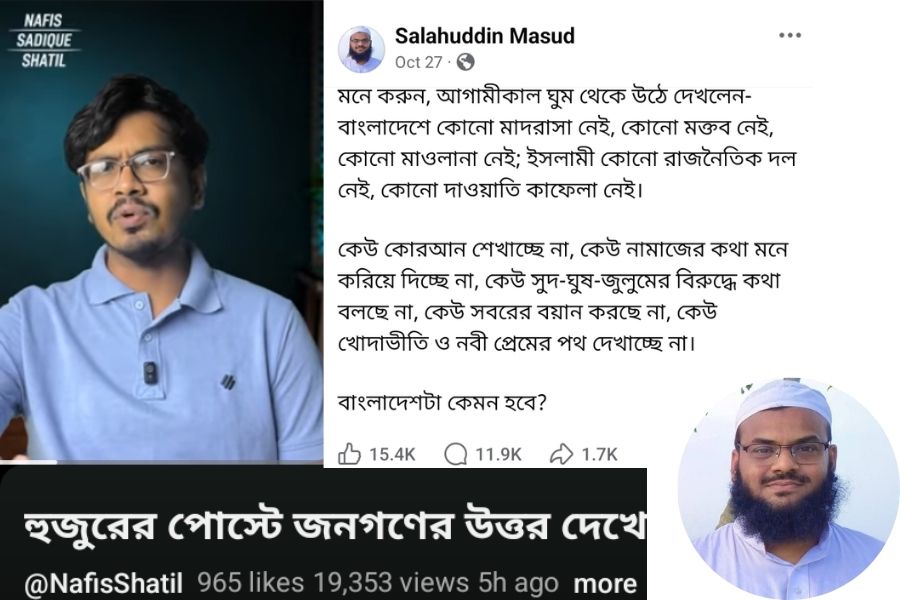
An Islamic activist named Salahuddin Masud sparked intense online debate after posting a hypothetical scenario on Facebook asking what Bangladesh would look like if it suddenly had no madrasas, maktabs, Maulanas, Islamic political parties, or dawah caravans.
In the Facebook post, he posed: Imagine waking up tomorrow to a Bangladesh with no one teaching the Quran, reminding people to pray, speaking against usury and oppression, preaching patience, or guiding people toward God-consciousness and love for the Prophet. What would the country become?
Also Read: Child Sexual Abuse in Madrasa: Alarming numbers, weak protection, and failing support systems
Masud, who has roughly 142,000 Facebook followers, appears to have expected widespread sympathy and strong defenses of Islam. Instead, the comment section was dominated by the opposite reaction. Many users argued that the absence of these institutions and figures would improve the country, citing reduced crime, greater personal responsibility for religious education, less communal division, and a path toward a more peaceful and developed society.
The volume and tone of the replies have been described by commentators as a clear sign of growing public fatigue with what they call “religious business” and forced Islamization of everyday life.
Notable Public Comments
One widely noted reply by a user named Minhajur Rahman stated that in such a scenario, “no one would commit rape. Children would grow up safely. Religious education would be the family’s own responsibility.” Other comments suggested Bangladesh would quickly resemble “civilized and humane” countries such as those in Europe, America, Canada, Australia, Japan, or Korea, and that it could become “the happiest country in the world.”
Several users wrote that true justice would be established, people would stop believing they could wash away sins simply by performing Hajj, and society would learn to call good good and bad bad. Others predicted lasting peace with no mutual hatred or communal division. One commenter sarcastically asked which specific prayers or acts of worship would make the hypothetical come true, while another wrote “Alhamdulillah, may it happen” and claimed people would then become better on their own.
Also Read: Concerns mount over visits of Qawmi-linked Abul Qasim Nomani and Taqi Usmani to Bangladesh
Not all responses were critical. Some supporters insisted the scenario was impossible and that primary schools would instead be replaced by even stronger Islamic educational institutions. These defensive comments, however, received far fewer positive reactions and were frequently met with laughter and ridicule in the form of “haha” reactions.
Commentator’s Analysis of Public Sentiment towards Madrasa
In a detailed video commentary based on the post, activist Nafis Shatil argued that the backlash reflects long-standing public irritation with the activities of many “Hujurs” (religious preachers).
According to the commentary, these figures are widely seen as contributing little practical value to society while spreading hatred—particularly anti-Hindu and anti-India rhetoric—and attempting to restrict cultural practices such as music, dance, boat racing, cinema, and folk theater.
The video highlighted recurring complaints about madrasas, including allegations of child sexual abuse, using students for begging, and financial exploitation through donations. It noted that people are now openly discussing these issues in ways that were less common in previous years.
Nafis Shatil contrasted the role of religious leaders with productive workers such as rickshaw pullers, doctors, and teachers, arguing that a strike by any of those groups would immediately disrupt daily life, whereas the absence of Hujurs would not. Religious functions such as leading prayers, performing funeral rites, or conducting aqeeqah, the video claimed, do not require a salaried professional class and can be handled by ordinary knowledgeable individuals.
Also Read: Pro-BNP Hefazat launches 7-party Qawmi Islamist platform ahead of Sheikh Hasina’s return
The analysis further described the expansion of madrasas as resembling a multi-level marketing or franchise model, in which graduates with few practical skills open new institutions and sustain themselves through charity rather than productive work.
Public donations of food, money, and building materials are portrayed as sustaining an unskilled class that has little incentive to strike or demonstrate its necessity, because its absence would not create measurable hardship.
Ongoing Debate over Madrasa Education
After facing heavy criticism, Masud reportedly pinned a comment claiming that isolated bad incidents in a small number of the country’s hundreds of thousands of madrasas are being exaggerated by opponents, creating the false impression that such problems are constant. He later posted a simplified version of his original question, listing the absence of madrasas, maktabs, Maulanas, Islamic parties, and waz mahfils as acceptable, then asking who would teach the Quran, remind people of prayer, speak against usury and bribery, or recall death, the afterlife, and accountability.
Critics dismissed these points as unnecessary. They argued that smartphones and personal alarms make repeated prayer reminders redundant, that moral opposition to corruption does not require religious specialists, and that the historical spread of Islam occurred long before the modern madrasa system.
Nafis Shatil he commentator described the later appeals to heaven, hell, and the Day of Judgment as a familiar tactic used when ordinary arguments fail to generate sympathy.
Broader Context of the Reaction
The episode has been interpreted by Nafis Shatil as evidence that ordinary Bangladeshis are growing less tolerant of what they see as hypocrisy, communal division, and the gradual expansion of religious control over social and cultural life.
While Islamic supporters continue to defend the institutions and warn against any reduction in their influence, the dominant visible reaction to Masud’s post has been one of rejection rather than defense. Whether this sentiment remains confined to social media or reflects a wider shift in public opinion continues to be debated.