


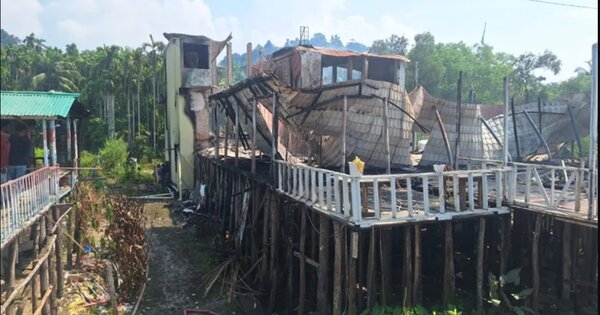
In the quiet village of Mohonpur in Manirampur, Jashore, a father’s final words of reassurance have become an unbearable echo. On Wednesday morning, the bodies of Nahidur Rahman, his wife Afsana Khatun, and their two young daughters, Inaya and Ihana, arrived home eleven days after a fire tore through the TupTup Resort in Inani, Cox’s Bazar.
The village, once filled with the laughter of the girls during holidays, now sits under a heavy pall of mourning as preparations for the funeral prayers and burial continue.
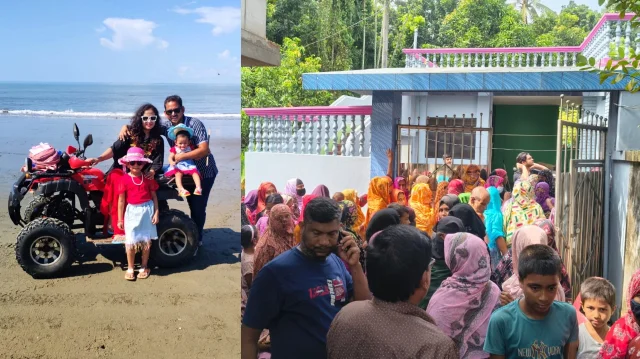
Nahidur, an officer at Grand Power Limited in Shyamoli, Dhaka, had taken his family to Cox’s Bazar during the Puja holidays. They checked into the resort on 16 October with plans to leave on the 18th. Instead, a blaze erupted in the early hours of 17 October. Ten people died. Among them were Nahidur (41), Afsana (36), and their daughters—Rozaïna Inaya (9) and Munaina Ihana (6).
DNA testing and prolonged legal formalities delayed identification. The bodies were handed over on Tuesday afternoon by Cox’s Bazar District Commissioner Abdul Mannan and senior police officials, then reached the family home on Wednesday.
Motiar Rahman, Nahidur’s elderly father who lives alone in the family’s two-storey house “Farzana Mansion,” sat surrounded by relatives, stunned by grief. In a voice thick with tears, he recalled their last conversation the night before the fire: “He said, ‘Father, don’t worry. Your granddaughters are at the sea beach, the children are playing. We’ll return to Dhaka on Tuesday. On Wednesday, come to our flat in Mirpur.’ That was the last we spoke. There will be no more conversations.”
Remembering the girls, he said they would fill the house with joy whenever they visited the village. “How we used to play together. Nothing will happen now. Flower-like innocent children have also burned to death. How much my golden ones must have suffered.”
Relatives have directly blamed the lack of proper measures at the unauthorized and hazardous resort.
Abdul Latif, Nahidur’s uncle, said working people seek brief leisure at resorts, yet “if the resort is uncontrolled or has no fire-fighting arrangements, there is always a risk to life. Because of such mismanagement, fresh lives were cut short. Who will take responsibility? An entire family has been finished. We will not get them back. These irregularities must end and those involved must be brought to justice.”
The four will be buried in the family graveyard beside Nahidur’s mother after the Janaza on Wednesday afternoon. Local residents, watching four graves being dug side by side, said they had never seen such a sight in the village before.
The tragedy extends beyond this one family. The bodies of six other victims from Dhaka and Barguna areas were also handed over the same day: Moulita Mehzabin Alvi (19), Layla Jahan Nabila (25), Israt Jahan Maliha (27), Faria Kabir (33), her six-year-old son Faizan Noor, and her brother Nafis Tehami (24). Separately, the body of missing schoolteacher Nasrin Akter Mukta (27), from Ashulia in Savar, was recovered from a pond beside the resort on Tuesday after a fresh search—ten days after the fire.
Survivors have described the chaotic escape. Meherunnesa Mila and her husband, who were staying nearby, broke a window and jumped from the second floor to survive, only to watch relatives burn. Ashikul Islam, who lost his wife, said there was no emergency exit: “We three broke the window glass and jumped outside to live.”
The fire has drawn attention to systemic failures across Cox’s Bazar, the country’s premier tourist destination that draws 8 to 9 million visitors annually. Along Marine Drive, in the city, and on Saint Martin’s, hundreds of hotels, resorts, and cottages have sprung up. Journalists and officials note that most lack fire extinguishers, trained staff, emergency exits, and proper clearances. Senior journalist Ahmad Gias has pointed out that, outside star-rated hotels, the majority have neither fire-safety systems nor environmental clearances, and many lack sewage treatment plants. Emergency escape routes are often absent.
Cox’s Bazar Fire Service records show that while star hotels have equipment, only a fraction of medium-sized establishments have received fire-safety licenses after applications. The Cox’s Bazar Development Authority has issued notices to around 250 illegal structures along Marine Drive. The Department of Environment says only 44 hotels and resorts hold environmental clearance, and just 14 have sewage treatment plants—despite rules requiring clearance for resorts with more than 20 rooms in the Ecologically Critical Area declared in 1999.
Local administration has acknowledged gaps caused by manpower shortages. Hotel owners have asked for six months to correct irregularities and called for a one-stop service to reduce harassment. District officials have formed a committee to examine these demands and pledged action against establishments lacking minimum safety standards.
For Motiar Rahman and the families of the other victims, such promises come too late. The wooden-and-bamboo resort in Inani has already claimed ten lives, including four members of one family whose last words of reassurance never turned into a safe return home. The silence in Mohonpur now stands as a stark reminder of what the absence of basic fire safety, emergency exits, and regulatory oversight can cost in a city built on tourism.