


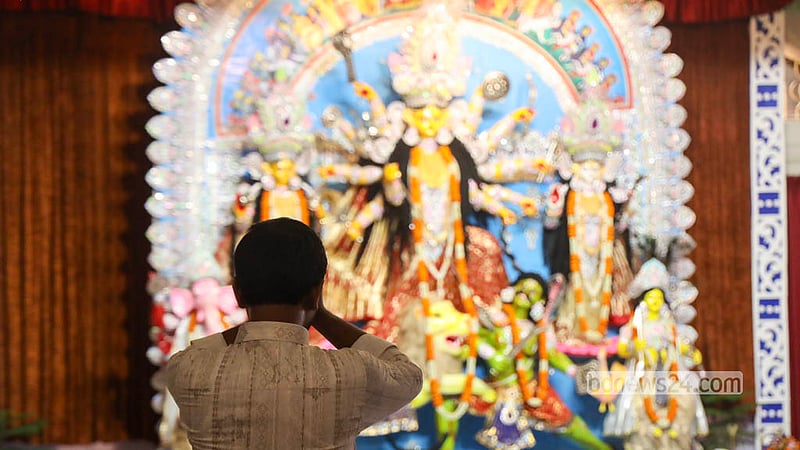
Bangladesh’s Hindu community is observing Sharadiya Durga Puja at approximately 33,851 mandaps nationwide, including 258 in Dhaka, amid extensive security deployments of police, specialised units, drones, and helicopters.
Minority organisations have described the need for such heavy protection—by law enforcement, aerial surveillance, and political party workers—as “saddening and unfortunate,” arguing that it constrains religious freedom and harms the country’s international image.
The Bangladesh Hindu Buddhist Christian Unity Council (BHBCUC), in a statement issued by Joint General Secretary Manindra Kumar Nath ahead of the festival, noted that communal threats intensify as the puja approaches.
Drawing on partial records from July to September, the Council listed 16 killings, four cases of rape or sexual harassment, 36 incidents of temple attacks, looting, land grabbing or idol vandalism, six arrests on alleged religious defamation charges, seven attacks on indigenous communities, 11 attacks or lootings of homes and businesses, 26 assaults or robberies, 14 property seizures, three abductions or death threats, four extortion cases, and 14 other incidents.
It highlighted an incident on the night of 12 October at Jagannath University, where bricks from a campus temple were reportedly used to cook beef khichuri in front of the structure in an alleged attempt to provoke communal tension.
The Council also cited ongoing hate speech on social media and the absence of arrests in many cases, which it said emboldens perpetrators.
Separate reports from the Bangladesh Puja Udjapan Parishad put the number of idol vandalism, temple attacks and related incidents ahead of the festival at 34, concentrated in districts including Sylhet, Rajbari, Panchagarh, Netrokona and Tangail, with additional looting of Hindu homes, shops and temples reported in Sunamganj and a theft at a historic Kali temple in Faridpur. Parishad General Secretary Santosh Sharma stated that security for the five days of puja is insufficient and that protection must be ensured year-round. Arrests have been reported in a limited number of these cases.
These developments occur against the longer backdrop of elevated minority-targeted violence following the August 2024 ouster of the Awami League government. Groups operating under the banner of Touhidi Janata (also spelled Tawhidi Janata)—a loose, non-formalised Islamist mobilisation invoking monotheistic purity—have been linked to attacks on Sufi shrines, Baul cultural gatherings, and Hindu sites.
Such groups have engaged in moral policing, shrine desecrations and disruptions of events deemed un-Islamic, often with limited subsequent accountability. Human rights monitors and minority organisations have documented hundreds of attacks on Hindu properties in the immediate post-ouster period, with the pattern of communal incidents continuing under the interim administration and the subsequent BNP-led government.
Hefazat-e-Islam figure Mufti Harun Izhar, described in reporting as having historical associations with Lashkar-e-Tayyiba networks, has publicly urged Muslims not to participate in or extend greetings for Durga Puja, labelling those who do as kafir, fasiq and munafiq.
Izhar has previously made other statements targeting the Hindu community and is associated with campaigns promoting Sharia-oriented measures.
On the official side, the BNP government under Prime Minister Tarique Rahman has expanded security arrangements, including round-the-clock surveillance, SWAT and quick-response teams, CCTV, a reporting app, and deployment of drones and helicopters especially for idol immersion.
BNP leaders have directed party workers to assist as volunteer guards at mandaps in coordination with puja committees and police. The government extended the puja holiday, increased funding for the festival, and issued messages stressing harmony. Prime Minister Rahman urged Hindus to celebrate “peacefully and safely” and “without fear,” stating that religion is personal while the state belongs to all and that security is a right irrespective of faith. President Mirza Fakhrul Islam Alamgir and other officials have echoed calls for religious tolerance.
Minority leaders counter that visible fortification around festivals, combined with persistent attacks and inflammatory rhetoric, signals incomplete state protection and a climate of impunity for extremist actors that has worsened since the 2024 regime change. They argue that reliance on police, drones and party cadres for routine religious observance restricts the free practice of faith and raises questions about Bangladesh’s commitment to equal citizenship. The Puja Udjapan Parishad and BHBCUC have reiterated longer-term demands, including a minority protection law and a National Minority Commission.
As immersion processions conclude and the festival winds down, the contrast between official assurances of harmony and the documented pattern of attacks continues to shape perceptions of minority security in Bangladesh.