


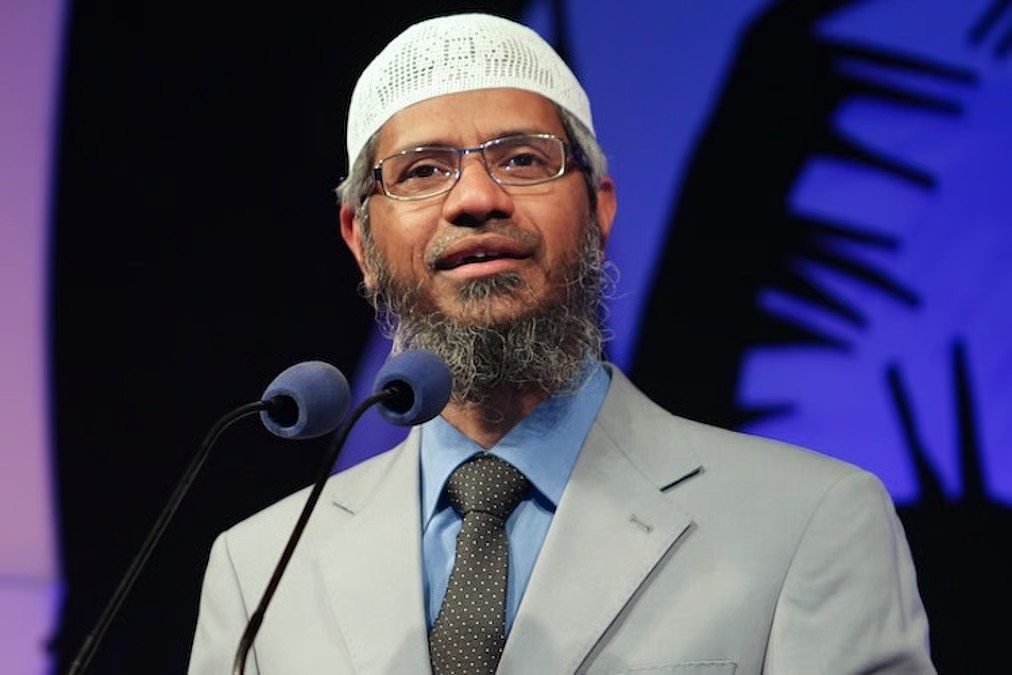
Fugitive Indian Islamic hate preacher Zakir Naik has drawn sharp international criticism for publicly defending the Taliban’s long-standing restrictions on girls’ and women’s education in Afghanistan, portraying an indefinite ban as a mere temporary “postponement.”
His comments stand in stark contrast to his earlier assertions that the Taliban were created by the United States.
In a widely circulated video, Naik claimed that “everything that comes in the media is not true” and said he had spoken with Taliban representatives. He asserted that primary education for girls continues up to Class 6, while secondary and higher education has been delayed only because “the environment is not safe” and there is a shortage of female teachers.
He added that “if someone delays the education till they have the right teacher, there is no problem at all,” and claimed Afghan women are still pursuing master’s degrees and PhDs in Islamic studies, Sharia, and related fields.
These claims have been rejected by activists, Afghan exiles, and education advocates.
Ziauddin Yousafzai, father of Nobel laureate Malala Yousafzai, called the remarks “deeply troubling and disappointing,” stating that presenting an indefinite ban as a “postponement” and citing a lack of female teachers—without explaining how those teachers can be trained under the ban—is not a credible defense and risks legitimizing “gender apartheid.”
Exiled Afghan parliamentarian Mariam Solaimankhil mocked the logic: “Afghan girls aren’t banned from education. They’re just waiting for female teachers. The same female teachers the Taliban banned from working?”
UNICEF and UNESCO data contradict Naik’s portrayal. Afghanistan remains the only country in the world where girls and women are formally barred from secondary and higher education. Girls have been denied formal schooling beyond sixth grade since September 2021, and women have been barred from universities since December 2022. More than 2.6 million girls have been excluded from secondary education in the five years since the Taliban returned to power, with the numbers continuing to rise. The restrictions have been described by the Taliban as temporary but have remained in place for years.
Critics have also highlighted the apparent hypocrisy in Naik’s evolving stance. In earlier public remarks, he explicitly stated that the Taliban were created by the Americans during the Soviet invasion of Afghanistan: “Who created Taliban when Russia came? The Americans supported the Afghans, created Taliban… Who is the creation? Americans.” He has repeatedly labeled former US President George W. Bush the “world’s number one terrorist,” claimed the September 11 attacks were an “inside job” carried out by Bush and White House politicians, and positioned himself against what he described as American-created or American-backed groups.
Naik, who faces charges in India related to money laundering and incitement and lives as a fugitive abroad, has a long history of controversial statements on terrorism, 9/11, and geopolitics. He was also barred from entering Bangladesh for his statements provoking armed jihad and disrespecting other religions while making false explanations of Islam.
His latest defense of Taliban policies has united critics across India, Pakistan, and Afghanistan, who argue that his statements lend religious credibility to the systematic exclusion of millions of Afghan girls from education and undermine any claim of consistency in his views on the Taliban.