


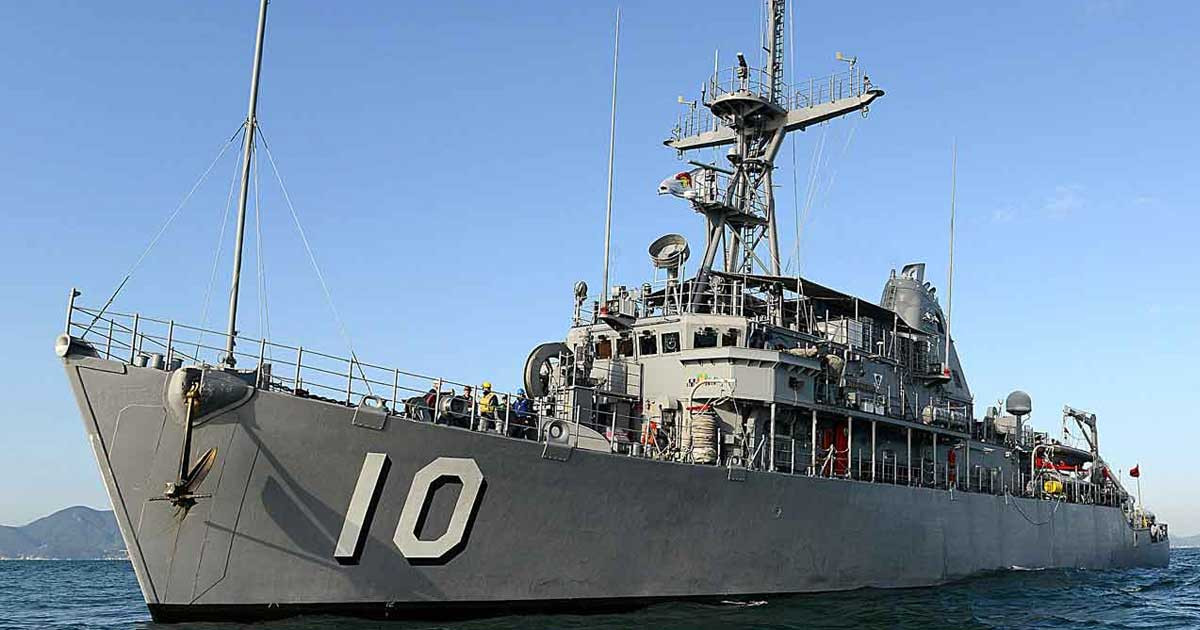
The US Navy’s mine countermeasures ship USS Warrior arrived at Chattogram Port on Sunday to take part in the bilateral naval exercise CARAT-2026 with the Bangladesh Navy.
The 68-metre Avenger-class vessel, commanded by Lieutenant Commander Mary Senoyuit, berthed at the port jetty as part of the Cooperation Afloat Readiness and Training (CARAT)-2026 exercise. The exercise aims to further strengthen existing bilateral military cooperation between the two navies, enhance mutual professional skills, and bolster joint capacity for maritime security.
Captain Mir Md. Mahbubul Hasan, Chief Staff Officer of the Commander Chattogram Naval Area, welcomed the commanding officer and the visiting delegation on arrival. Senior officials of the Bangladesh Navy and the US Defence Attaché in Bangladesh were present. A Bangladesh Navy band performed a traditional military musical welcome as the ship approached, reflecting the longstanding friendly relations, mutual trust and cooperation between the two navies.
Courtesy call and opening ceremony
During its stay, Lieutenant Commander Mary Senoyuit, Head of Delegation Captain Stephen, the US Defence Attaché and other members of the delegation will call on Commander BN Fleet Rear Admiral Mojak Ahmed. The meeting will cover existing professional ties, training and capacity building, and matters of mutual interest.
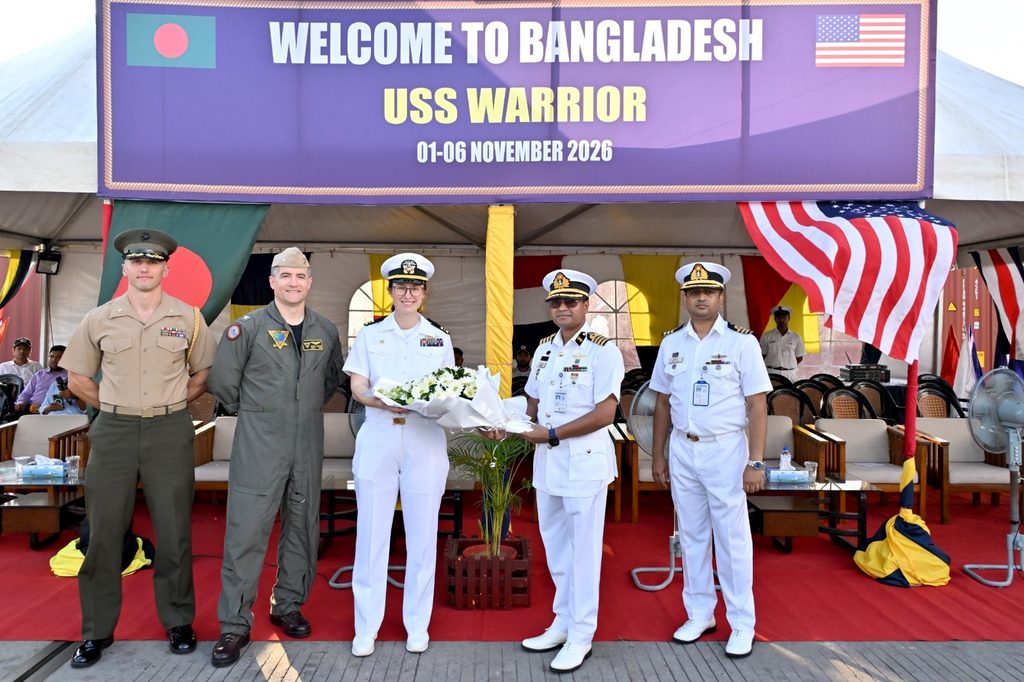
The opening ceremony of CARAT-2026 will be held on Monday, November 2, at the auditorium of the School of Maritime Warfare and Tactics (SMWT) in Chattogram. The commanding officer of USS Warrior, the head of the US delegation, the US Defence Attaché and other relevant representatives will attend. The ceremony will formally begin the joint exercise activities.
Participating assets and objectives
USS Warrior, a US Navy P-8A aircraft, and various Bangladesh Navy ships, bases, units under the Commodore Squadron Command, and Naval Aviation will take part in the exercise, which runs from November 2 to November 5. It will provide opportunities for professional knowledge and experience exchange, improve the ability to conduct joint operations, and strengthen coordination in addressing maritime security challenges.
CARAT is a significant bilateral training initiative that enhances operational readiness, mutual understanding on maritime security issues, and regional maritime cooperation. The exercise is expected to further deepen the existing friendly relations and bilateral cooperation between the Bangladesh and US navies. USS Warrior will depart Bangladesh on November 5 after the conclusion of the exercise.
Context of Growing US Military and Trade Engagement Since August 2024
This visit comes amid a broader increase in US-Bangladesh military and economic interactions following the student-led uprising and the ouster of the Sheikh Hasina government in August 2024, which brought an interim administration under Muhammad Yunus.
Last year, in October 2025, the guided-missile destroyer USS Fitzgerald (DDG-62) made a three-day port call and participated in Naval Engagement Activity (NEA) Bangladesh 2025 (October 8–10). Officially framed as a goodwill visit focused on maritime security, professional exchanges, and interoperability, it marked the first docking of a US warship of that type in Chattogram in roughly 54 years. The visit drew attention and some criticism over its timing under the interim government and perceptions of expanding US strategic presence in the Bay of Bengal amid regional competition involving China and India.
Since the 2024 political changeover, concerns have centred on the scale and terms of US influence. The interim government negotiated and signed an Agreement on Reciprocal Trade with the United States in early February 2026, just days before the national election. The deal reduced reciprocal tariffs on Bangladeshi goods (notably ready-made garments) from higher levels toward 19 percent, but included commitments for Bangladesh to increase purchases of US goods such as Boeing aircraft, liquefied natural gas/energy products (with figures cited in the range of $15 billion over 15 years in some reports), agricultural products, and military equipment, while limiting or reducing procurement from other sources.
Critics, including economists and policy analysts, raised issues about the rushed nature of the agreement by an unelected government, limited public transparency, potential constraints on defence autonomy, and clauses aligning Bangladesh more closely with US economic and national-security preferences—particularly regarding China, which has long been a major supplier of military hardware to Bangladesh.
Other elements of the engagement have included joint exercises (such as earlier CARAT iterations, Tiger Lightning army training, and other maritime activities), discussions around foundational agreements like GSOMIA and ACSA, commercial deals involving aircraft and agricultural imports, and high-level military visits.
While these steps are presented by both sides as supporting maritime security, professional capacity-building, and economic ties in the Indo-Pacific, they have prompted debate in Bangladesh about strategic hedging, sovereignty, costs of preferential purchases, and the balance between US, Chinese, and Indian interests in the region. The February 2026 election brought BNP leader Tarique Rahman to power as prime minister, shifting the political context for implementing or reviewing such arrangements.