



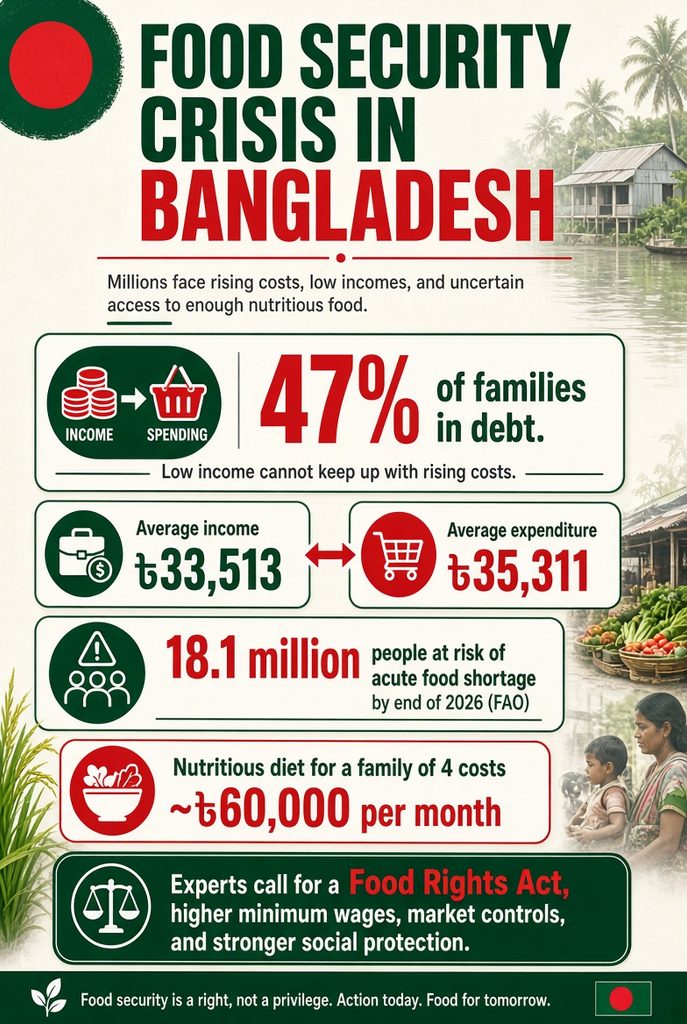
At a discussion held at the National Press Club in Dhaka, speakers highlighted growing food security risks, noting that average household spending now exceeds income, leaving 47 percent of families in debt. They warned that up to 18.1 million people could face acute food shortages by the end of 2026, urging immediate steps to secure food and nutrition rights.
The event, titled “Food Security Warning, Nutrition and Poverty Situation and Development of the Food System,” was jointly organized by Food Rights Bangladesh and the Web Foundation. Participants stressed that ensuring food security and nutrition requires a dedicated Food Rights Act, higher minimum wages, better market regulation, and more coordinated social security programs.
AK Enamul Haque, Director General of the Bangladesh Institute of Development Studies (BIDS), said inflation is likely to worsen further from the coming winter. He noted that the government alone cannot address the challenges and called for shifts in food habits adapted to climate change. While urban incomes are relatively more stable, rural livelihoods remain vulnerable, making localized changes in market systems essential.
Economist Professor MM Akash described the current situation as worrying, pointing to the risk of a deeper crisis from recession and inflation that could reduce incomes while raising the prices of essential goods. He said food shortages are already linked to theft and looting, and emphasized the need for social protection for those who fall further behind.
Saima Haque Bidisha, professor in the Department of Economics at Dhaka University and research director at SANEM, observed that inflation and nutritional deficiencies are steadily increasing.
She recommended securing long-term energy supplies, raising allocations for the Trading Corporation of Bangladesh (TCB), and increasing workers’ minimum wages to help households cope.
In the keynote paper, Professor Asif M Shahan of Dhaka University’s Department of Development Studies reported that average monthly household income stands at about Tk 33,513, while average expenditure is Tk 35,311. This gap has pushed 47 percent of families into debt.
Citing FAO data, he warned that 18.1 million people could face acute food insecurity by the end of 2026. He also identified excessive partisan appointments, rather than effective local governance, as a major obstacle to food security.
Tania Sharmin, senior adviser at Save the Children, said a nutritious diet for a four-member family now costs roughly Tk 60,000 a month. She called for bringing social security programs under a single integrated framework.
In his presidential remarks, Mohsin Ali, general secretary of Food Rights Bangladesh and executive director of the Web Foundation, urged the immediate passage of a Food Rights Act. He described the right to food as a human right that should be enshrined in law and called on the government to begin prompt consultations with relevant stakeholders.
Other speakers included researcher Ahmed Borhan and Malte Schumelfeder, head of programs at Welthungerhilfe (WHH). The session was moderated by Kaniz Fatema, coordinator of Food Rights Bangladesh and deputy director of the Web Foundation.
Overall, the discussion underscored that rising costs, debt, climate pressures, and weak governance are converging to threaten food security and nutrition, and that legal recognition of the right to food, combined with wage support and better-targeted social protections, will be essential to prevent a wider crisis.