


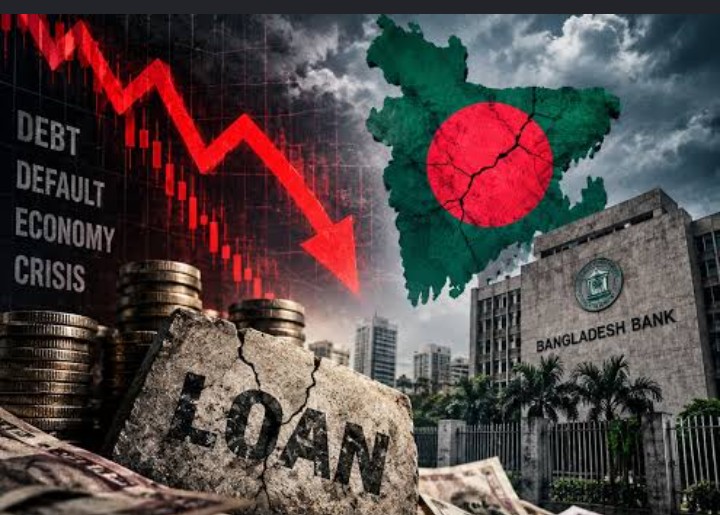
The government will pay government officials and employees their salaries according to the new pay scale or salary structure on November 1. On that day, along with October’s salary, the arrears of the new salary for the previous three months will also be paid. To meet this additional expense, the government has increased borrowing from banks this month. Bangladesh Bank has called an auction of 14-day special Treasury bills today. Through this auction, Tk 5,000 crore will be borrowed from the banking sector.
The government usually issues 91-day, 182-day and 364-day Treasury bills to borrow from the country’s banks. When a temporary shortfall arises between revenue income and daily or monthly expenditure, 14-day Treasury bills are issued for a short period. Recently, there had been no need to issue such special bills. When asked about the sudden issuance of the special bill, a responsible official of the central bank’s Debt Management Department, speaking anonymously to Bonik Barta, said: “On Sunday, i.e., 1 November, the government will pay the salaries of officials and employees according to the new pay scale. Extra money is needed for this. Considering the matter, an auction of 14-day Treasury bills has been called.”
According to central bank data, as of yesterday the government had borrowed Tk 55,300 crore through Treasury bills and bonds in the current October. If another Tk 5,000 crore is borrowed today, total borrowing this month will reach Tk 60,300 crore. Such a volume of borrowing in a single month has not been seen since the government took office. Earlier, in the first month of the current 2026-27 fiscal year, i.e., July, the government raised Tk 56,000 crore from the banking sector through bills and bonds. Borrowing in August and September was Tk 50,000 crore and Tk 41,500 crore respectively.
However, the borrowing figure through Treasury bill-bond auctions is not net. A large part of the newly raised borrowing is used to repay or re-issue previous bills and bonds that have matured. For this reason, the net borrowing stock is much lower compared with the amount raised in the auctions.
Bangladesh Bank data shows that in the first three months of the current fiscal year (July–September), the government’s net borrowing from the banking sector was Tk 24,245 crore. Of this, Tk 23,227 crore was taken from the country’s commercial banks. The remaining Tk 1,017 crore was supplied by the central bank. While the figure for new borrowing in October is known, officials of the relevant department were unable to say yesterday how much debt had been repaid this month.
Meanwhile, as the government’s borrowing demand has increased, yields on Treasury bills and bonds have also risen in the current October. In the auction of 5 October at the beginning of the month, the yield on 91-day Treasury bills was 8.13 percent. But it rose steadily and reached 8.55 percent in the auction of 26 October. Yields on bills and bonds of all other maturities have similarly increased. Bill and bond yields are rising at a time when the country’s banks have the highest-ever excess liquidity. At the end of August, surplus liquidity in the banking sector stood at Tk 4.42 lakh crore. A large portion of this liquidity is lying idle.
Arif Hossain Khan, Executive Director and spokesperson of Bangladesh Bank, said that due to the rise in the government’s borrowing demand, additional bills and bonds have to be issued in addition to holding the special auction. He told Bonik Barta: “The responsibility of the central bank is to supply the government with loans through Treasury bills and bonds according to demand. We are only fulfilling that responsibility. The government is not able to collect revenue as expected. That is why additional borrowing from the banking sector is needed.”
Arif Hossain Khan further said: “In addition to conventional bills and bonds, the central bank is taking a major initiative to issue Shariah-based Sukuk. A target has been set to issue Tk 32,000 crore of Sukuk in the current fiscal year alone. If long-term funding is supplied through Sukuk, the government’s dependence on the banking sector will reduce to some extent.”
The government has announced a record budget of Tk 9.38 lakh crore for the current 2026-27 fiscal year. Of this, a deficit of Tk 2.43 lakh crore has been estimated. This amount is to be met by borrowing from domestic and foreign sources. Of this, a target of Tk 1.12 lakh crore has been set for borrowing from the country’s banking sector. In the previous fiscal year, the government borrowed a record Tk 1,34,571 crore from the banking sector, although the target in the revised budget had been set at Tk 1.18 lakh crore. Concerned people believe that due to the increase in salaries and allowances of government employees, the government will have to become even more dependent on bank borrowing this time.
In the announced budget, the National Board of Revenue (NBR) has been given the responsibility of collecting Tk 6.04 lakh crore in revenue. However, in the first two months of the fiscal year alone (July and August), a shortfall of Tk 25,491 crore was observed. NBR has also failed to collect revenue as expected in September and October. For this reason, the government is borrowing from banks for daily expenditure.
A review of central bank data shows that in the current October (up to 27 October), four auctions of 91-day bills were held. The face value of these auctions was Tk 20,000 crore. Through the same number of auctions, Tk 12,000 crore was raised in 182-day bills. Auctions of 364-day bills raised another Tk 8,000 crore. Altogether, Tk 40,000 crore was raised in October through bills alone.
Through Treasury bonds of 2 to 20 years’ maturity, the government borrowed Tk 15,300 crore in October. Yesterday as well, the government borrowed Tk 2,500 crore from the market through 15- and 20-year bonds. The yield on these two bonds was 9.38 percent.
Former Finance Secretary and Comptroller and Auditor General (CAG) Mohammad Muslim Chowdhury considers the issuance of 14-day special Treasury bills to meet the need of paying employees’ salaries and allowances as “not good news for the country’s economy and the government’s capacity.” He told Bonik Barta: “Usually, the central bank issues 14-day bills when there is surplus liquidity in the market. Now we see that the government is also issuing special Treasury bills to pay the salaries and allowances of its employees. The government is not able to increase its revenue collection. On the contrary, it is increasing expenditure in various sectors including the new pay scale. Large mega projects are also being taken. If this continues, the government’s debt burden will grow rapidly. In contrast, the private sector will shrink and weaken further.”
Central bank data shows that in the previous fiscal year (2025-26), the growth of the government’s borrowing from the banking sector was more than 34.5 percent. In the same period, credit growth in the country’s private sector was only 4.47 percent, the lowest in history. The prevailing credit drought in the private sector is intensifying further. In contrast, the government’s tendency to borrow is continuously increasing. According to the latest projection of the Finance Division, if the current trend continues, the government’s total debt stock will stand at nearly Tk 34 lakh crore within the next three years, i.e., in the 2028-29 fiscal year.
Economist Dr. Zahid Hossain believes that the government has already fallen into a debt repayment cycle by borrowing from both domestic and foreign sources. The former Chief Economist of the World Bank’s Dhaka office told Bonik Barta: “The government is not able to increase revenue collection as expected. For this reason, it is having to borrow at a higher level than the target announced in the budget. The government will be forced to ‘roll over’ the Treasury bills and bonds that are maturing. Because the government does not have the capacity to repay these debts at the moment.”
Currently, the number of government officials and employees working in the civil and defence sectors in the country is about 24 lakh. In addition, there are 9.25 lakh pensioners. In the budget of the current 2026-27 fiscal year, the government has allocated Tk 1,31,284 crore for the salaries, allowances and pensions of government employees. Of this, Tk 1,06,292 crore has been allocated for salaries alone. In this situation, the government will pay salaries according to the new pay scale from next Sunday. Under the new structure, the basic salary in the lowest grade has increased from Tk 8,250 to Tk 20,000. And the highest determined basic salary has been raised from Tk 78,000 to Tk 1.56 lakh. The entire structure of salaries and allowances will be implemented step by step. When the ninth pay structure is fully implemented, the government’s annual expenditure will increase by about Tk 1.05 lakh crore.
Mushfiqur Rahman, Chairman of the Parliamentary Standing Committee related to the Finance Ministry, said that the current government is working to ensure foreign investment and low-interest financing to overcome the economic crisis. This Member of Parliament from Brahmanbaria-4 constituency told Bonik Barta: “The BNP government has inherited a fragile economy. High inflation and unemployment were already severe. The government’s expenditure is also much higher than its income. In this situation, it is impossible for any government to turn things around overnight. Our government is trying to handle the situation with the utmost sincerity.”
Mushfiqur Rahman further said: “Due to the rise in the prices of goods, the living standards of fixed-income employees had become difficult. For this reason, the government has given a new pay scale to encourage employees and increase their efficiency. We had no alternative. But it is also true that to cope with the pressure of increased expenditure, we must increase income.”
Critical Analysis
This is a clear case of fiscal stress being managed through short-term bank borrowing rather than sustainable revenue measures. Issuing 14-day special Treasury bills specifically to fund salary payments (including arrears) is irregular. These instruments are intended for temporary cash-flow mismatches, not recurring wage bills. Their sudden reappearance after a period of non-use signals that ordinary cash management and revenue flows are inadequate for even basic obligations. Officials’ inability to provide October net-borrowing figures (new borrowing minus maturities repaid) further reduces transparency.
Key structural problems visible in the numbers:
- Revenue failure is the primary driver. NBR already showed a Tk 25,491 crore shortfall in just July–August against a full-year target of Tk 6.04 lakh crore. This forces the government into higher bank borrowing than budgeted.
- Crowding-out is occurring in real time. Government borrowing from banks grew more than 34.5% in the previous fiscal year while private-sector credit growth fell to a historic low of 4.47%. Excess liquidity of Tk 4.42 lakh crore exists, yet yields are rising (91-day bills from 8.13% to 8.55% in October). This indicates that government demand is absorbing funds that could otherwise support private credit, even if banks are not fully deploying the liquidity for private lending.
- The new pay scale is a large permanent increase in the wage bill. Lowest-grade basic pay roughly 2.4× (Tk 8,250 → Tk 20,000); top grade doubles (Tk 78,000 → Tk 156,000). Full implementation is projected to add ~Tk 1.05 lakh crore annually. The budget already allocates substantial sums for salaries/pensions (Tk 1.31 lakh crore total), yet the government is still resorting to special short-term borrowing for the first phased payments plus arrears. Phased implementation delays the full hit, but does not remove the long-term fiscal cost.
- Debt dynamics are deteriorating. Net bank borrowing was already Tk 24,245 crore in Q1. Gross auction volumes are high because of heavy rollover needs. Projections of total debt stock reaching ~Tk 34 lakh crore by 2028-29, combined with the admission that maturing instruments must be rolled over because repayment capacity is lacking, describe a classic debt-rollover trap. Continued large mega-projects alongside the wage increase and weak revenue compound the problem.
The political framing from the BNP-linked MP (inherited broken economy, inflation, unemployment, no alternative to the pay rise) is consistent with the facts on the table but does not resolve the sustainability issue. Previous governments also ran large deficits and high bank borrowing; the current data show the pressure intensifying rather than easing. There is no direct evidence of nepotism in the text, but the combination of weak revenue administration, rising recurrent expenditure, short-term cash-management tools for salaries, and persistent private-sector credit starvation points to inefficiency and prioritisation of short-term political/administrative goals over fiscal balance. Former Finance Secretary Muslim Chowdhury’s assessment—that this is not good news for economic capacity and that private-sector space will shrink further—aligns with the data presented.