


Every Bangladeshi faces a Tk 1.5 lakh debt bill by next year
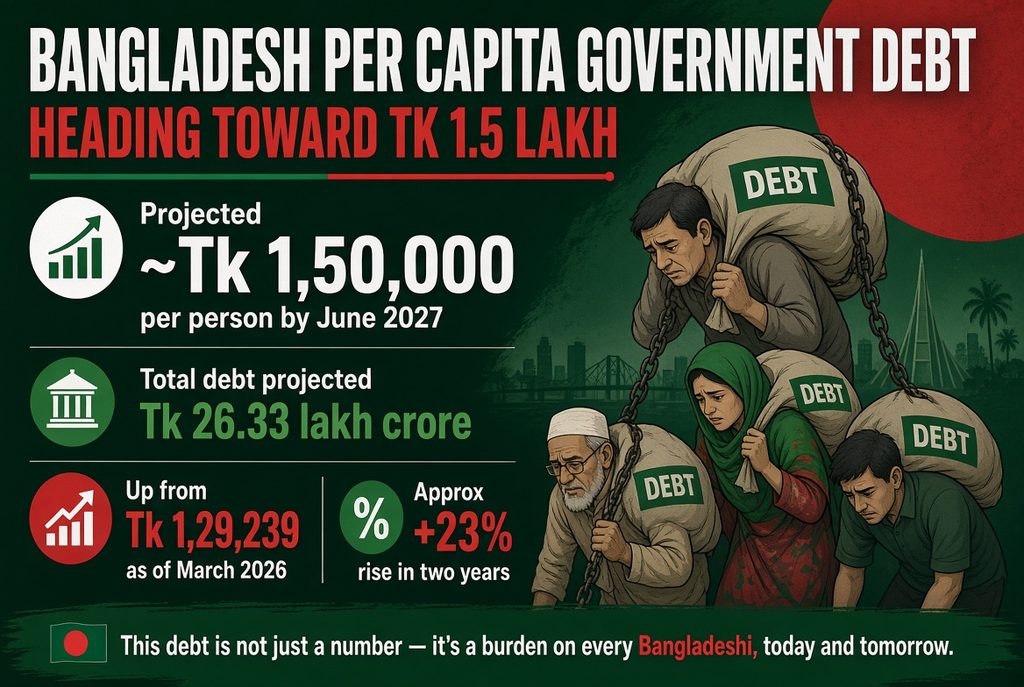
If the current pace of government borrowing continues, Bangladesh’s per capita public debt is projected to approach Tk 1.5 lakh (Tk 150,000) by the end of the 2026-27 fiscal year, according to Finance Division estimates.
By June 2027, the government’s total outstanding debt is forecast to reach Tk 26,33,100 crore. With the country’s population estimated at around 17.5 crore, this works out to roughly Tk 1.5 lakh per person. Using a slightly higher population figure of 17.6 crore brings the figure to about Tk 1,49,600. Either way, the number is expected to sit close to Tk 1.5 lakh, Bangla Tribune has reported.
Finance Minister Amir Khosru Mahmud Chowdhury told Parliament on 6 September that as of 31 March 2026, per capita government debt stood at Tk 1,29,239. The Finance Division’s projection implies an increase of roughly Tk 21,000 by the end of June 2027. The final figure will depend on actual debt stock, population numbers, and related calculations. Per capita debt is simply the government’s total debt divided by population — it is not a personal liability of individual citizens.
Debt Stock Projected to Rise About 23% in Two Years
At the end of 2024-25, total government debt stood at roughly Tk 21,44,000 crore (38.61% of GDP), comprising about Tk 11,95,000 crore domestic and Tk 9,49,000 crore foreign debt. By the end of 2026-27, the total is projected to reach Tk 26,33,100 crore — an increase of around 23% over two years.
Further rises are projected: Tk 29,56,700 crore by the end of 2027-28 and Tk 33,77,600 crore by the end of 2028-29. The Finance Minister has noted that Bangladesh’s debt risk has moved from “low” to “moderate.”
Foreign Debt Hits Record $114.98 Billion
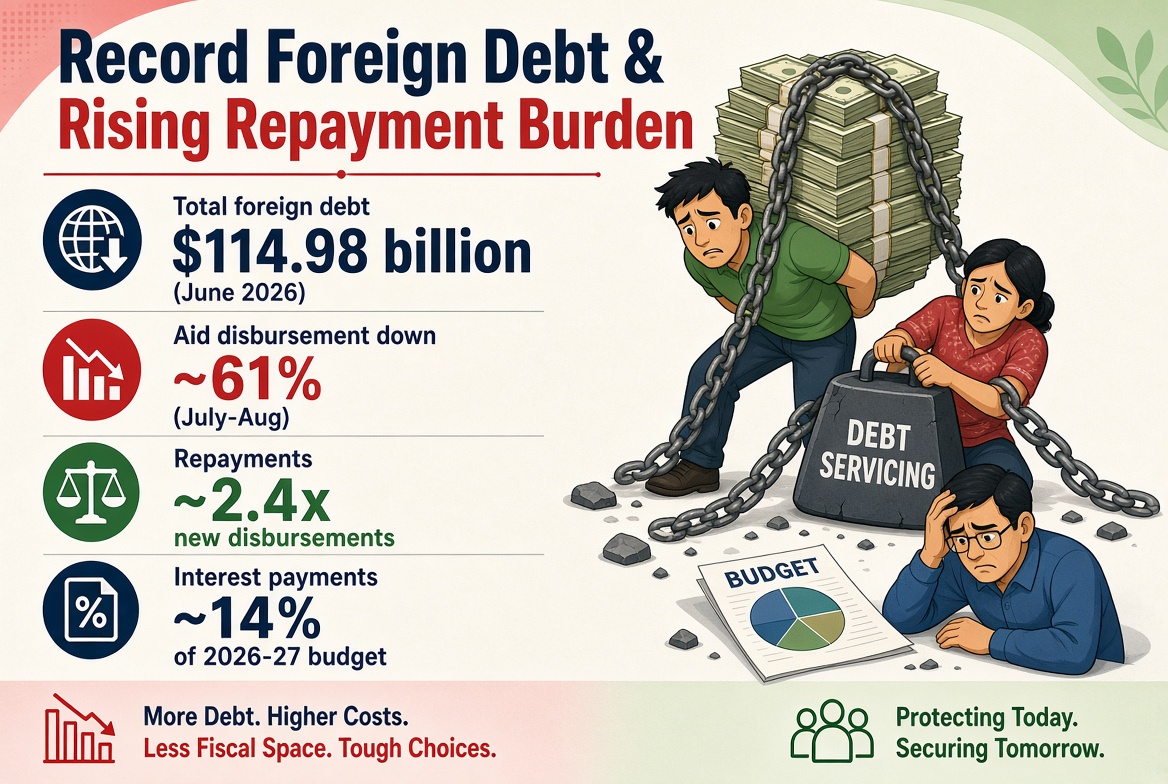
Bangladesh Bank data shows the country’s total foreign debt reached a record $114.98 billion at the end of June 2026, up from $110.93 billion at the end of March—a rise of $4.05 billion (about 3.65%) in three months. Public-sector foreign debt rose from $90.91 billion to $95.10 billion, while private-sector foreign debt fell by $140 million to $19.88 billion.
A year earlier (end-June 2025), total foreign debt was $113.58 billion. At an exchange rate of Tk 123.20 per dollar, the June 2026 stock equals roughly Tk 14,16,000 crore. Long-term debt accounts for 87.52% of the total ($100.64 billion), with short-term debt at $14.35 billion.
Multilateral lenders (including the World Bank and ADB) accounted for $48.96 billion, bilateral creditors $32.54 billion, commercial loans $10.60 billion, and IMF loans about $5.97 billion.
Foreign Aid Disbursement Drops Sharply; Repayments Rise
In July and August of the current fiscal year, foreign assistance (loans + grants) disbursed totalled $294.5 million — about 61% lower than the same period of the previous year (around $750 million). New loan commitments were limited to about $240 million.
During the same two months, principal and interest payments on existing debt totalled $698.9 million (roughly Tk 8,626 crore) — about 2.4 times the new disbursements. This produced a net outflow of roughly $400 million. Repayments were up about 4.8% year-on-year. The Economic Relations Division earlier projected total principal and interest payments on foreign debt could reach a record $5.3 billion this fiscal year, with repayments on the Rooppur nuclear plant loan from Russia expected to begin in March 2027.
Domestic Bank Borrowing Also Rising
In the first two months of the fiscal year, the government’s net borrowing from the banking system rose by about Tk 13,000 crore — more than five times the amount in the same period of the previous year. By the end of the first three months (including September), the figure was reported at around Tk 24,000 crore. The 2026-27 budget targets Tk 1,12,000 crore in bank borrowing; the first two months already accounted for about 11.5% of that target.
Higher government borrowing from banks can crowd out private-sector credit, depending on bank liquidity, credit demand, and interest rates.
Interest Payments Consume About 14% of the Budget
The 2026-27 budget is sized at Tk 9,38,000 crore, with a revenue target of Tk 6,95,000 crore, leaving a deficit of Tk 2,43,000 crore. Interest payments are allocated about Tk 1,27,000 crore — roughly 14% of the total budget. By 2028-29, interest expenditure is projected to rise to around Tk 1,62,000 crore.
Meanwhile, non-performing loans in the banking sector stood at Tk 6,06,555 crore at the end of June 2026 (32.78% of total disbursed loans), up Tk 17,851 crore from the end of March.
Expert View and Government Response
Dr Fahmida Khatun, Honorary Fellow at the Centre for Policy Dialogue (CPD), noted that the projected rise in per capita debt and the increase in foreign debt are understandable sources of public concern. While per capita debt is an average and not a direct personal bill, interest and principal repayments ultimately fall on the government budget, which is largely financed by taxes and other revenue.
She stressed that the key issues are how borrowed funds are used and whether repayment capacity is being built. Productive use in infrastructure, education, health, energy security, and job creation can support future growth; waste, weak project design, implementation delays, or failure to generate expected returns can limit benefits and squeeze other spending. Transparency on debt terms, use of funds, project outcomes, and future repayment capacity is important so citizens can demand accountability rather than simply panic.
The Finance Minister has said the government is prioritizing higher revenue collection, more efficient public-finance management, and disciplined debt management. Measures include expanding tax and non-tax revenue, controlling non-priority spending, reforming the domestic debt and government securities markets, limiting excessive reliance on savings certificates, and following an annual borrowing plan. The Finance Division nonetheless projects continued growth in the overall debt stock in the coming years, alongside rising principal, interest, and budget interest costs.