


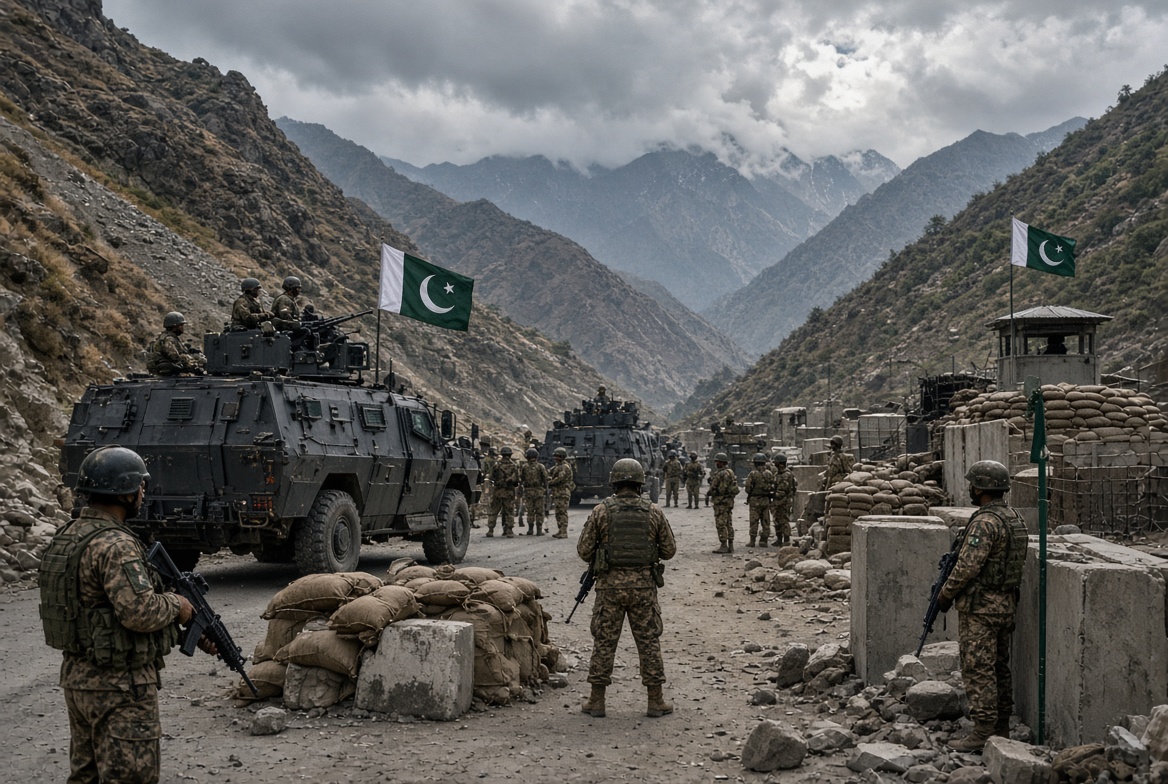
On 11 October 2026, President Asif Ali Zardari, acting on the advice of Prime Minister Shehbaz Sharif and the federal cabinet, proclaimed a state of emergency under Article 232 and governor’s rule under Article 234 in Khyber Pakhtunkhwa (KP). The official rationale was a sharp rise in terrorist incidents (cited at roughly 195% from March 2024 to September 2026), heavy targeting of police and security forces, increased use of drones and IEDs, and the PTI-led provincial government’s alleged “deliberate disengagement” from coordinated counter-terrorism efforts.
This suspended the PTI provincial administration (the only province under PTI control) and transferred executive functions to Governor Faisal Karim Kundi (PPP). Parliament ratified the measures: the National Assembly and Senate endorsed the emergency, and a joint sitting on 15 October approved both the emergency and governor’s rule (initially for two months, extendable under constitutional limits up to six months). Special administrative arrangements, including an advisory council of technocrats and an Area Development Secretariat, apply particularly to 12 affected districts (e.g., North and South Waziristan, Bajaur, Kurram, Bannu, DI Khan). Army deployment under Article 245 has been authorised to assist civil authorities.
Current Situation
Governor Kundi is administering the province with a technocratic advisory body. Former Chief Minister Sohail Afridi, the provincial assembly speaker, and several other PTI leaders were taken into preventive custody shortly after the proclamation; government statements describe this as temporary and linked to public-order concerns, while PTI characterises it as political victimisation. Internet and cellular disruptions were reported in the early days, and containers were used in some areas to manage movement.
Security operations continue. Local reporting from 17–18 October notes bomb-defusal incidents, intelligence-based operations resulting in terrorist casualties, and ongoing low-level violence (including criminal and militant-related shootings). Independent and government data previously highlighted KP as the epicentre of Pakistan’s post-2021 TTP resurgence, with high fatalities among security personnel and civilians in the first nine months of 2026. Cross-border dynamics with Afghanistan remain a factor in official statements. No comprehensive post-11 October statistics showing a clear drop in attacks are yet available, as the measures are only one week old.
Politically, PTI rejects the move as an assault on an elected mandate and provincial autonomy, linking it to broader demands for Imran Khan’s release and access. The federal government and allies maintain it was a last-resort response to a national-security threat after failed engagement. On 18 October, PPP Chairman Bilawal Bhutto-Zardari stated that the emergency and governor’s rule could end if the opposition agrees to a joint, unified plan against terrorism and engages constructively with the centre. PTI has signalled continued parliamentary and legal resistance.
Key Implications and Outlook
The intervention ends more than a decade of continuous PTI rule in KP and shifts direct responsibility for security and development in the province to the federal government and the PPP-aligned governor. Success will be measured by measurable reductions in militant attacks, improved coordination with security forces, and delivery of relief and development in the 12 priority districts. Failure or prolonged rule risks deepening political polarisation, allegations of selective enforcement (critics note violence elsewhere), and further erosion of provincial autonomy.
Constitutionally, governor’s rule is time-bound and subject to parliamentary oversight; emergency powers are similarly constrained. Dialogue remains the stated off-ramp: Bilawal’s conditional offer and earlier negotiation attempts indicate that a credible anti-terror consensus could accelerate an exit. Absent that, the measures are likely to continue for the initial two-month window while security operations and administrative restructuring proceed. The episode underscores the persistent intersection of counter-terrorism challenges, centre-province tensions, and the unresolved political status of Imran Khan in Pakistan’s current hybrid governance environment.