


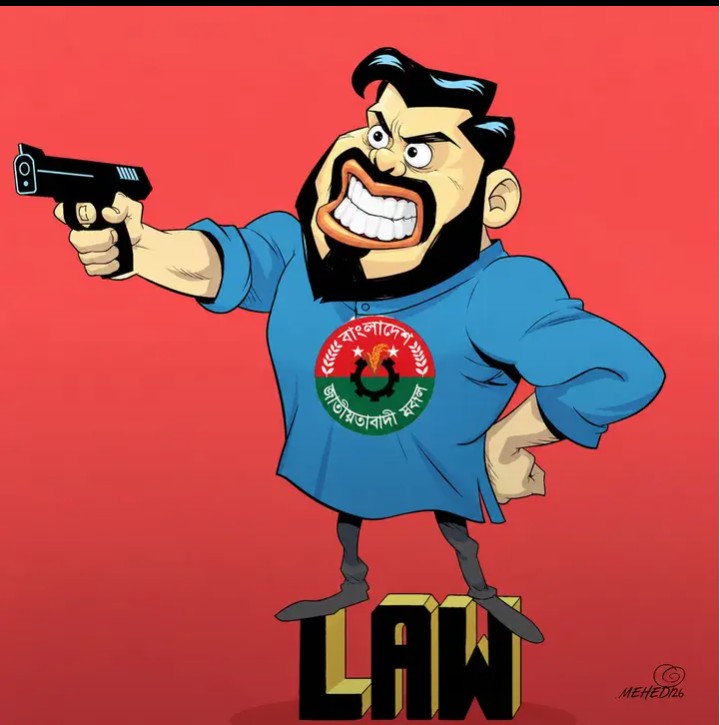
Many people obtain firearm licenses citing personal security. However, a valid license does not automatically give the holder the right to openly display a pistol or other firearm, or to use it to threaten others in public places. Legal experts emphasize that ownership and carrying are subject to strict conditions under Bangladeshi law.
The issue has drawn attention after State Minister Ishrak Hossain was seen carrying a firearm during an “anti-drug” operation on October 17.
Supreme Court lawyer Adnan Yazdanii told Bangla Tribune that carrying a firearm in public is not solely a matter of personal safety. It also raises concerns about public safety, law and order, and the potential to create fear among others.
Arms Act, 1878 sets the main rules
The primary legal framework governing firearms in Bangladesh is the Arms Act, 1878.
- Section 13 states that no one may go about with arms without a license, and that any licensed weapon must be carried only within the limits and in the manner approved by the license.
- Section 14 prohibits keeping a firearm in one’s possession beyond the conditions and approved limits of the license.
Yazdanii, who is also an executive member of the human rights organization Rights for Rights Foundation, explained: “Having a firearm license is one thing; having the right to carry and display that weapon publicly in any situation is another. The type of license, its specific conditions, its validity period, and any applicable government restrictions must all be considered.”
Government can impose temporary restrictions
Under Section 17-A of the Arms Act, the government may, in the public interest, impose temporary restrictions on carrying firearms. The law also provides for disarming individuals and suspending or canceling licenses if restrictions imposed during elections are violated.
In addition, the Dhaka Metropolitan Police Ordinance contains provisions restricting the carrying of arms on roads or in public places without lawful authority. Even a person holding a valid license must comply with any special local restrictions that are in force.
Penalties for violating conditions
If license conditions are breached, Section 21 of the Arms Act allows for imprisonment, a fine, or both (when no other specific penalty applies). Authorities examine factors such as the type of license held, whether carrying was approved, whether any special restrictions were active at the time, and the circumstances of the incident.
Senior Supreme Court lawyer Manzil Morshed told Bangla Tribune: “Under the Arms Act, there are conditions both for obtaining a license and for what happens afterward. You cannot scare anyone with it, you cannot use it in public places, and so on. It may only be used for security purposes.”
If a person publicly displays a firearm or uses it to threaten others and cannot show a reasonable justification, authorities may cancel the license, issue a show-cause notice, impose fines, or take other legal action.
In short, a license legalizes possession under defined conditions. It does not grant an unrestricted right to carry, display, or brandish a pistol in public.