


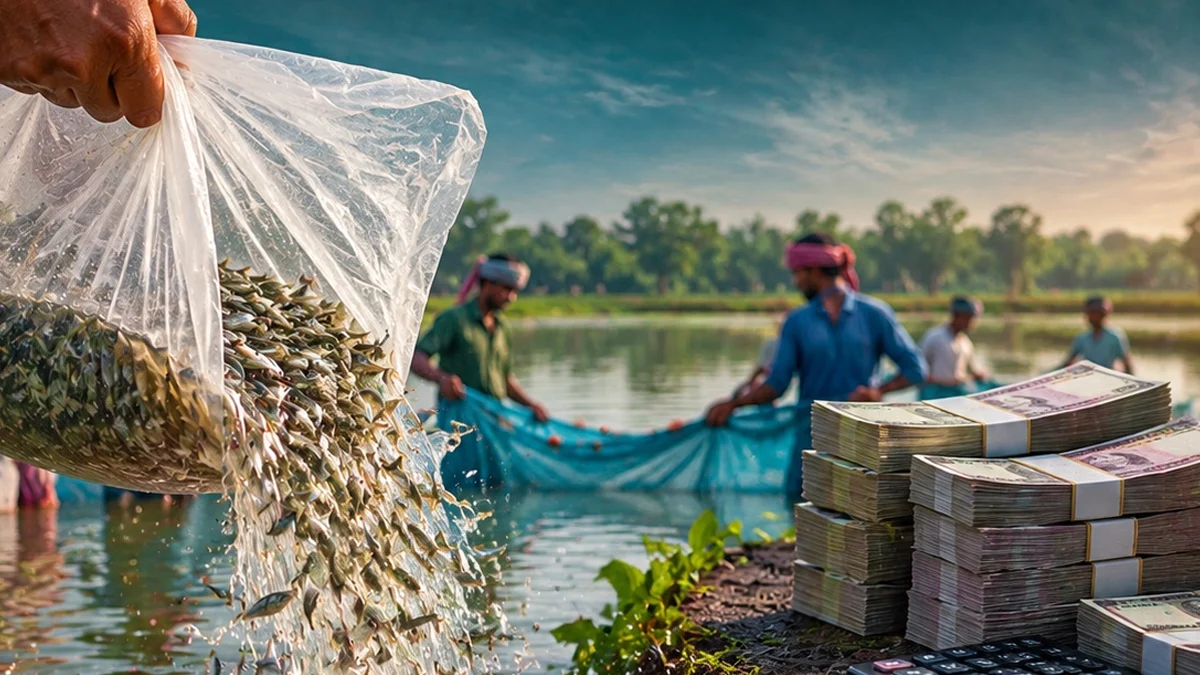
Under the BNP-led government, the Department of Fisheries has proposed a project titled “Community-based Fisheries Resource Management in Selected Baor Areas” that has drawn sharp scrutiny for its wildly inflated budget and spending pattern amid a sluggish economic situation. The five-year scheme aims to raise fish production by just 10% in 29 baors (oxbow lakes) across Jessore, Jhenaidah, Chuadanga, and Kushtia at a total cost of Tk 47.55 crore.
The core activity—purchasing and releasing fish fry—accounts for only about Tk 2.90 crore (roughly Tk 3 crore). The remaining nearly Tk 45 crore, or roughly 15 times the fry cost, is earmarked for “other” heads. In simple terms, the proposal allocates 15 taka in miscellaneous spending for every 1 taka spent on actual fish fry. Only about 6.1% of the total budget is for fry purchase; the other 93.9% goes elsewhere.
Among the eye-catching items is a provision of Tk 8 lakh for just four computers—averaging Tk 2 lakh each—along with allocations for air conditioners, photocopiers, office rent, and meetings/seminars. The Planning Commission has already raised objections, noting that such abnormal expenditures create clear scope for irregularities, the daily Jugantor reported.
A senior official, speaking anonymously, described the underlying goal of boosting production in the baors as positive in principle, but called the proposed costs for computers, ACs, and related items abnormal and said they open the door to misuse. The Commission has questioned the necessity of these items, their users, usage plans, and the overall rationality of the spending. It also wants clarity on total allocations for office rent and seminars and how they relate to field-level work.
The project proposal lacks key details: current annual fish production in the 29 baors, the basis for the 10% increase target, expected additional output, the exact number and species of fry to be bought (with prices), and any clear plan to monitor survival and growth of the released fry.
Six staff positions are proposed (three on deputation, one on additional charge, and two through outsourcing), but the Planning Commission has sought explanations of their exact responsibilities, total personnel costs (especially over five years), and measurable field-level results.
The project is still unapproved and appears on the list of unallocated, unapproved projects in the 2026-27 Annual Development Programme (ADP). The Ministry of Fisheries and Livestock sent the Development Project Proposal (DPP) to the Planning Commission in early October after earlier meetings in January and April.
Acting Director General of the Department of Fisheries Dr. Md. Khaled Kanak said he had not yet reviewed the DPP and declined to comment, directing inquiries to Chief Scientific Officer Shahed Ali (the proposal’s preparer), whose phone was switched off.
Critics see the pattern—heavy spending on equipment, rent, and seminars relative to the stated core activity, combined with missing justifications and weak monitoring frameworks—as part of a broader pattern of inflated project budgets under the current government that create opportunities for fund diversion rather than genuine development.
The Planning Commission’s objections underscore concerns that non-essential purchases are being prioritized over transparent, results-oriented development.