


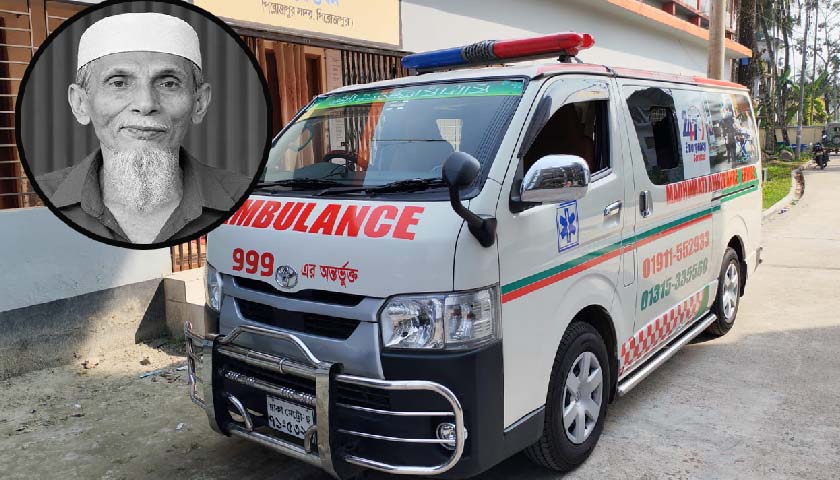
The family of Freedom Fighter Manik Poshari, 87, faced obstruction from local Jamaat-e-Islami leaders over his guard of honor and burial in Pirojpur on Saturday (October 24).
Poshari, from Chitalia village under Shankarpasha Union in Pirojpur Sadar, was the plaintiff and a key prosecution witness in the International Crimes Tribunal (ICT-BD) case against Jamaat leader and former MP Delawar Hossain Sayedee (alias Deilya Razakar) for crimes against humanity during the 1971 Liberation War.
Poshari died around 10 a.m. at his daughter’s in-laws’ home in Tungipara, Gopalganj, where he had been sheltering in poor health for months after going into hiding following August 5, 2024. Relatives brought the body to the Pirojpur Sadar Upazila Parishad premises around noon. The family alleges Jamaat leaders blocked both a proper state guard of honor and burial in Pirojpur soil.
After roughly seven hours of waiting—with the body kept in a general ambulance without ice—a secret guard of honor was finally conducted inside the police lines around 5 p.m. The body was then handed back to the family amid ongoing uncertainty about burial arrangements.
Local Jamaat leaders, including district assistant secretary Abdur Razzak, dismissed him as a “fake freedom fighter” and declared that neither honors nor burial in Pirojpur would be allowed.
This treatment is a continuation of Jamaat’s long pattern of obstructing justice in the Sayedee case. During the trial process, the party and its supporters hindered proceedings, with reports of intimidation, the killing of at least one prosecution witness (Mostafa Hawlader, who was stabbed after testifying and later died), and the abduction of another witness under circumstances aimed at forcing favorable testimony or silencing evidence against Sayedee. Witnesses lived under constant threat and often required police protection.
Before the February 28, 2013, verdict that sentenced Sayedee to death (later commuted by the Supreme Court to life imprisonment) on charges including murder, arson against Hindu communities, forcible conversions, and other crimes against humanity, Jamaat launched countrywide violence.
Clashes with police and others left dozens dead (reports put the toll in the 40–44 range in the immediate aftermath, with further deaths in subsequent unrest). Similar violence erupted in 2023 after Sayedee died in prison custody while serving his life term; party supporters clashed with police in Dhaka and elsewhere over funeral arrangements and absentee prayers.
As a cleric, Sayedee built popularity through fiery anti-India and anti-secular rhetoric, narrations of the life of Prophet Muhammad, and efforts to convert Hindus to Islam. He was far less popular, however, for longstanding allegations of adultery involving young women and girls. Explicit phone-sex recordings attributed to him have circulated and been widely discussed in Bangladesh for more than a decade.
Jamaat’s move to deny Manik Poshari a dignified funeral and the honors due a freedom fighter forms part of a broader pattern under the Yunus interim regime: the systematic dishonoring of freedom fighters, the destruction or neglect of Liberation War symbols, and the pursuit of revenge cases against Awami League leaders and pro-liberation figures in response to the earlier trials and executions of top Razakars. A son of Sayedee has become a parliament member in the staged election of February 12 this year.
Denying a 1971 veteran proper last rites for the “crime” of seeking accountability for wartime atrocities is an act of political vengeance, not religious principle.
In 1971, Sayedee was a grocery shopkeeper at Parerhat Bazar (oil, salt, onion, pepper), an Alim from madrasa, and fluent in Urdu. The tribunal held that he welcomed Pakistani troops at Parerhat on 7 May 1971, helped form the local Peace (Shanti) Committee, then led the local Razakar bahini, and became treasurer of a “Panch Tahabil” fund built from looted Hindu shops.
After the assassination of Bangabandhu, he became a nationally known waz orator and, later, Nayeb-e-Amir of Jamaat-e-Islami and an MP (1996, 2001). In parliament, he used to make blistering comments, issue strict fatwas, and hate speech against the war crime trial campaigners, the Awami League, India, Hindus, and other non-Muslims.