


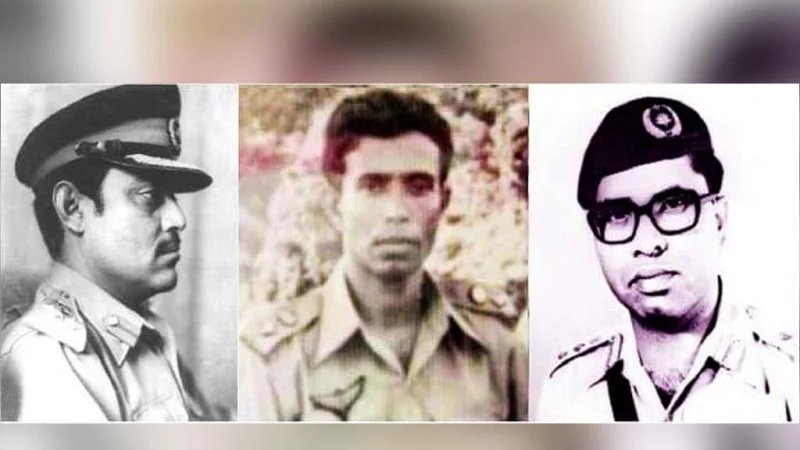
The Awami League and families of fallen officers observed the anniversary of the November 7, 1975 killings of pro-Liberation War army officers, including Major General Khaled Musharraf (Bir Uttom), Colonel Khondaker Nazmul Huda (Bir Bikrom), and Lieutenant Colonel ATM Haider (Bir Uttom).
In a statement posted on X on November 6, Mahjabeen Khaled, daughter of Major General Khaled Musharraf and chairman of the Khaled Musharraf Trust, paid tribute to the officers. She wrote: “Today, we pay our deepest respect to the brave army officers, decorated freedom fighters, and sons of Bangladesh who were assassinated on 7 November 1975. They had stood on the frontlines of our Liberation War in 1971, risking their lives for an independent Bangladesh. Yet, in the turbulent and tragic events of November 1975, their lives were taken.”
She specifically highlighted her father, Colonel Huda, and Colonel Haider, stating that “their contribution to the Liberation War and whose place in our national history deserve to be remembered with dignity and examined with historical honesty.”
She added that “their deaths remain a painful chapter in the history of our nation. Their stories deserve more than silence, political interpretations, or selective remembrance,” and expressed hope that “future generations will know who these officers were, what they stood for, what happened to them, and the circumstances surrounding their tragic deaths.”
She concluded: “Today, we remember their sacrifices, honour their service to the motherland, and hope that their stories will receive the rightful place they deserve in the history of Bangladesh. May the fallen heroes never be forgotten. May the truth prevail. May history remember them justly.”
The Awami League marks November 7 as the day of the killings of freedom fighter army officers.
The events came four days after the November 3 assassination of four national leaders—Syed Nazrul Islam, Tajuddin Ahmed, Muhammad Mansur Ali, and Abul Hasnat Muhammad Qamaruzzaman—inside Dhaka Central Jail, and roughly three months after the August 15, 1975 assassination of President Sheikh Mujibur Rahman and most of his family.
Party circles describe the sequence as part of a broader blueprint involving Pakistan-backed army officers led by then-Major General Ziaur Rahman, along with elements of leftist groups such as the Jatiya Samajtantrik Dal (Jasod) and Sarbahara Party, during a period of successive coups and mutinies that consolidated power under Zia.
On November 3, Khaled Musharraf, then Chief of General Staff, led a counter-coup that deposed Khondaker Mostaq Ahmad (who had assumed power after the August 15 killings), placed army chief Ziaur Rahman under house arrest, and sought to restore army chain of command and address the August 15 assassins.
The subsequent November 7 coup, associated with Colonel (Retd.) Abu Taher and the Biplobi Shainik Sangstha, freed Zia and led to the point-blank killings of Musharraf, Huda, and Haider at the 10th East Bengal Regiment location in Sher-e-Bangla Nagar, reportedly by officers including Majors Jalil and Asad. Dozens of other army officers were also killed in the ensuing chaos. Zia later hanged Col Taher and became the president and chief martial law administrator.
While General Zia’s party observes November 7 as National Revolution and Solidarity Day and some left groups mark it as the Sipahi-Janata Revolution, the Awami League and the officers’ families frame it as the targeted elimination of pro-Liberation War officers.
Mahjabeen Khaled, a former Member of Parliament, has long called for a proper investigation and justice for the November 7 killings.