


By Probir Kumar Sarker
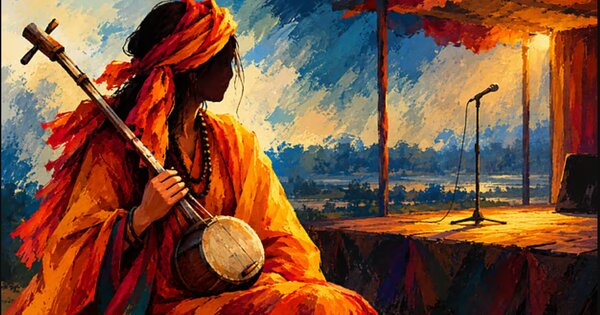
Last week in Dirai upazila of Sunamganj—near the birthplace of Baul legend Shah Abdul Karim—local objections halted (or nearly halted) a small private Baul music gathering at a UK expatriate’s home. The stated reason was the participation of female singers Tanisha and Nila, which objectors said risked “obscenity in the name of music” and threatened the village’s “religious values and Islamic tradition.”
A written complaint was filed with police; the organiser initially cancelled under pressure before reports indicated the event proceeded later that night with female performers. One complainant was linked to the National Citizen Party (NCP). Just weeks earlier, in the same upazila, a women’s friendly football match was cancelled after objections from local clerics and a group styling itself an “Anti-Islamic Activities Resist Committee,” with police advising postponement.
These are not isolated episodes. They fit a broader pattern of moral policing, cultural suppression, and targeted violence that intensified after the fall of the Sheikh Hasina government in August 2024.
The transition brought an interim administration under pro-Jamaat Muhammad Yunus, followed by the February 2026 elections in which the Bangladesh Nationalist Party (BNP) secured a majority under Tarique Rahman, with Jamaat-e-Islami emerging as a strong second force. The Yunus regime saw a documented resurgence of Islamist assertiveness and vigilante actions under loose banners such as Touhidi (or Tawhidi) Janata—“the people of Tawhid.”
Touhidi Janata is not a formal organisation with membership rolls or a central command. It functions as a mobilising label under which crowds enforce self-defined Islamic moral codes in public space. Local level leaders and activists of the BNP, Jamaat, Hefazat-e-Islam, Islami Andolan Bangladesh, Bangladesh Khelafat Majlis and teachers and students of Qawmi madrasas comprise the Touhidi Janata gangs.
Targets have included women’s clothing and mobility, women’s sports, Baul and other cultural performances, Sufi shrines and urs festivals (often labelled shirk), rock or folk concerts, village fairs, and events involving minorities. Rights monitors and media reports document dozens of shrine attacks—some estimates exceed 90–100 between August 2024 and early 2026—involving vandalism, arson, looting, and occasional killings, with limited arrests or prosecutions. Baul gatherings and performers have faced disruption or violence; women’s football matches in places such as Dinajpur, Joypurhat, Rangpur, and Sunamganj have been cancelled after protests, marches by madrasa students, or threats.
Moral policing of women—harassment over attire, smoking, or public presence—has been reported repeatedly, sometimes escalating to police-station sieges demanding the release of harassers. Allegations of blasphemy, frequently tied to social media posts (sometimes disputed or fabricated), have triggered mob attacks, particularly against Hindus.
Religious minorities, especially Hindus, have faced sustained pressure. The Bangladesh Hindu Buddhist Christian Unity Council and other monitors recorded thousands of incidents of property attacks, temple vandalism, and related violence in the months after August 2024, with elevated numbers continuing into 2025 and 2026. Reports ahead of Durga Puja 2026 cited dozens of temple attacks, idol desecrations, and looting of homes and shops in multiple districts, including Sunamganj.
Blasphemy-linked accusations have repeatedly escalated into communal targeting. Sufi sites and practitioners have also been hit, reflecting hardline rejection of popular Bengali Islamic traditions that emphasise music, shrine veneration, and syncretic elements. These attacks often exploit online rumours and occur amid weak law-and-order capacity after the upheaval, when many police stations were attacked and staffing gaps emerged.
Politically, the interim period saw the lifting of bans on Jamaat-e-Islami and its student wing, the open mobilisation of banned militant groups such as Hizb ut-Tahrir (which held public calls for a caliphate), and the release or bail of certain figures previously linked to militant networks. Jamaat and allied Islamist parties gained organisational space and electoral relevance. Analysts note that hardline elements exploited the political vacuum and legitimacy crises, while state responses have frequently involved yielding to crowd pressure rather than consistent enforcement of law.
The BNP-led government that took office in February 2026 has condemned some excesses and pledged minority protection, yet reports of temple attacks, shrine violence, and moral policing have continued, and law-and-order challenges—including political and mob violence—persist. Critics from secular and minority perspectives argue that earlier counter-terrorism efforts under the Awami League are now reframed in some quarters as persecution of “pious” Muslims, while current authorities face pressure from Islamist constituencies.
Bangladesh’s modern identity has long rested on a Bengali linguistic and cultural nationalism that accommodated religious diversity and popular Islamic forms alongside a constitutional framework that once emphasised secularism.
The Baul tradition, Sufi shrines, women’s public participation in sport and culture, and Hindu festival practices are not marginal imports; they are part of the country’s social fabric. When crowds operating under a religious banner can cancel private music gatherings, women’s matches, or shrine events—and when attacks on minorities and cultural sites face limited accountability—the practical space for pluralism narrows. This is not merely a matter of private piety; it is the contestation of public space and the rule of law.
Restoring consistent law enforcement, protecting the rights of women, minorities, and cultural practitioners, and rejecting impunity for vigilante violence are necessary regardless of which party holds power. The 2024 transition ended one authoritarian period; it has not automatically secured a tolerant or stable public order. Documented patterns of moral policing, shrine and temple attacks, and cultural disruption under banners such as Touhidi Janata warrant sustained attention and firm, impartial responses if Bangladesh is to preserve the pluralistic traditions that have long defined it.
Probir Kumar Sarker is a senior journalist, researcher, and chairperson of Write For Rights. He co-authored “The Yunus Files: Unmasking The Fake Saint.”