


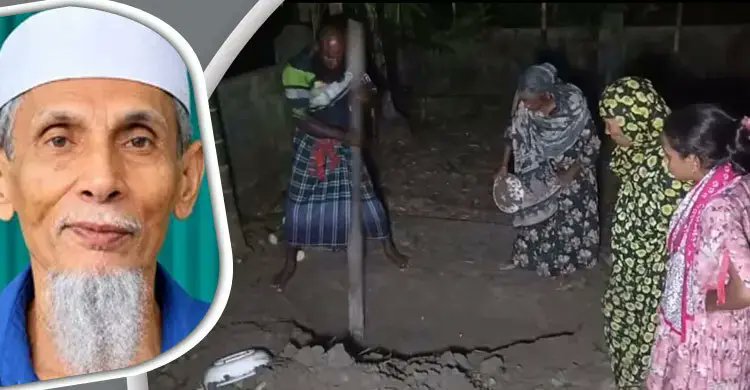
Twenty-eight noted citizens of Bangladesh have issued a joint statement expressing deep concern, outrage, and strong condemnation over the obstruction of the burial and state guard of honour for freedom fighter Manik Poshari by local leaders and activists of Jamaat-e-Islami in Pirojpur.
The citizens described the incident as a grave violation of fundamental human rights and a criminal offence. They stressed that only the state has the authority to determine whether a person officially recognised as a freedom fighter holds that status, and that a party which opposed independence cannot decide who is a freedom fighter and who is not.
“A party that opposed independence can at no stage decide who is a freedom fighter and who is not — a party that not only opposed independence and the Liberation War in 1971, with documented proof of war crimes including the killing of intellectuals against many of its leaders, and which has yet to acknowledge responsibility for those crimes or offer a minimum public apology for opposing the Liberation War,” the statement said.
They added that such an ordeal surrounding the final farewell of a valiant freedom fighter 55 years after independence raises profound questions and deep concerns about the state, society, and political culture of Bangladesh.
The Incident
Manik Pashari, an 87-year-old gazetted freedom fighter and resident of Chitalia village in Shankarpasha Union under Pirojpur Sadar Upazila, died on October 24 at his daughter’s residence in Tungipara, Gopalganj, where he had been staying since the mass uprising of August 5, 2024, due to security concerns. Reports indicated that his house in Pirojpur was set on fire after the political change.
His body was brought to Pirojpur on the afternoon of October 24 for funeral prayers and a state guard of honour as per rules for freedom fighters. Local Jamaat-e-Islami leaders and activists opposed both, with some publicly calling him a “fake” freedom fighter and declaring that he would not be buried on Pirojpur soil or receive state honours. A procession and gatherings were reported, and a freshly dug grave in the family graveyard was filled with earth.
According to the citizens’ statement and contemporaneous reports, the burial was delayed for nearly 15 hours. After approximately 2 a.m., Pashari’s daughter and two sisters re-dug the grave with the help of village police under the light of mobile phones. He was finally buried under police protection in the early hours of October 25. A guard of honour was accorded earlier at Pirojpur Police Lines under security.
Family members later recounted that fear kept many villagers and relatives from assisting, and that women of the family had to dig the grave themselves. One sister, Mosammat Rina Akter, was quoted in reports saying that “not a single man came forward.”
Background: Role in the Sayedee Case
Manik Pashari was the complainant and a key prosecution witness in the crimes against humanity case against late Jamaat-e-Islami leader Delwar Hossain Sayedee, a former MP from Pirojpur-1. He filed the case in 2009 over atrocities committed during the 1971 Liberation War. Sayedee was sentenced to imprisonment until death (later commuted from a death sentence) and died in custody in 2023.
Following the August 2024 political upheaval, Pashari had gone into hiding. Local Jamaat leaders denied organising obstruction after the burial, stating that the party does not engage in “politics over the dead,” though earlier statements from some local leaders had opposed the guard of honour and burial on the grounds that he was not a genuine freedom fighter. Jamaat-e-Islami later formed a two-member central committee to investigate the allegations.
Separately, the Ministry of Liberation War Affairs has constituted a high-level probe committee to examine the circumstances of his death and burial, as well as questions raised in media reports about the authenticity of his freedom fighter certificate.
Citizens’ Demands and Signatories
The 28 citizens demanded a fair investigation and strict legal action against those responsible for the obstruction. They emphasised that the proper burial of a deceased person is a fundamental human right that no individual, group, or even the state can violate, and that obstructing a janaza or burial on the basis of political beliefs or past roles is unacceptable and contrary to the teachings of Islam and other religions.
The signatories include human rights activist and founding chair of Manabadhikar Sanskriti Foundation Advocate Sultana Kamal; Nijera Kori coordinator Khushi Kabir; Transparency International Bangladesh Executive Director Dr Iftekharuzzaman; senior Supreme Court advocates ZI Khan Panna, Subrata Chowdhury and Tabarak Hossain; Manusher Jonno Foundation Executive Director Shaheen Anam; Campaign for Popular Education Executive Director Rasheda K Choudhury; photographer Shahidul Alam; Association for Land Reform and Development Executive Director Shamsul Huda; Dhaka University professors Samina Luthfa, Sumaiya Khair, Tanzimuddin Khan, Zobaida Nasreen and Robaet Ferdous; and others from academia, law, and human rights organisations, including Nova Ahmed, Rahnuma Ahmed, Salma Ali, Nur Khan, Pavel Partha, Zakir Hossain, Saidur Rahman, and several other rights activists.