


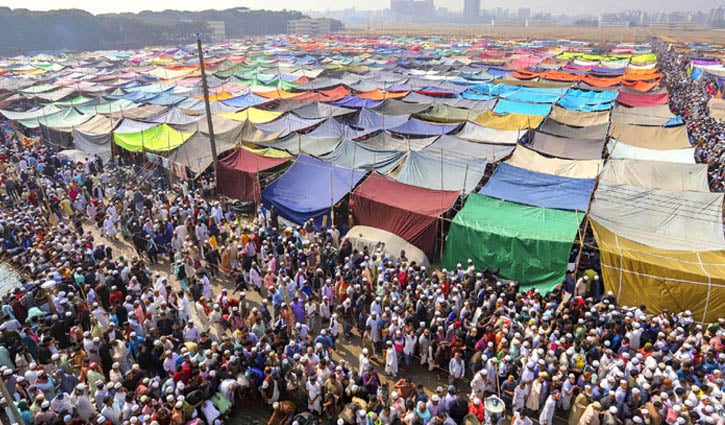
Saad-aligned Tablighi Jamaat followers accuse a faction of Hefazat-e-Islam of politicizing the dispute over the Bishwa Ijtema, as they demand an early announcement of the event’s dates and an end to what they describe as incitement and one-sided political interference.
Followers of Maulana Saad Kandhlawi have put forward four demands, including the immediate announcement of dates for the Bishwa Ijtema, an end to disinformation and incitement, and a halt to one-sided political interference in the ongoing dispute within Tablighi Jamaat.
Their other demands are a swift judicial investigation to ensure justice for all killings and the immediate implementation of a fair allocation of Kakrail Mosque and the Ijtema grounds.
The demands were announced at a press conference held on Monday morning at the Tofazzal Hossain Manik Mia Hall of the National Press Club in Dhaka.
The press conference was organized under the banner of “Distinguished Islamic Scholars and Civil Society of the Mainstream Tablighi Jamaat Bangladesh” to demand the announcement of dates for the Bishwa Ijtema and a resolution to the ongoing crisis.
Mohammad Nazim Uddin Bhuiyan, a faculty member of the University of Dhaka’s Department of Accounting, read out the written statement.
According to the statement, the mainstream faction of Tablighi Jamaat Bangladesh has been organizing the Bishwa Ijtema in Tongi for 60 years. However, over the past six to seven years, the internal dispute within Tablighi Jamaat has led to a steady increase in confrontational statements and controversy surrounding the gathering.
The statement warned that if the situation continues, the Ijtema’s international appeal could weaken further, creating serious concerns for Bangladesh and all those involved.
It also alleged that controversial remarks, accusations and disinformation targeting Maulana Saad Kandhlawi, the global leader of Tablighi Jamaat, have been circulated at religious gatherings, from mosque pulpits and in other forums.
The organizers said Islamic scholars should play a neutral role in resolving the division within Tablighi Jamaat. Rather than making inflammatory statements on behalf of either faction or exerting one-sided pressure on the government, all parties should work toward a peaceful settlement.
Allegations against Hefazat-e-Islam
In response to a question at the press conference, Mufti Shafiullah Makki, principal of Markazus Suffah Al Islamia Bangladesh, alleged that followers of Maulana Saad face obstruction from the rival Zubair-aligned faction whenever they attempt to organize their own Bishwa Ijtema. He said the rival faction was issuing open threats again this year.
He further alleged that a third party was joining the dispute and turning it into a political issue.
Asked to identify the third party, Rezaul Karim, a former official of the Bangladesh Agricultural Development Corporation, said that a faction of Hefazat-e-Islam was involved.
Karim alleged that those organizing recent press conferences and engaging in incitement had political affiliations. He said these individuals were not visible at other times but became active when the Bishwa Ijtema approached.
The allegation points to the growing political role of elements associated with Hefazat-e-Islam in a dispute that has traditionally centered on religious leadership and organizational control within Tablighi Jamaat. The press conference participants portrayed the involvement of such actors as an attempt to politicize the dispute and increase pressure on the government.
The allegations were made by representatives of the Saad-aligned faction; the report does not independently establish the extent of Hefazat-e-Islam’s involvement or the political affiliations of the individuals concerned.
Academics and religious scholars attend press conference
Among those attending the press conference were Maulana Golam Mustafa, senior hadith scholar at Markazul Ulum Ash Shariah in Savar; Maulana Abdul Ahad, principal of Moinul Islam Madrasa in Bhatara, Dhaka; Manjurul Haque, a retired professor in the University of Dhaka’s Department of Psychology; Shafiul Bari, a professor in the Department of Civil Engineering at Bangladesh University of Engineering and Technology (BUET); Ashfaq, chairman of the University of Dhaka’s Department of Botany; and Khaled, chairman of its Department of Pharmacy.