


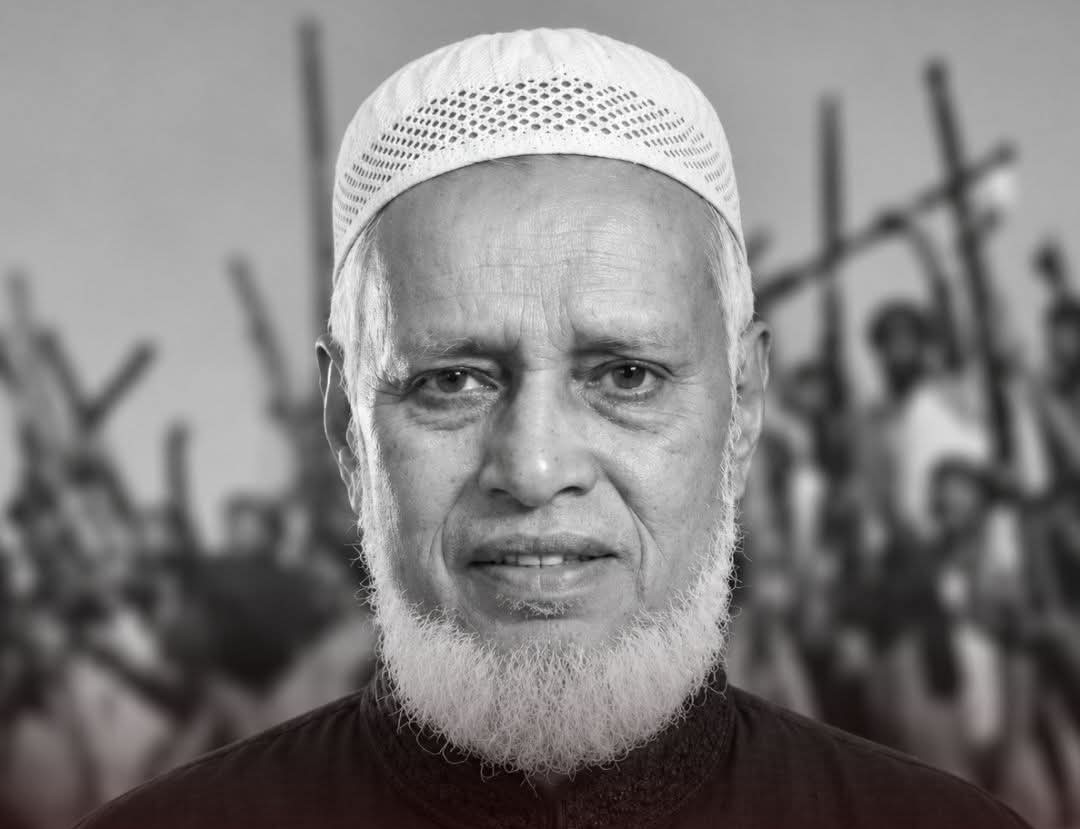
Criticism has erupted in Cumilla after 78-year-old freedom fighter Abdus Sattar was buried without state honour on Thursday (5 November).
The incident has drawn sharp local outrage and is being viewed by many as another example of the diminished practical recognition accorded to Liberation War veterans since the fall of the Awami League government in August 2024.
Abdus Sattar, who fought for nine months in the 1971 war and later served in the communications and law ministries, died earlier the same day at his son’s house in Dhaka. After the first janaza there, his body was taken to the family home in Mahalakshmipara village of Sadar Union, Brahmanpara upazila. It arrived past 5:30 pm. Family members and locals waited for the upazila administration to accord him a final farewell with state dignity, including a guard of honour. No representative of the administration appeared. He was ultimately buried without state honour.
His brother Shahjahan said: “We wanted to bid my brother a final farewell by giving him the last bit of honour. But that did not happen. The man who fought for nine months with arms in hand to make the country independent did not even receive the honour due to him after death. This is extremely painful and shameful for us.”
Local freedom fighter Abdus Sattar Molla called the episode “extremely painful,” noting that even if a full guard of honour was not possible after evening, administrative officials could at least have come to pay their respects. Brahmanpara upazila Freedom Fighter Commander Idris Mia Master said they had stayed in constant contact with the administration, but Upazila Nirbahi Officer (UNO) Munni Islam told them a guard of honour cannot be given after evening. Union Parishad Chairman Zahirul Haque, who attended the janaza, said the failure has triggered intense criticism across the area.
Police Officer-in-Charge Md Faruk Hossain stated that officers had been dispatched with the necessary equipment for a guard of honour, but could not proceed because no one from the upazila administration was present. Police personnel did attend the janaza.
The burial has become a flashpoint in a wider pattern of institutional and narrative shifts affecting Bangabandhu Sheikh Mujibur Rahman and freedom fighters since August 2024. Under the Muhammad Yunus-led interim government (August 2024–February 2026), a June 2025 ordinance amended the National Freedom Fighters Council law. It narrowed the definition of “valiant freedom fighter” around active combat or training between 26 March and 16 December 1971, introduced separate categories for “associates of the Liberation War,” and removed multiple references to “Father of the Nation Bangabandhu Sheikh Mujibur Rahman.” Many reports interpreted the changes as stripping or downgrading the formal status of Bangabandhu, key Mujibnagar leaders, and hundreds of others previously recognised as freedom fighters. The Yunus administration denied full revocation, insisting Mujibnagar government members remained freedom fighters and that associates retained equivalent honours and benefits, while critics described the move as eroding the centrality of Bangabandhu’s leadership and rewriting aspects of the 1971 narrative. Reports of attacks on some freedom fighters and vandalism of Liberation War memorials also circulated in the months after the uprising.
After the February 2026 elections, the BNP under Prime Minister Tarique Rahman took power. While the party’s manifesto pledged accurate lists of genuine Liberation War martyrs, state honour for freedom fighters, inflation-adjusted allowances, and accurate historical accounts in education, local administrative lapses such as the Cumilla burial continue to fuel perceptions of reduced practical respect. Political debates with Jamaat-e-Islami (now the main opposition) over 1971 roles persist, and some voices within the current political landscape have argued against equating freedom-fighter benefits with those for July 2024 uprising participants.
In Brahmanpara, the failure to provide even a basic official presence at Abdus Sattar’s burial has left family members and fellow freedom fighters describing the episode as a source of deep pain and shame—reinforcing concerns that the post-August 2024 governments have not consistently upheld the traditional state recognition long associated with the country’s Liberation War veterans.