


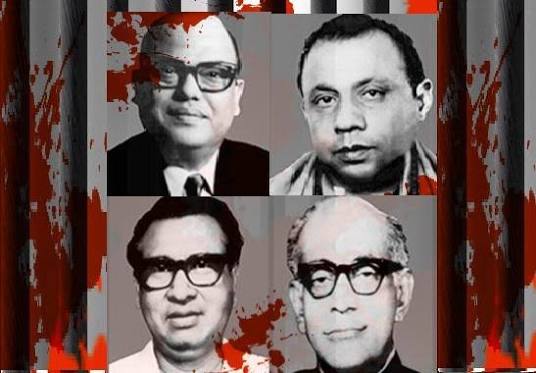
Bangladesh marks Jail Killing Day on Tuesday, a solemn occasion to honour four key architects of the 1971 Liberation War who were brutally assassinated inside Dhaka Central Jail on this date in 1975.
Since BNP founder Major General Ziaur Rahman was involved in the August 15 coup, when President Sheikh Mujibur Rahman was assassinated with most of his family members, and November 3 assassinations, the BNP never remembers this day for mourning.
On Tuesday, the BNP government suspended the official commemoration event at the Liberation War Museum citing security
It implies that the BNP is following the path of the Yunus regime, which cancelled all programs and special days involving Bangabandhu Sheikh Mujibur Rahman and the Awami League.
Any suspension or restriction of commemorative programmes, memorials, or related publications on this day must be unequivocally condemned as an affront to the nation’s history and the sacrifices that secured its independence, pro-liberation activists say.
On the night of November 3, 1975—less than three months after the August 15 assassination of Bangabandhu—junior army officers entered the old Dhaka Central Jail and killed four national leaders held in state custody. The victims were:
- Syed Nazrul Islam, acting president of the Mujibnagar government-in-exile;
- Tajuddin Ahmad, wartime prime minister;
- Captain (Rtd.) M. Mansur Ali, a cabinet member who later served as prime minister; and
- AHM Qamaruzzaman, who handled home, relief, and rehabilitation affairs.
While Bangabandhu was imprisoned in Pakistan, these four leaders formed and directed the provisional government that organised the Liberation War, conducted diplomacy, managed refugees, and turned the struggle into a people’s war.
Their refusal to lend legitimacy to the post-August 15 regime under Khondaker Mostaq Ahmad led to their imprisonment and subsequent murder—by gunfire followed by bayonet charges—in the early hours of November 3. The killings, widely viewed as a calculated continuation of the August 15 plot to erase the Liberation War leadership and leave the nation leaderless, remain one of the darkest chapters in Bangladesh’s history.
A murder case was filed the next day at Lalbagh police station. Investigation and prosecution were stalled for more than two decades under successive regimes. Proceedings resumed after 1996; a trial court delivered its verdict in 2004, with later confirmation by higher courts. Some convictions followed, including the execution of one accused, but several others remain fugitives. The day has long been observed with wreath-laying, memorial meetings, discussions, and prayers at sites including the old jail premises, Banani graveyard, and other locations associated with the leaders.
Activists say suppressing or suspending remembrance of these events—whether through restrictions on public programmes, removal of memorials, or curbs on publications—does not erase history. It only deepens the injustice done to leaders who kept the flame of independence alive in 1971. Their organisational skill, political commitment, and ultimate sacrifice are inseparable from the story of Bangladesh’s birth. Honouring them is not a partisan act; it is a national duty.
Senior journalist Probir Kumar Sarker said that it is not unusual for the BNP to skip the commemoration of Bangabandhu and valiant freedom fighters since the party’s founder,eral Zia, masterminded the killings and rehabilitated the assassins and the Pakistani forces like the Jamaat-e-Islami in politics.