


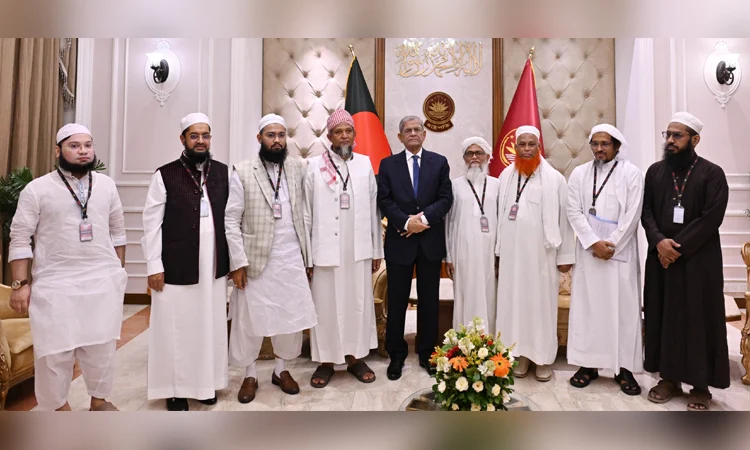
A delegation of Islamic clerics and figures associated with #Hefazat-e-Islam Bangladesh met President Mirza Fakhrul Islam Alamgir at Bangabhaban on Monday afternoon. The meeting, described officially as a courtesy call, has raised alarms among secular voices and minority rights advocates over the apparent normalization of hardline militancy and extremism under the current political climate.
The delegation was led by Hefazat-e-Islam Bangladesh’s central organizational secretary, Maulana Mufti Bashirullah. It included Joint Secretary General Mufti #HarunIzhar—a figure long linked by counter-terrorism agencies and open-source reports to Lashkar-e-Taiba networks, past alleged plots targeting diplomatic missions, and Taliban-aligned ideology—along with Maulana Mir Idris Nadvi, Maulana Rafiqul Islam (imam and khatib of the Prime Minister’s Office mosque), Maulana Faisal (coordinator of the National Imam-Khatib Council), and Maulana Afsar Mahmud (publicity secretary of #Khatme Nabuwat Bangladesh).
President’s Press Secretary Md. Sarwar Alam confirmed the meeting to BSS. During the discussion, the president recalled the “unspeakable torture” and “unbearable imprisonment” suffered by prominent ulema during the previous “fascist” rule. He urged unity in nation-building after the fall of the previous regime, warned against any return of authoritarian misrule, and called for vigilance so that “no one creates confusion in the name of religion.”
He noted that the late President Ziaur Rahman and former Prime Minister Khaleda Zia had shown great respect for Islamic scholars. Ziaur Rahman inserted “Bismillahir Rahmanir Rahim” into the Constitution and included “absolute trust and faith in Almighty Allah” among the fundamental principles of state policy. The president described himself as “completely non-political” yet pledged to monitor any government actions that might harm Islamic values and Sharia.
The delegation requested that the Arabic-language skills, networking abilities, and personal connections of the country’s ulema be used to expand trade, attract investment, and secure grants from oil-rich Middle Eastern countries.
Observers note that the meeting occurs as Hefazat leadership appears to be distancing itself from Jamaat-e-Islami while aligning with the BNP to advance its revised charter of demands (previously a 13-point list focused on stricter Islamic governance, blasphemy punishments, and restrictions on minorities and cultural practices). Under the new political dispensation, figures previously treated as militants have gained access to the president, prime minister, and ministers, with efforts underway to reframe them as “Islamic scholars” deserving of release from detention.
Mufti Harun Izhar, in particular, has drawn sustained scrutiny. Intelligence-linked reporting and past arrests have associated him with LeT, HuJI-B, and the Taliban in the Lalkhan Bazar Madrasa bomb incidents and radicalization of madrasa networks. He has been accused of spreading communal hatred under the banner of dawah, including recent public statements targeting Hindus (such as warnings that they would be “silenced” in Chittagong) and campaigns against ISKCON and other minority institutions, for announcing the setting up of mosques near temples and carrying out a flag campaign to promote al-Qaeda and the Taliban. Khatme Nabuwat Bangladesh, represented in the delegation, has a documented history of aggressive, sometimes violent campaigns demanding that the Ahmadiyya community be declared non-Muslim, alongside calls to restrict or ban Sufi shrines, jatra folk theater, and Baul songs as un-Islamic.
Rights groups and secular commentators argue that granting such high-level access risks mainstreaming jihadist networks and ideological patrons of #extremism. #jihad #militancy #mobocracy #TouhidiJanata